


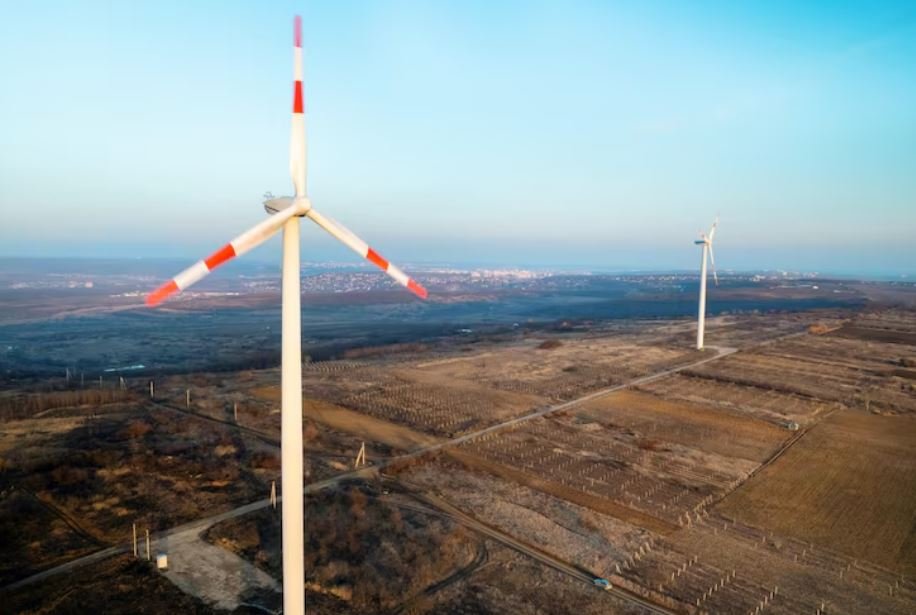
The scale strikes you before anything else when you stand on the edge of practically any wind farm on a clear Wyoming morning. The turbines are massive, standing 100 meters tall, with blades that spin at a speed of about 170 miles per hour. A lone golden eagle riding a thermal appears nearly insignificant against that background. It isn’t.
In North America alone, wind turbines are thought to kill between 140,000 and 328,000 birds annually. Golden eagles, bald eagles, and other protected raptors are among those killed; it took decades of conservation work to bring these birds back from the brink. Nobody is unaware of the irony that a technology designed to save the environment has subtly turned into one of its more annoying issues.
On a Duke Energy wind farm outside of Glenrock, Wyoming, a small tower is situated close to the turbines. In comparison to its neighbors, it is almost comically short, standing only ten meters tall. On top of that tower, however, is a full circle of cameras, one of which swivels above the others. IdentiFlight’s primary function is to observe what the eagles do not.
The system detects flying objects within a kilometer by scanning the sky in a 360-degree radius. When it detects something, it compares the image to about 200 characteristics, such as body length, wingspan, and wing posture, and in five seconds, it determines whether the approaching bird is a protected species on a collision course. A turbine shutdown occurs if it is. After thirty seconds, the blades have slowed down to the point where an eagle can safely fly through. From detection to safe passage, the entire process takes less than a minute.
The cameras’ superiority over human monitors is truly remarkable. IdentiFlight identified 562 percent more birds than human observers, according to a 2016 study involving The Peregrine Fund. It is difficult to dispute that disparity. Since then, the system has switched from conventional machine vision to a neural network, which helps lower false positives, which are expensive for wind companies, and false negatives, which are expensive for eagles.
The technology is becoming more widely used. One of the more instructive test cases is now Germany. With only about 130 breeding pairs remaining in the area, the lesser spotted eagle prefers to hunt over the same type of open, level terrain where Germany is quickly increasing its wind capacity. The birds frequently don’t notice a spinning rotor until it’s too late because they keep their eyes downward, searching for mice and lizards. Certification is anticipated after IdentiFlight’s neural networks are specifically trained to identify these birds.
It’s important to remember that other tools are being tested in addition to AI detection. A single turbine blade painted black decreased bird collisions by about 70%, according to Norwegian researchers at the Smøla wind farm. The reasoning is almost embarrassingly straightforward: the contrast breaks the visual blur that renders spinning blades almost undetectable to birds. It appears to function, is inexpensive, and doesn’t require any software. Additionally, a flight simulator has been created by the U.S. National Renewable Energy Laboratory to simulate how soaring raptors, which favor riding updrafts, navigate wind farm terrain. Before a turbine is ever constructed, the objective is to identify the areas where conflicts are most likely to occur.
Not everything is resolved by this. The effectiveness of IdentiFlight may be diminished by fog, rain, and poor visibility. Birds are still occasionally misclassified by neural networks. Additionally, conservationists have been alarmed by Germany’s recent relaxation of buffer zones around eagle nests, which was done to speed up wind development. They believe that political pressure to build quickly is outweighing caution. The new law, according to an anonymous nature protection officer, is “a catastrophe.” It appears that the legal disputes are still to come.
However, the fact that this specific issue is receiving significant engineering attention is encouraging. The coexistence of wind farms and wildlife was never really a question. The question is whether anyone would put in enough money to make that coexistence a reality. Currently, a small tower with a ring of cameras is keeping an eye on the sky to make sure the answer is yes, at least in Wyoming, parts of Germany, and Tasmania.
