


When most people see a certain picture for the first time, it stops them cold. A photographer using only a dim handheld spotlight and a camera set to maximum sensitivity managed to capture two aardvarks, nose to nose in the Botswana night, mid-greeting. Not a flash. No artificial flood lighting. What was previously thought to be physically impossible can now be accomplished with just a high ISO setting.
That picture was captured in 2014 by wildlife photographer Will Burrard-Lucas. It appears to have been lit by a larger, more intentional source than it actually was. A quiet revolution in nocturnal wildlife photography has been taking place in that gap between what the human eye can detect at night and what a contemporary digital sensor can silently capture.
For the majority of the history of photography, taking pictures in the dark meant having to decide whether to walk away with nothing or disturb the animal with bright light. Neither was a wise choice. By their very nature, nocturnal animals are adapted to live in the dark. When a spotlight strikes them, many are programmed to scatter, freeze, or completely stop acting in response to sudden illumination. By taking advantage of the fact that most nocturnal animals are practically blind to wavelengths just beyond the visible red spectrum, the camera trap community eventually discovered a workaround in near-infrared flash.
These cameras record crisp black-and-white frames without the animal seeming to notice, all while triggering silently and covertly. The pictures appear flat and gray, almost clinical, but they are incredibly helpful.
The capabilities of the sensors themselves have undergone more significant changes in the past ten years. Fifteen years ago, large-format digital sensors—especially those found in high-end mirrorless and DSLR bodies—would have produced useless noise at ISO settings. Today, these sensors can collect useful light. As a result, photographers are no longer limited to selecting between invisible infrared and blinding flashes. Subtle, warm-toned illumination, such as tungsten lights or diffused orange-gelled sources, that minimizes the blue wavelengths that nocturnal animals are most sensitive to while still providing enough light to a functional sensor, is now a feasible compromise.
With his BeetleCam project, a remote-controlled ground-level buggy that could position a camera at an animal’s eye level in total darkness, Burrard-Lucas advanced this. The images that returned were bizarre and remarkable: hyenas caught in mid-stride with the Milky Way arching overhead, lions framed against a canopy of stars. In technical terms, these required balancing two completely different exposures in one frame: a ten-second or longer exposure to capture the faint starlight, followed by an off-camera flash firing at the beginning of a long shutter opening to capture the animal. The entire shot collapsed with just one incorrect light source, such as an early-rising moon or a car headlamp.
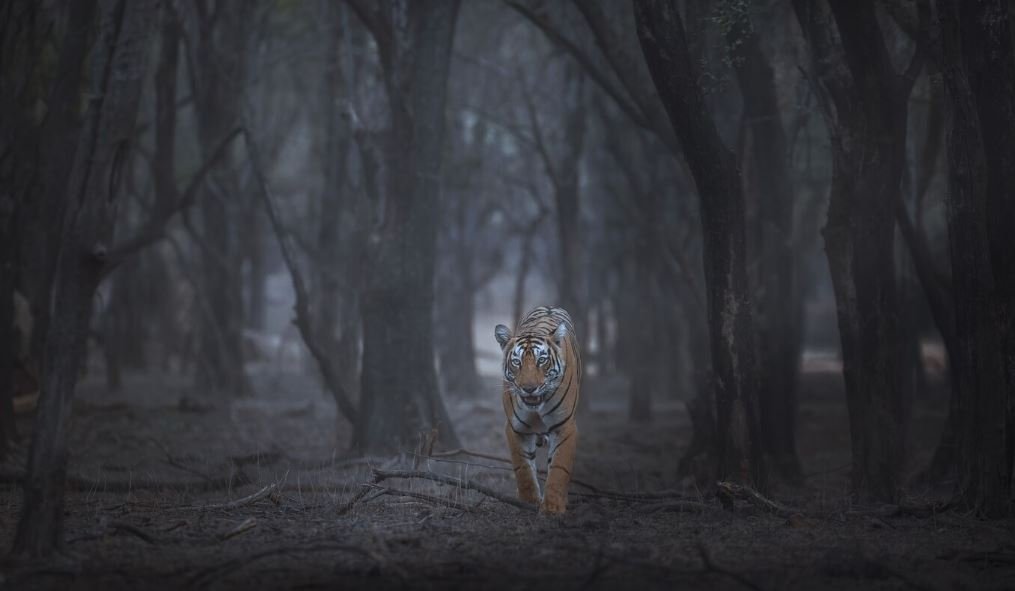
It’s important to consider what this technology is truly revealing. The majority of land animals are either nocturnal or crepuscular, active during both twilight periods, as scientists have long known. However, for centuries, research on these creatures has been far behind that of their daytime counterparts. The obstacles were pragmatic: since humans are essentially visual beings, darkness just keeps us out. Orlando Park, an American naturalist, discovered what he called the “nocturnal problem” in 1940. This was a formal recognition that biological science had a significant blind spot that artificial illumination alone was unable to address because light fundamentally alters the behavior being observed.
Infrared-triggered camera traps started to erode that issue. They could record animals that would never have put up with a human presence for weeks at a time. The remote scrublands of Australia, the dense thickets of Zambia’s national parks, and the urban forest edges of Singapore all started producing footage that researchers could not have obtained in any other way. These techniques contributed to the eventual rediscovery of the elusive Australian Night Parrot, which had been thought to be extinct for the majority of the twentieth century.
From an artistic perspective, there’s a feeling that technology has also changed what photographers think is possible. It used to be necessary to accept a certain flatness when photographing nocturnal wildlife: harsh shadows, flash-lit eyes reflecting back at the camera, and a lack of environmental context. Images that feel inhabited, cozy, and truly alive can now be produced by a photographer who is prepared to work carefully with low-level supplemental lighting and a camera with strong high-ISO performance. Instead of being an impediment to the frame, the darkness itself becomes a part of it.
It’s still unclear how far sensor technology will progress and whether humans will ever be able to observe truly shy nocturnal species in a non-intrusive manner. However, the movement’s direction is clearly discernible. One meticulously calibrated exposure at a time, the night, long neglected in science and photography, is gradually revealing its mysteries.
