


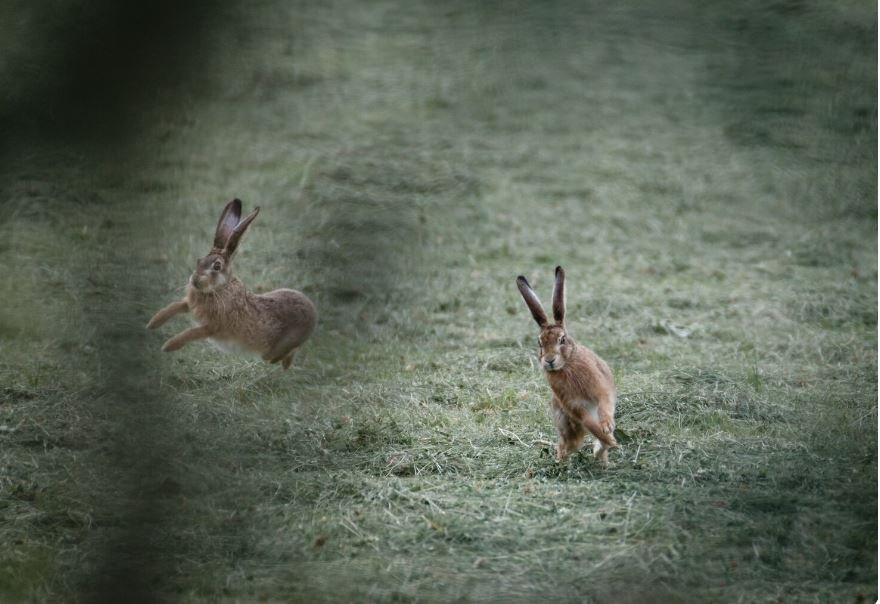
The British Wildlife Photography Awards consistently produce at least one picture that compels you to stop scrolling and take a closer look. There were multiple in 2026. Among the category winners, however, Sarah Darnell’s shot of two brown hares engaged in a fierce, mid-air altercation across Norfolk’s open fields struck a particularly powerful chord because of everything that had to happen just before the shutter clicked.
In the world of professional wildlife photography, Darnell is not well-known. That contributes to the intrigue of this tale. In addition to seasoned pros, enthusiasts and amateurs have always been welcome to submit entries to the British Wildlife Photography Awards, and the results often bridge that gap in ways the industry doesn’t always like to acknowledge. It’s not insignificant to win the Animal Behavior category out of over 12,000 entries. It requires more than a little stubbornness and true skill.
Photographing brown hares is notoriously challenging. They are quick, wary, and likely to disappear as soon as they notice anything out of the ordinary. The feeling of driving out at dusk, waiting in the cold, and seeing nothing is familiar to anyone who has spent time in the British countryside. The following evening, you return. And the following. This dynamic is aptly captured in an Instagram post that appears to be from Darnell’s personal account: “I still can’t believe how incredible this wildlife encounter was… Despite knowing that hares lived here, I went down there several times every evening without finding anything. When this hare eventually… The image itself is where the sentence ends. It is difficult to pretend to have that level of commitment, and it is even more difficult to create it after the fact.
All things considered, the competition in 2026 was exceptionally strong. Paul Hobson’s black-and-white photograph of a toad leaping silhouetted across the surface of a Sheffield pond won him the overall title of British Wildlife Photographer of the Year.
Hobson constructed a unique waterproof glass container for his camera, added ballast to make it heavier, and lowered it into the water to obtain it. He then bided his time. He pointed out that instead of jumping across the box in a way that would result in the shot he had in mind, the majority of toads would just swim under the surface or sit on top of it. Both Hobson’s and Darnell’s images demonstrate patience, which is something that the competition consistently rewards: the willingness to make repeated mistakes before succeeding.
With a powerful close-up of a pine marten in the Scottish heather of Ardnamurchan, Alastair Marsh won Animal Portraits. Jamie Smart, who is eleven years of age or younger, won the 11 and Under category after taking a picture of a leaf-cutter bee looking out from its nest in a homemade bee hotel in her Welsh garden. It’s especially worth stopping on that last one. After spending months studying the bees and building the hotel herself, Smart created a photograph that truly rivals anything produced by the adult categories in terms of composition. The tale of a kid with a camera is not endearing. It’s simply a nice picture.
In the end, the 2026 British Wildlife Photography Awards show how popular this type of photography is in Britain across all of its categories. Photographed under neon security lights are urban foxes. Cygnets sleeping. Slime molds captured in macro detail that resembles a scene from science fiction. Every year, between 12,000 and 13,000 photos are submitted for the competition, and the variety is astounding, ranging from professional photographers to backyard naturalists who have been silently observing the same area of garden for years.
That has a genuinely encouraging quality. It implies that there is less of a difference than one might think between a great wildlife photograph and professional gear or credentials. Darnell’s hares serve as a reminder that the field is owned by the person who consistently shows up and searches.
