


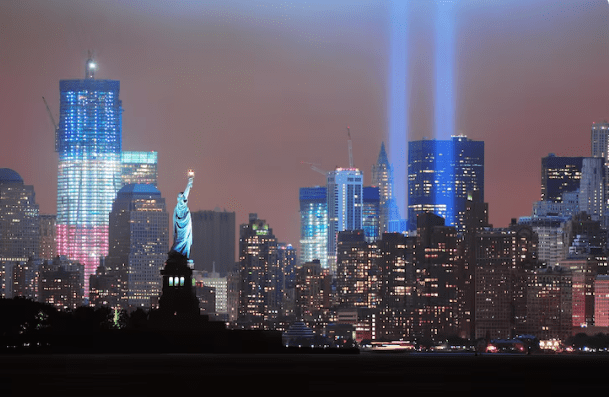
For a city that hardly ever stops acting, lower Manhattan performs something unique every September. The Tribute in Light, which consists of the two massive blue beams ascending from the World Trade Center site, is turned off for a few hours. Not because the memorial has ended, but rather because thousands of migratory birds have become stuck inside the light columns and are circling around in clear anguish until the beams darken and the birds disperse back into the nite sky. Most years, it occurs. Quietly, it has evolved into one of the more bizarre fall customs in New York.
Dustin Partridge has seen this unfold multiple times, and it appears to reside in his thoughts as a condensed representation of all he has been struggling with. For years, Partridge, the head of conservation and research at New York City Audubon, has argued that the hundreds of bird species that visit the city each spring and fall are seriously harmed by the city’s interaction with its nocturnal light. One of the four main migration routes in the US, the Atlantic Flyway, passes right into New York. Millions of birds go thru the metro area in a single nite during peak migration, guided by stars and magnetic fields as they search for the remains of the marshes and grasslands that once covered this archipelago before anything was built on it.
Glass and light are the issues, in that order. During the day, birds are confused by reflective facades because they perceive trees reflected in windows and attempt to fly toward them. Artificial light at nite causes birds to veer off course and into structures they are unable to see well enough to avoid. Every morning during migration season, the consequence is visible on sidewalks: dead warblers, sparrows, thrushes, and hummingbirds picked up by sanitation workers, who have mostly ceased commenting on it because it occurs so frequently. Researchers use estimates of up to a quarter of a million birds annually, but considering how many go uncounted, the true number is probably higher.
Partridge’s strategy has been deliberate rather than combative, which could be why some things have really changed. In order to register dead and injured birds, over 140 volunteers walk designated routes past glass-covered skyscrapers in Manhattan every spring and fall. In addition to tracking the toll, the data identifies which particular buildings are the biggest offenders year after year, providing Audubon with tangible information to discuss with building managers and owners. A list of addresses is difficult to dispute. In reaction to the survey results, a number of landlords have discreetly consented to modifications, such as providing window coverings or modifying lighting schedules.
As is often the case, the larger legislative drive has been slower. A bill that would mandate that business establishments turn down their lights throughout the nite during migratory season was submitted by Councilmember Francisco Moya. The premise is straightforward: a Chicago research from 2021 discovered that reducing half the lights in major buildings decreased bird collisions by a factor of six to eleven. For what is essentially a scheduling modification, that is a substantial reduction. It remains to be seen how many exemptions are carved out along the way and whether the measure proceeds.
