


Observing a species that was once thought to be completely safe move toward threatened status in the course of a single human lifetime is unsettling. That’s precisely what happened to the snowy owl, and the conservation community is still figuring out what that means.
The Snowy Owl held a certain symbolic security for many years. Vast, striking, and distinctly Arctic. Its official assessment by Canada’s Committee on the Status of Endangered Wildlife in 1995 was “Not at Risk.” The population appeared to be sufficiently large, dispersed, and stable. No one was especially concerned.
That assessment has been completely reversed thirty years later. In Canada, which is home to between 90 and 95 percent of all North American breeding populations, the same committee redesignated the Snowy Owl as Threatened in May 2025. The change was not motivated by a fresh disaster. Better counting served as its foundation. The population is actually much smaller than previously thought, revised downward by about an order of magnitude, according to improved estimation techniques. That’s a significant correction. That’s the scientific equivalent of discovering you’ve been misreading the map for thirty years.
On the international scene, the Snowy Owl was already classified as Vulnerable on the IUCN Red List due to evidence of rapid population declines in North America and likely declines in northern Europe and Russia. A population of between 14,000 and 28,000 mature individuals is cited in the criteria; this range alone indicates how incomplete the picture is.
Over the past 24 years, there has been a decrease of more than 42 percent, according to data from the North American Christmas Bird Count, which monitors winter movements in the southern part of the range. This equates to an annual loss of about 2.3 percent, which is quietly compounded over three generations of owls.
The thorough reevaluation of every bird species that went into the IUCN’s most recent global update, which was presented at the IUCN World Conservation Congress in October 2025, was coordinated in part by Stuart Butchart, Chief Scientist at BirdLife International. The results were not happy. Over 61% of bird species worldwide are currently experiencing population declines. The Snowy Owl’s predicament fits into a larger pattern of avian stress that Butchart and his colleagues have been recording for years. This pattern is characterized by the accumulation of individual species stories into something more significant and difficult to overlook.
Who saw the decline first is what makes the Snowy Owl case so remarkable. Indigenous communities on Baffin Island and along the Yukon coast had previously reported seeing fewer owls; these reports were directly linked to changes in the tundra’s landscape caused by warming. The 2025 Canadian assessment formally included this information. It serves as a reminder that ecological change isn’t always detected by scientific instruments first. Sometimes it’s people who have been observing the same area of sky for generations.
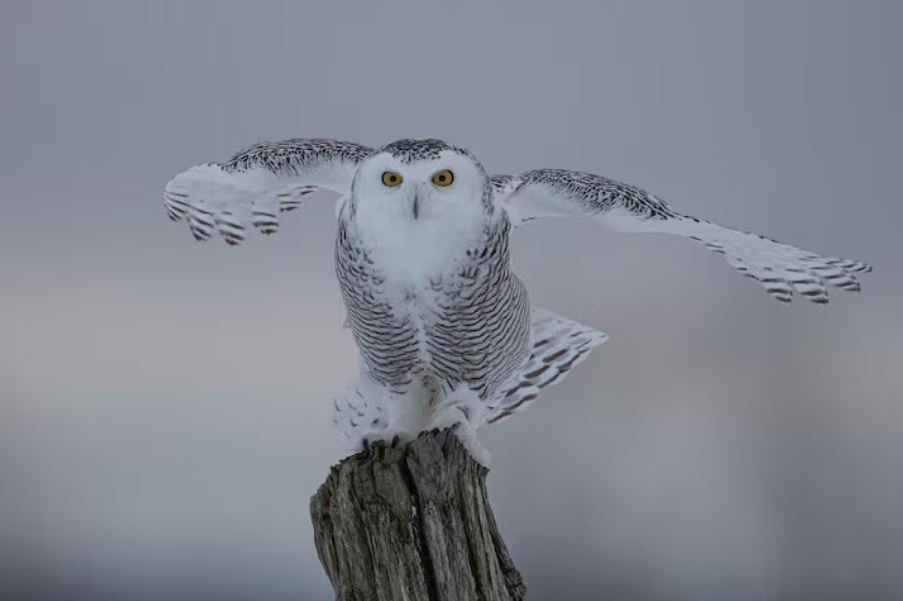
Although it is still challenging to rank them according to severity, the threats that are converging on the species are not mysterious. Snowy Owls rely on lemming cycles for nearly all of their food during the breeding season—lemmings can make up as much as 95% of their diet—but climate change is changing Arctic breeding grounds and upsetting these cycles. Beyond the tundra, owls traveling southward in the winter risk poisoning from anticoagulant rodenticides used in agricultural areas, electrocution on power lines, and collisions with cars and infrastructure. In terms of the long-term population impact, avian influenza adds another strain that is still poorly understood.
The IUCN Red List’s Vulnerable designation may be an understatement. The assessment itself states that the species may be eligible for uplisting to Endangered if the rate of decline turns out to be greater than what the available data indicates. That uncertainty is unsettling, but it’s honest, and even when the answers aren’t perfect, science is meant to be honest.
There is still the Snowy Owl. During irruption years, when lemming populations plummet and birds migrate farther south than usual, it continues to cross borders and show up in farm fields and airport tarmacs. However, as we watch this develop, it’s difficult not to feel that we’re seeing the gradual erosion of a species’ margin, and that the silence that remains in the Arctic speaks for itself about the state of a world that we haven’t fully figured out.
