


A natural history museum’s bird storage rooms have a certain quiet. Dozens of specimens with paper tags fastened to their feet, their feathers intact, and their shapes created by long-dead hands were kept in rows of drawers. The majority of people never visit this location. However, a small but expanding group of fine-art photographers have begun to emerge, and their work is altering our perceptions of both bird photography and avian art in general.
Serious bird work required fieldwork for the majority of photography’s history. awakening prior to dawn. spending hours sitting still in a hide. Patience and good fortune were equally rewarded by the best shots. There is no end in sight for that custom. Alongside it, though, there’s an intriguing development: photographers are turning to museum taxidermy collections in search of a different kind of truth. A frozen reality. One that could never be produced in the field.
Once you’ve stood in front of a well-mounted bird specimen, it’s easy to understand the appeal. No photograph of a live bird can fully capture the anatomical precision of an animal positioned by a master taxidermist. A stationary subject receives light in a different way. Angle, shadow, background, and focal depth are all under your control. Additionally, the birds themselves—many of which were collected a century or more ago—carry a weight that living subjects just do not. A few of these specimens are representative of extinct species.
That’s a big deal. When Sarah Leen wrote about photographer Robert Clark’s work in museum collections for National Geographic, she put it simply: taxidermy might be the last chance to see some extinct species at all. Clark wasn’t just creating stunning pictures when he took pictures of heath hens, great auks, and passenger pigeons for museums and private collections. His work was more akin to historical portraiture. Future viewers might view this piece in the same way that we view daguerreotypes: as priceless documents of things that will never be seen again.
Another aspect of the appeal is the technical possibilities. It would take a field photographer years or even a lifetime to come across species in museum bird collections with their plumage. For example, the male pheasant specimens at London’s Natural History Museum exhibit the entire spectrum of sexual dimorphism in a single instance: deep reds, iridescent blues, mottled chestnut, and pale yellow—a visual range that nature disperses throughout the seasons, regions, and fortunes. A museum collection is practically unattainable for a photographer attempting to develop a significant comparative body of work.
This conceptual layer appears to be particularly appealing to fine-art practitioners rather than nature photographers working in the documentary tradition. A taxidermied bird can be photographed as a natural specimen, a scientific artifact, a craft item, and, in certain situations, a piece of Victorian or Edwardian cultural history.
There was a bird. Then it passed away. After that, it was preserved by human hands using methods that haven’t really changed in 200 years: skinning, cleaning, wiring, mounting, and glass eye insertion. Even though a clean wildlife shot is technically excellent, it doesn’t always have the same density as the resulting images because of this layering of meanings.
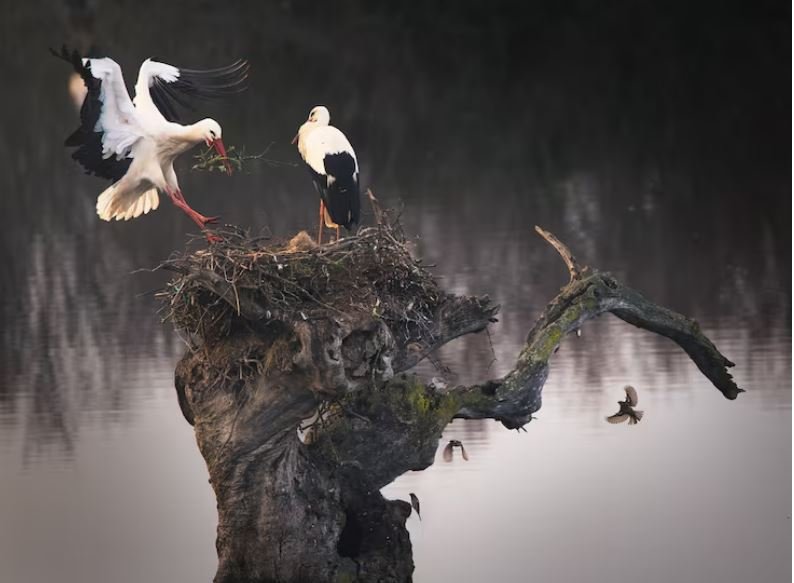
The results of this work don’t neatly fall into preexisting categories. It is not traditional nature photography. Although it takes inspiration from that tradition, it is not still life. It falls somewhere between conservation statements, fine-art portraiture, and natural history documentation—a genre that is still developing its own vocabulary. By photographing specimens against stark studio backgrounds that highlight the object-ness of the mount, some photographers embrace artificiality. Others attempt to recreate the appearance of life by employing composition and lighting to make a bird that has been dead for a century appear as though it might take flight. Both strategies bring up important issues.
Additionally, there is a subtle but persistent discussion about loss at the beginning of this work. At a time when bird populations around the world are under severe strain, museum taxidermy is experiencing a resurgence of interest, as evidenced by the Smithsonian and the Natural History Museum in London. Compared to photographing a healthy wild population, photographing a specimen that was once common but is now rare carries a different emotional register. When viewing this piece, it’s difficult not to feel that way—a kind of elegance tinged with melancholy that seems perfectly appropriate for the occasion.
It’s still unclear if this is a fully developed movement or just a collection of like-minded artists working side by side. However, the pictures are there, mounting, and visually arresting enough to command attention. As it happens, the archive was never merely a storage facility. It was ready.
