


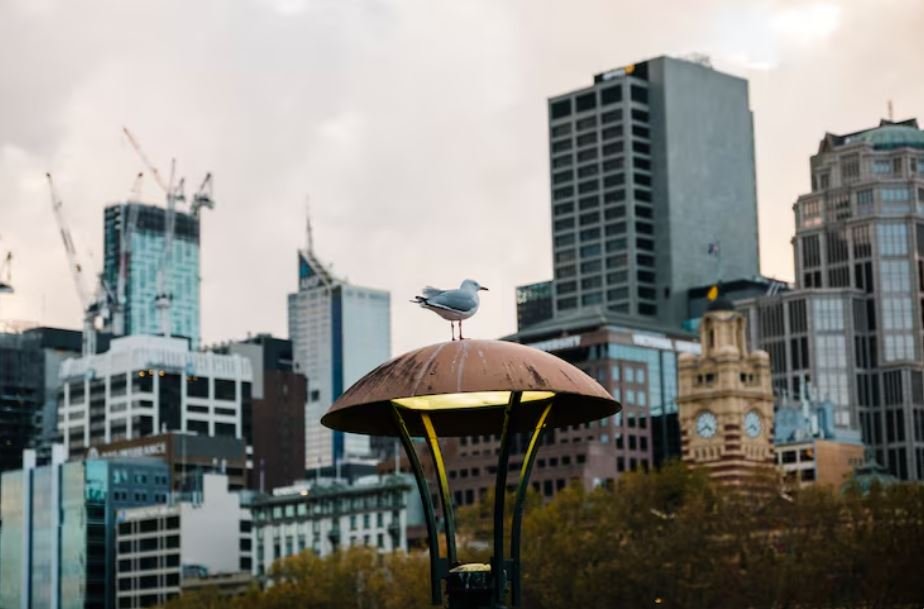
Standing on a clear morning in Bonifacio Global City and watching migratory birds fly around towers of steel and glass while traffic idles in one of the world’s most oppressive urban knots is almost surreal. Metro Manila is already well-known for its harsh commutes and consistently high levels of traffic in Asia. The effects of those shiny skyscrapers on the millions of birds that fly over them twice a year as they travel across the Philippine flyway between their breeding and wintering grounds are less well known.
Globally, the numbers are astounding. According to the American Bird Conservancy, glass collisions cause up to a billion bird deaths worldwide each year. Over a thousand birds were killed on a single October day in Chicago when migratory flocks flew directly into the facade of a glass-covered building, confused by the illuminated interior. Manila’s situation is structurally similar: it is situated directly beneath one of Asia’s busiest migratory corridors, has a dense, rapidly expanding skyline, and is heavily lit artificially. It’s possible that the city has been quietly tolling itself for years without anyone noticing.
The architecture itself is what elevates this above the status of an environmental footnote. Over the past 20 years, glass has become the standard language of prestige development throughout Metro Manila thanks to the same reasoning that has spread it throughout all Asian boomtowns: it conveys modernity, fetches high rents, and takes excellent pictures. However, a bird in flight perceives glass that appears transparent to human eyes as an open sky. Cloud and tree reflections are not helpful. The glow emanating from office towers, which remain lit long after the last worker has left, doesn’t either.
The good news is that the design solutions are already available and reasonably priced. Fritted glass, which is printed with tiny ink dots or ground-glass particles that give it a subtly opaque quality, has been used successfully in structures like Jeanne Gang’s Aqua Tower in Chicago, where the textured glass surface and wave-like facade reduce bird collisions and serve human-centered functions like shade and wind shielding. By directly applying patterns to windows, architect Joyce Hwang has demonstrated how to discourage birds without sacrificing a building’s aesthetic logic. Columbia University and other buildings in New York have embraced bird-friendly film, which is basically a laminate of dots stuck to regular glass. These interventions are not drastic. More than money, they need intention.
The more difficult issue is lighting. According to a 2021 Chicago study, there were six to eleven times fewer bird collisions when half of a building’s lights were turned off at night. Legislation to forbid illuminating unoccupied buildings at night has been discussed in New York. Manila has not yet made a significant contribution to this discussion, despite the fact that towers there frequently remain lit for a variety of reasons, including branding and security.
There’s a feeling that the city is still too focused on resolving its traffic problem, which is understandable for a metro where the average road commute can take more than 45 minutes, to consider what else might need to be fixed.
However, at least among a select group of Filipino architects and ornithologists who have been gradually bringing up the matter, something is changing. Breeding populations throughout East Asia are connected to southern wintering grounds by the Philippine Flyway. Birds whose local populations are already under stress are among the species that fly over Metro Manila’s airspace. The claim is not that glass towers should no longer be constructed in Manila. It’s that the same towers could be constructed in a different way, with coordinated lighting protocols and fritted surfaces, without significantly altering how they appear to the occupants.
It’s difficult to ignore the fact that Manila is experiencing a unique period of urban aspiration. The city is developing at a rate not seen in a generation, including subway lines, elevated expressways, and artificial island projects. It’s still unclear if that goal incorporates bird-safe design. However, the precedents set by Chicago, New York, and Toronto indicate that the changes are neither technically challenging nor aesthetically detrimental when cities choose to take it seriously. Political will is the main obstacle, and awareness usually precedes that.
