


When you hear it for the first time, it seems almost ridiculous. A $320 million federal construction project is put on hold by a woodpecker, a bird that weighs less than a coffee mug. No congressional vote, no protest march. Just a judge, a federal lawsuit, and a creature that no one had definitively established was still alive at the time of the ruling.
In 2006, a federal judge in Arkansas temporarily halted the Grand Prairie Irrigation Project of the U.S. Army Corps of Engineers due to concerns about the ivory-billed woodpecker, a species that most ornithologists had already declared extinct for decades. The project’s goal was to restore draining aquifers throughout a 242,000-acre agricultural belt—a real issue with real financial consequences. Nevertheless, the entire timeline was called into question by a bird that hadn’t been captured on camera since 1944.
The existence of the woodpecker in the area was not stated by Judge William Wilson. It might, he said. And that was sufficient under the Endangered Species Act. “When an endangered species is allegedly jeopardized,” he wrote, the odds are in the species’ favor. He ordered more research on habitats. The Corps calculated that the cost of a one-month delay would be $264,000. $3 million would be the result of a six-month pause. There was a bird running up the tab, possibly a ghost bird.
It’s difficult not to notice something subtly noteworthy in that legal reasoning. Early in 2004, a kayaker near the White River in eastern Arkansas may have seen the ivory-billed woodpecker. Cornell scientists investigated further. They logged more sightings, recorded audio, and took grainy video footage. It wasn’t all airtight. Skeptics continued to be vocal. However, the report had already prompted a $10 million research commitment and a federal announcement from the Interior Department in 2005. In a sense, the bird had legal standing after that. Even though the biology had not yet caught up, the courts had to take it seriously.
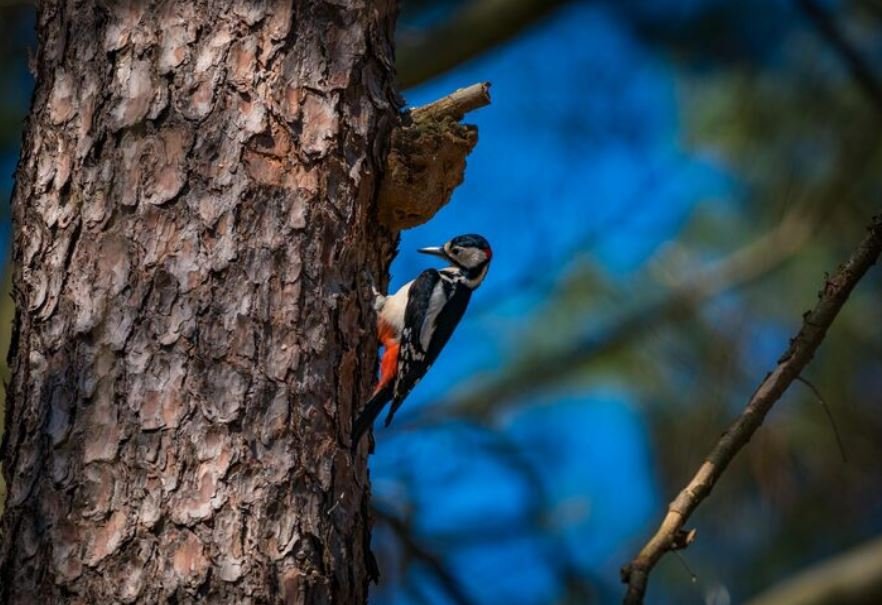
This is not a singular peculiarity of US environmental legislation. As a family, woodpeckers have a tendency to have a disproportionate impact on ecosystems and, consequently, on decisions about land use. Woodpeckers and other cavity-excavating birds serve as what ecologists refer to as ecosystem engineers, according to British Columbian research spanning 17 years and 25 forest sites. They make holes. Owls, secondary cavity-nesting birds, and small mammals are among the other species that follow. A site’s subsequent species community is richer when there are more excavators there. You don’t simply lose the woodpeckers when you remove them. You bring down a chain that was constructed over many years.
These birds continue to appear in court in part because of this ecological context. Large-scale water infrastructure and logging operations do more than just cut down trees. The mature forest structure, dead wood, and snags that woodpeckers rely on for food and nest sites are all being eliminated. Contractors may face substantial legal risks if a species associated with that architecture is protected by federal law.
To its credit, the Corps claimed that its biological assessment revealed no appreciable damage to the habitat of the ivory-bill. Its biologist observed that the pump station was being constructed in an area that was already used to machinery, on a former farm field, close to a highway. That is a valid counterargument. It’s acceptable for construction companies to contest injunctions based on unverified species sightings. The delays compound and the expenses are genuine.
Beneath the legal wrangling, however, is a more serious problem. When drilling into wood, woodpeckers use their entire body, not just their neck muscles, according to new research from Brown University that was published in 2025. This allows them to coordinate their musculature and respiration in ways that scientists had not previously fully mapped. It’s the kind of discovery that changes your perspective on these birds. They’re not merely kissing. They’re executing a biomechanical feat that scientists are still trying to fully comprehend.
It is still genuinely unclear whether the ivory-billed woodpecker is extinct or still alive. It’s weird to sit with that ambiguity. However, the ecological and legal principle it revealed is fairly obvious: possibility has weight in American environmental law. A multimillion-dollar project can be halted by a bird that may live in a disturbed forest, at least long enough to compel a closer examination. That is an unsettling reality for the infrastructure and timber industries. It might be the only effective defense for the forests.
