


Standing on flat, featureless farmland in eastern England and being informed that you are, technically, at the bottom of what was once a vast and teeming freshwater sea can be subtly disorienting. With long stretches of drained clay soil, drainage ditches that cut arrow-straight lines across the horizon, and hardly a tree in sight, the Fens of Lincolnshire, Cambridgeshire, and Norfolk appear to be industrial agriculture at its most productive. They don’t appear to be the richest freshwater wetland in the British Isles, but that’s precisely what they were before centuries of drainage transformed them into something completely different.
Depending on who you ask and what you count, Britain has lost between 75% and 90% of its wetlands over the past few centuries. When you sit with that figure, it’s astounding. Wetland habitats are essential to about 40% of the world’s plant and animal species. The decision to drain the Fens involved more than just land use. The entire cost of this slow-motion ecological disintegration is still being calculated.
They weren’t abstract species that vanished with the water. In the reedbeds, bitterns nested. Over open water, marsh harriers hunted. Once common enough to be hunted for food, cranes are now so uncommon that their return makes national news. Over the flooded levels, large rafts of wildfowl spent the winter. Even seemingly insignificant species, like water voles, breeding lapwings, and reed warblers, have drastically decreased over the years, to the point where seeing them now seems like a minor event worth stopping for. In terms of ecology, it’s difficult to ignore how much of what people refer to as “the English countryside” is a relatively recent and rather bare replacement.
The true scope of restoration ambition has shifted in recent years. Rebuilding entire ecosystems from scratch was once thought to be impossible, but projects like RSPB’s Ouse Fen in Cambridgeshire, a three-decade quarry-to-reedbed conversion that is quietly becoming one of the largest new wetland habitats in England, are trying to do it.
Raising the water table, removing drainage infrastructure, letting vegetation collapse back into wet sedge and reed, and then waiting are the general steps in the process. Where they have been reintroduced, beavers speed up the process in ways that continue to surprise conservationists. After releasing beavers into a wooded enclosure close to a chalk river, a farmer in Norfolk discovered that the animals had impounded a small stream into a sizable pond, which subsequently supported a headwater river during the dry months of an increasingly erratic year.
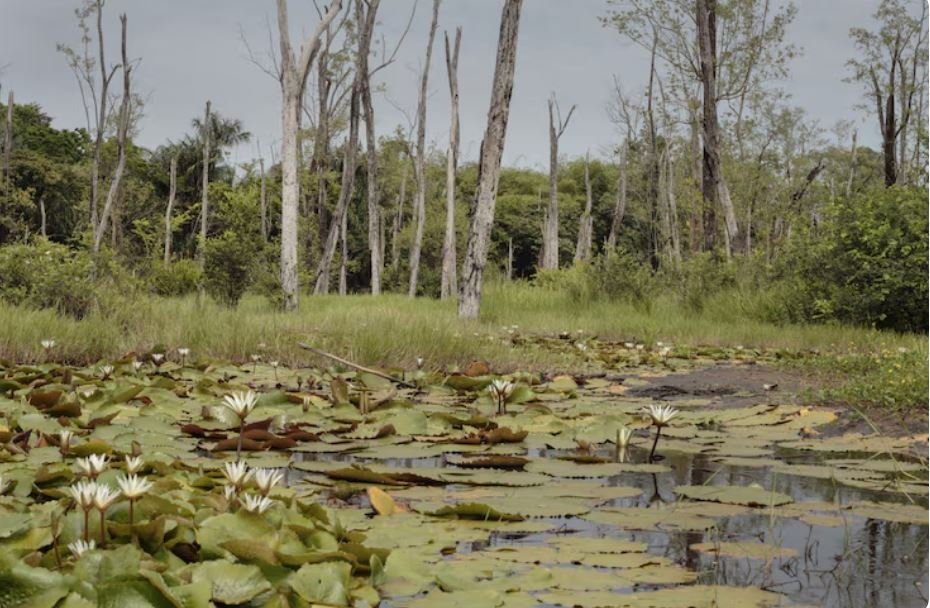
As of right now, the ecological logic of restoration is a well-established scientific concept. Restored wetlands store carbon at rates that are comparable to nearly everything else land can do, slow floodwater, replenish aquifers, and trap agricultural nitrogen before it reaches rivers. The older and deeper layer beneath many of the Fens is called a peatland, and it stores twice as much carbon as all of the world’s forests put together.
The drained peat oxidizes and releases carbon back into the atmosphere each year that it is left outdoors. Rewetting it benefits more than just the bitter. In quantitative terms, it is among the more affordable climate interventions.
The only thing that is truly uncertain is whether and how soon the birds return. In Somerset and Cambridgeshire, species such as the bittern and marsh harrier have already returned to restored reedbeds, indicating that the habitat functions as intended when it is rebuilt with care. Wetland birds, however, require scale. A networked landscape of water, reed, sedge, and open bog differs from a small reedbed encircled by miles of intensive farmland. The Great Fen project is betting on the idea that connected wetlands function differently from isolated pockets. The project’s goal is to reconnect fragments of surviving peatland over a large area of Cambridgeshire.
Additionally, there is a financial argument that is gradually gaining momentum. Newer projects like Boothby Wildland in Lincolnshire and rewilded estates like Knepp in Sussex are proving that land managed for nature can make money through carbon markets, ecotourism, and biodiversity credits—sometimes more consistently than the subsidy-dependent farming it replaced. Since it’s still early, treating these examples as evidence for a universal model would be premature. However, the direction is noteworthy.
It is evident that the Fens, as well as the wetlands of England in general, are no longer merely a relic. Tentatively, they are a project. A small number of cranes have returned. The number of marsh harriers is increasing. And somewhere in Ouse Fen’s growing reedbeds, bitterns—that low, foghorn call that once characterized these landscapes before going silent for a long time—are booming once more in the spring.
