


There is a certain stillness in the desert before sunrise that feels earned. A woman is standing next to a hooded falcon that is sitting motionless on its perch, adjusting the leather jesses around its legs with the ease of someone who has done this ten thousand times. Her young daughter keeps a close eye on her. This scene is not new; it can be found in both the steppes of Kazakhstan and the sands of Abu Dhabi. It’s just recently apparent.
That distinction is more important than it may seem.
Women have been involved in falconry for centuries, training birds, hunting alongside men, and sometimes even outperforming them. Aquitaine’s Queen Eleanor was a famous falconer. The Duchess of Burgundy, Mary, always carried a hawk in her fist when she appeared in public. A goshawk was depicted on the right hand of Chand Bibi, a Muslim regent in Mughal India. An entire section of the Taymouth Hours, an illuminated English manuscript from approximately 1325, features young women flushing game, hunting deer, and hawking; not a single man is depicted. Instead of the smaller merlins that women of the time were supposed to fly, these women flew goshawks. They weren’t ornamental figures.
Nevertheless, the majority of them were somehow excluded from the predominant visual record of falconry, which includes paintings, photos, and magazine spreads.
Vidhyaa Chandramohan, a photojournalist, saw the opening. She had lived in the United Arab Emirates for more than sixteen years, and she had witnessed enough of daily life there to understand how deeply ingrained women were in the falconry tradition. However, the photographic record seemed to indicate otherwise. She then started searching.
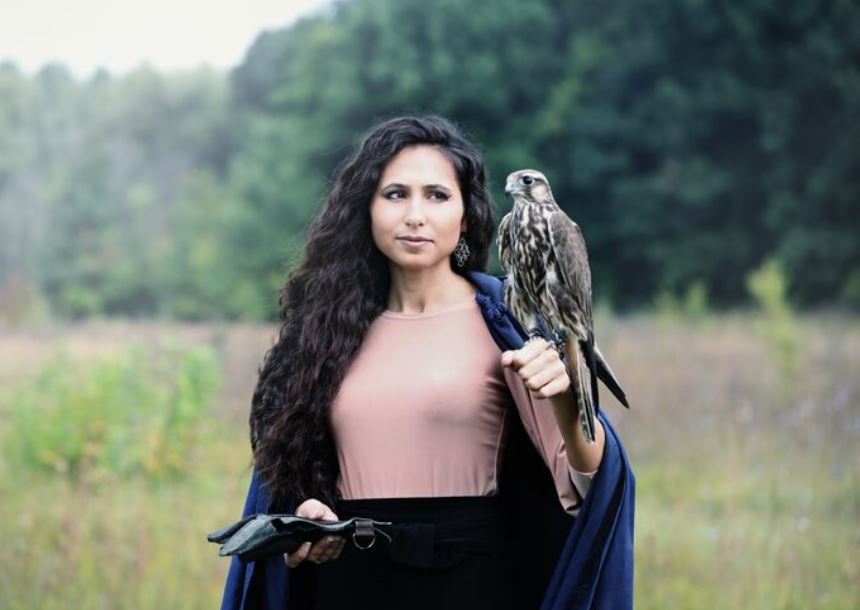
After searching social media and following leads, she finally located Ayesha Al Mansoori, a woman who has seven falcons, trained almost 150 women and 70 girls, and constructed a ventilated enclosure made of desert sand at home to properly house her birds. Additionally, Al Mansoori founded the Abu Dhabi Falconers Club’s first Ladies Section. By all accounts, she is a serious practitioner. She simply hadn’t been discovered by the camera until now.
For years, art historians have been discreetly recording what Chandramohan’s photos show. As a Falconry Research Fellow at NYU Abu Dhabi, Anne-Lise Tropato has been compiling a global database of artistic falconry photographs with an emphasis on women’s appearances and the messages they convey about gender, power, and the long-standing human connection to raptors. According to her research, women have been “nearly invisible in texts about falconry, but their presence in images is more significant than expected.”” Queens purposefully projected strength and authority by using their identity as falconers. Female falconers were used allegorically by painters. They were occasionally used by manuscript illustrators to reverse the natural order of things, such as predator and prey or man and woman.
That history is almost subtly humorous. Women were always present in the sport that kept them out of the official record.
It’s getting more difficult to ignore that presence these days. Learning falconry is becoming more and more of a rite of passage for both boys and girls in the United Arab Emirates. Sheikha Mozah bint Marwan, a member of the ruling family of Dubai, participates in the sport and talks about the discipline needed to keep the bond strong, which goes beyond simply training the bird. Al Mansoori’s daughter Osha, who is eight years old, is already using a live pigeon lure. These are serious hobbyists. They are upholding a 4,000-year-old custom with the gravity it merits.
Women have always participated, so it’s possible that what’s changing now is documentation rather than participation. At last, the camera is pointing in the proper direction. And in that minor adjustment, a bigger picture emerges: a history that was never truly lost, only dimmed.
