


Every wildlife photographer is familiar with the moment when a kingfisher lands thirty meters away, remains motionless for roughly four seconds, and then disappears. Depending almost entirely on the type of glass you are holding, you may or may not return home with anything usable. The solution to that issue was costly, bulky, and taxing to transport for the majority of the previous few decades.
Calculus is changing. Additionally, it’s changing more quickly than most photographers anticipated.
Super-telephoto lenses, or anything larger than 400mm, have historically been associated with a particular type of shooter: the professional with a monopod, a memory card vest, and an unthinkable budget. Any major manufacturer’s 600mm f/4 prime could weigh well over three kilograms and cost as much as a used car. The reach was incredible. It was more difficult to get in.
The weight has changed. For example, Nikon’s Z 600mm f/6.3 VR S weighs about 1,470 grams, which is roughly 57% less than its f/4 professional equivalent. Canon has taken comparable actions. The practicality of using these lenses in the field has changed significantly, but the physics of what they can accomplish hasn’t changed all that much. A lens that requires you to stop, set up a tripod, and hope your subject waits is entirely different from one that you can hold for three hours while tracking birds through a wetland.
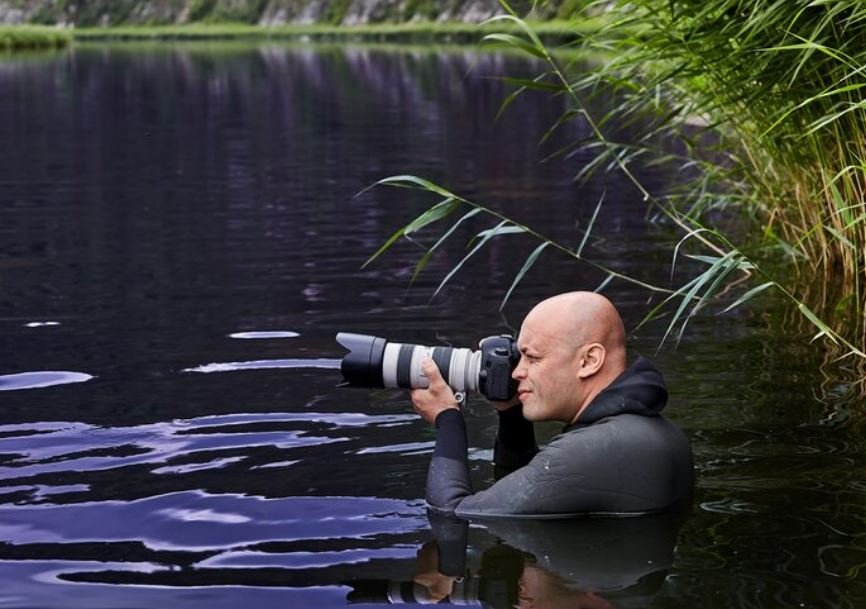
The weight loss might not seem like a revolution on its own. However, if you spend an entire day in the field with a 3 kg lens hanging off your shoulder and then try the same outing with something weighing less than 1.5 kg, the difference becomes noticeable very quickly. It becomes really feasible to take mobile photos while strolling along riverbanks or through coastal scrub. This has made it possible to photograph wildlife in a way that previously required either extraordinary physical fitness or a vehicle.
However, there are actual optical trade-offs. Simply put, an f/4 prime collects light better than a lighter lens at f/6.3. That distinction matters whether you’re in the shade of a forest canopy or during the golden hour. The animals that make the most interesting subjects—those with strong survival instincts—tend to appear in low, challenging light because wildlife doesn’t always behave as planned. For precisely this reason, fast lenses continue to be the industry standard.
However, there’s a feeling that the latest generation of low-cost super-telephotos has produced something more valuable than a less expensive version of high-end equipment. It has produced a type of lens that is ideal for a completely different type of photographer—one who is not making a living from their work but has a strong passion for wildlife and wants to work morally and respectfully away from their subjects. It’s important to consider the ethical aspect of this. When a 600mm lens is used correctly, the photographer maintains a sufficient distance so that birds continue to feed, mammals do not flush from their resting places, and the image itself becomes something observed rather than provoked.
Wildlife art, which used to only consist of paintings or the work of a small number of professional photographers, has begun to take on a more democratic appearance. In certain situations, it can be quite challenging to tell professional photographs from those taken by serious amateurs using contemporary zoom super-telephotos. Alongside the advancement of optics, autofocus systems have also improved. On mid-range mirrorless bodies, subject tracking that was unthinkable ten years ago is now commonplace.
The craft is still difficult, though. There is a learning curve when using a super-telephoto viewfinder for the first time. At these focal lengths, depth of field is harsh; even a slight change in a bird’s head angle can cause the eyes to soften, ruining an otherwise flawless frame. Anticipation, light reading, and shutter speed discipline have all been eliminated by automation.
The door’s dimensions have altered. It is now more affordable for more people to stand in front of it.
