


If you’ve ever seen an oriole move around on a branch in the morning light, there’s a moment when its plumage appears to completely change color. Orange turns into gold before becoming nearly amber in hue. It’s not a trick of fatigued eyes. It’s physics, and for the better part of the past ten years, physics has been subtly drawing scientists further into an issue that turns out to be far more difficult than it first appears.
Pigment is not the source of iridescence, the characteristic that causes some bird feathers to change color depending on the viewing angle. It originates from structure. Feather barbules contain tiny, precisely arranged nanostructures that interact with light in ways that selectively amplify particular wavelengths. These nanostructures are filaments too small to see without a microscope. You can alter the color by altering the angle. What paint cannot do, geometry can.
For digital rendering, that distinction is crucial. Animators and game designers are unable to simply choose a color and fill it in when attempting to depict the appearance of an iridescent feather on screen. The color depends on the angle. It moves. Furthermore, until recently, the methods for capturing that quality were either too computationally demanding or too simplistic to be convincing.
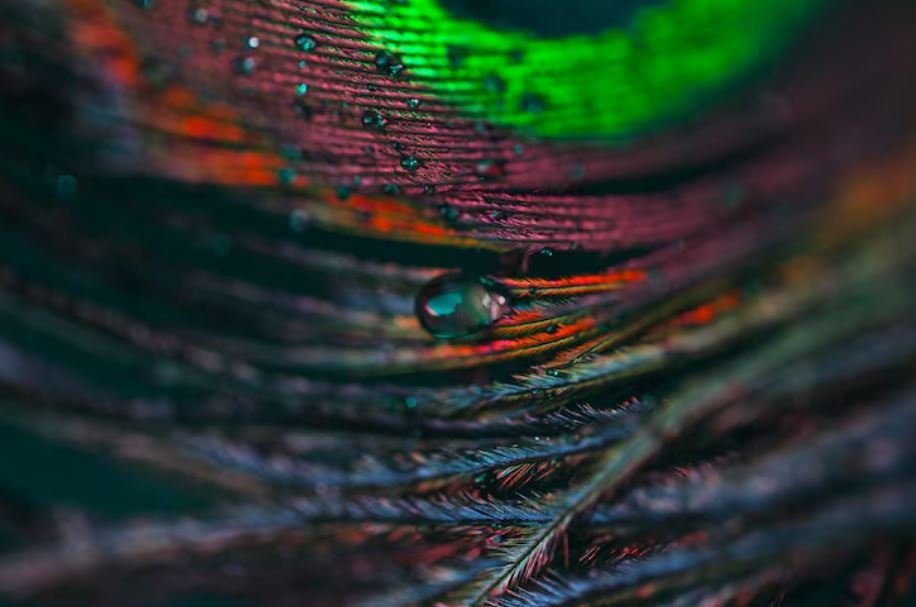
In collaboration with NVIDIA, Cornell University researchers set out to alter that. They created appearance models using real feather specimens from the Cornell Lab of Ornithology that were able to replicate both the subtle, glittery imperfection that gives real feathers their lifelike appearance and the color-shifting quality of iridescent plumage. The study, which was presented at SIGGRAPH Asia in late 2024, examined seven bird species, each of which represented a distinct kind of iridescent nanostructure. These species included mallards, peacocks, hummingbirds, starlings, and others.
The technical accomplishment wasn’t the only thing that made the work truly fascinating. It was the recognition that natural iridescence is flawed by nature. The lead researcher clarified that barbules are similar to snowflakes in that no two are alike. Previous rendering models produced results that appeared polished but felt a little off because they had essentially smoothed over that variation. In order to replicate those minute discrepancies, the new model added controlled randomness, and the outcomes were much more convincing.
This study may have revealed a long-standing flaw in digital color theory. Pigment logic—fixed values, repeatable hues, and stable output—has been the foundation of the predominant framework for digital color representation for decades. However, structural color—the type created by iridescent feathers—behaves differently. It doesn’t have a set value. It is totally dependent on the situation and how the light source, surface, and viewer are related. Standard profiles were not designed to handle that type of color because it is fundamentally different.
Contrary to popular belief, the science underlying iridescence has a long history. In 1704, Isaac Newton wrote about peacock feathers, observing that they seemed to change color based on the eye’s position. Since then, scientists have discovered that iridescent structural coloration dates back at least 161 million years to a dinosaur known as Caihong juji, whose fossilized feathers exhibited a nanostructure arrangement similar to that of contemporary iridescent birds. More recently, paleontologists studying a Cretaceous enantiornithine bird concluded that, depending on the viewing angle, the bird’s crested head feathers probably ranged from red to deep blue—a signaling mechanism that seems to predate birds as we know them.
The precise way this translates into the upcoming generation of digital tools is still unknown. The model may eventually be incorporated into artist-friendly interfaces, including real-time rendering environments for virtual spaces and games, according to the Cornell team. That would be a significant change. Currently, it takes a lot of computation to simulate iridescence convincingly. A different, more difficult issue is making it available to designers who are under time constraints.
This has a wider implication that is simple to ignore. The feathers of the hummingbird, peacock, and oriole did not develop to be attractive. They developed the ability to speak. The iridescence is a signal that has been adjusted over millions of years to be visible in the right light, at the right angle, and to the right viewer. In contrast, digital color profiles were designed to be universal, readable, and consistent. The assumptions that underpin our system and those of nature are entirely different. It turns out that more than just improved software is needed to close that gap. It necessitates rethinking what color is in reality.
