


The size of the sheds or the sound of ventilation fans won’t be the first thing you notice when you approach a high-security chicken farm these days. It’s the admissions procedure. The gate has a shower room. Before being permitted to be anywhere close to the birds, workers undress, wash thoroughly, and change into brand-new farm clothes. It has a clinical, nearly surgical feel. This would have seemed excessive a few years ago. Now, it seems like the bare minimum to farms that have survived an avian flu outbreak in their area or witnessed nearby operations being shut down overnight.
This change is the result of genuine, well-documented pressure. In 2015, highly pathogenic avian influenza killed about 50 million birds in about seven months in the United States, costing more than $3.3 billion. Due to HPAI’s devastation of flock numbers, egg prices in the United States have recently reached all-time highs, with consumers paying billions more than usual. These are not statistics from an abstract industry.
They appear in farm bankruptcies, grocery bills, and villages where raising chickens is the main source of revenue. Because of the magnitude of those losses, the industry was forced to confront an unsettling question: why did the virus continue to spread if conventional biosecurity was already in place?
It turns out that part of the answer was in the air. According to research, fine dust particles may have carried the virus between farms during the 2015 HPAI outbreak in the United States. This disproved a fundamental belief that biosecurity was primarily about regulating what vehicles and people brought through the gate. Disinfected clothes, car washes, and foot baths are all necessary and still relevant. However, none of them could prevent a pathogen from entering through a ventilation inlet on a dust particle. The most serious producers’ perspectives on flock protection have begun to change as a result of this realization.
Once considered an expensive luxury or a specialized issue, air filtration is now being discussed seriously in biosecurity discussions. Although HEPA filters are expensive to install on large farm fans and prone to clogging in dusty environments, they are capable of capturing particles. While misting systems can significantly reduce airborne dust, a University of Georgia study discovered that water sprays also increased ammonia concentrations, which harms birds’ respiratory systems and increases their susceptibility to infection rather than decreasing it. One of the things that makes this moment so intriguing is that there is still no one ideal solution. The industry is actively addressing the issue in real time.
It is becoming increasingly evident that biosecurity can no longer be viewed as a list of physical obstacles. It’s a systemic issue. Even with perfect cleaning procedures, a farm may still be exposed because the barn air, which is heavy with dust from feed, litter, and feathers, serves as a reservoir for bacteria and viruses that birds breathe in.
The air inside poultry houses is described by researchers as being full of bioaerosols, particularly in warm, crowded conditions. Thinking beyond fences and disinfectant mats is necessary to address that.
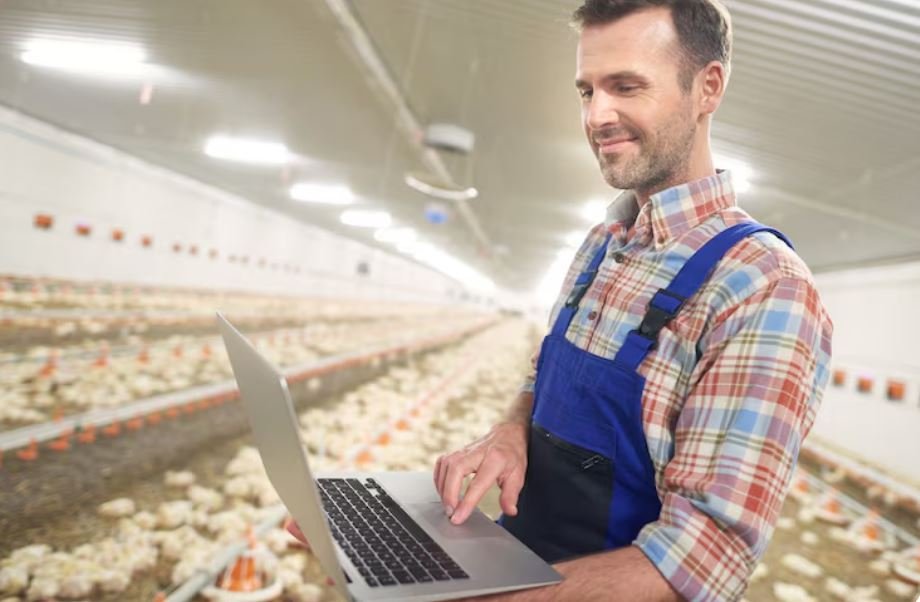
One of the more obvious manifestations of this move toward what some are referring to as extreme biosecurity is the requirement for showers at farm entry. Showering before entering high-security operations eliminates both surface contamination and the invisible microbial load that adheres to skin and hair after exposure to the external environment.
Of course, it’s inconvenient. Before entering the sheds, employees in some facilities must spend ten to fifteen minutes going through entry procedures. However, the farms that have implemented these procedures typically view them as an investment in continuity, a means of preventing the need to start over after a single biosecurity failure.
Additionally, these systems are incorporating technology in ways that ten years ago would have seemed excessive. These days, IoT sensors track humidity and ammonia levels in real time. Unusual patterns in bird behavior or feed consumption that may point to early disease are flagged by smart alerts. The goal is to identify issues as soon as possible to prevent them from spreading throughout a house or jumping to a nearby shed. According to research, plasma-based air treatment systems can neutralize airborne viruses more successfully than ultraviolet light in barn conditions, which is why some farms are investigating them. It’s still unclear if these technologies will become commonplace or continue to be specialized tools, but the direction is obvious.
All of this is part of a larger truth. For a large portion of its industrialized history, poultry farming was planned with efficiency and scale in mind. Although biosecurity was crucial, it was frequently viewed as an expense and a requirement rather than a competitive advantage. That computation is evolving. When disease pressure increases, farms that make significant investments in biosecurity—such as air filtration, entry procedures, and ongoing monitoring—are more likely to continue operating. Extreme biosecurity isn’t necessary in a world where a single outbreak can destroy years of investment in a matter of weeks. It appears to be the only sensible course of action.
