
When volunteers from the Chicago Bird Collision Monitors arrived at McCormick Place Lakeside Center on a morning in early October a few years ago, they discovered that the ground was covered in birds. More than a thousand of them. Dead at one building, in one day. The species included birds traveling thousands of miles, such as warblers, sparrows, and thrushes. Those journeys were never completed. It’s likely that the majority of them never saw what killed them.
That is the harsh, unglamorous reality of glass in contemporary architecture. Glass does not appear to be a wall to birds. It appears to be the sky. It resembles trees. It appears to be a safe place to fly. According to a 2014 study, window strikes kill up to a billion birds annually in the US alone. Despite the startling figure, there hasn’t been the expected public outcry. Maybe because every single death is silent. No spectacle is present. There was only a window, a bird, and then silence.
Though tall glass towers tend to garner the most attention, it’s important to realize that this isn’t primarily a skyscraper issue. Due to their sheer number, low-rise commercial buildings and regular homes are responsible for a higher overall number of bird deaths. A glass facade downtown can be just as deadly as a single picture window in a suburban home reflecting a backyard garden. Glass is an indiscriminate killer, according to Muhlenberg College researcher Daniel Klem, who has been studying this since the 1970s. Both healthy and sick birds are needed.
Confusion occurs quickly and frequently. The glow of illuminated buildings attracts birds that migrate at night. They descend at dawn into urban settings they were not meant to traverse, then come across glass surfaces that reflect the sky and vegetation they are seeking. The reflection is convincingly accurate rather than a distortion. That’s the issue. In some ways, the trap gets worse the better the glass.
One of the first significant structures to take this seriously during the design phase was Jeanne Gang’s 2009 Aqua Tower in Chicago. Its fritted glass, which is printed with tiny particles that give the surface a slightly frosted appearance, and its wave-like balconies were designed in part to lessen bird strikes.
Birds in flight are confused by the building’s curved shape, which breaks the flat reflective plane. It’s a sophisticated solution that didn’t detract from the building’s appearance. If anything, it increased the level of interest. According to reports, Gang was taking inspiration from Antoni Gaudí, who once observed that there are no straight lines in nature. The majority of glass skyscrapers are composed of nearly nothing.
Since then, a few workable solutions for both new construction and existing buildings have surfaced. Columbia University in New York and an increasing number of other institutions have embraced bird-friendly film, which is a laminate of tiny dot patterns applied directly to glass.
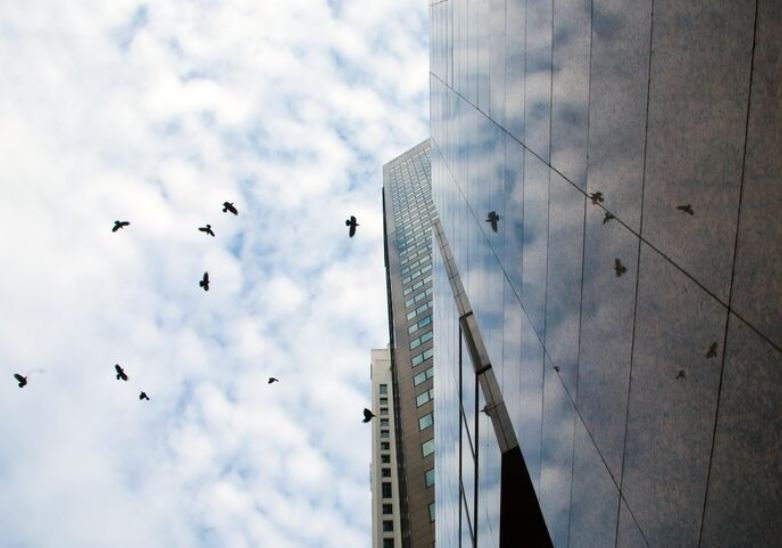
Without appreciably changing the view from within, the dots allow approaching birds to see the glass. Glass that reflects ultraviolet light is a more recent innovation. Humans cannot see UV, but birds can. As a result, the surface appears virtually unchanged to building occupants, but it makes it obvious to birds that something solid is present. This fix seems almost too easy, which could be the reason it took so long.
And there’s light. Turning off half of the lights in larger buildings at night reduced bird collisions by six to eleven times, according to a 2021 Chicago study. Half of the lights, not all of them. Artificial light and bird disorientation are known to be related.
When a lit office tower at two in the morning throws migratory birds off course, they circle, exhaust themselves, and become exposed to everything the city has to offer. Migrating birds are guided by stars and magnetic fields. During the busiest migration seasons, a number of American cities, including Dallas, Houston, Philadelphia, and New York, have started “Lights Out” programs. Legislation to completely forbid the lighting of unoccupied buildings at night has been discussed in New York. Although it hasn’t passed yet, the fact that it’s being given serious consideration seems to indicate a change in how cities view their own impact on wildlife.
Observing all of this, it seems as though the architectural and urban planning communities are beginning to face something they have long shied away from. Glass’s clean, open, and light-filled appearance has contributed to its status as the defining material of contemporary commercial construction. Songbirds were not on anyone’s minds. However, the solutions to the issue are now available and reasonably priced in comparison to the cost of a building. Dimmer switches, UV coatings, and dot patterns are not moonshot technologies. They are decisions. Cities, colleges, and some developers are increasingly making these decisions before the birds start to fall.
How quickly this changes at scale is still unknown. Bird-safe glass is still not required by building codes in the majority of cities. With laws reminding building owners that it is illegal to kill migratory birds, even inadvertently, Canada has started to move in that direction. The United States is still a patchwork. While most cities lag, some lead. The annual cost of that disparity is one billion birds.
