


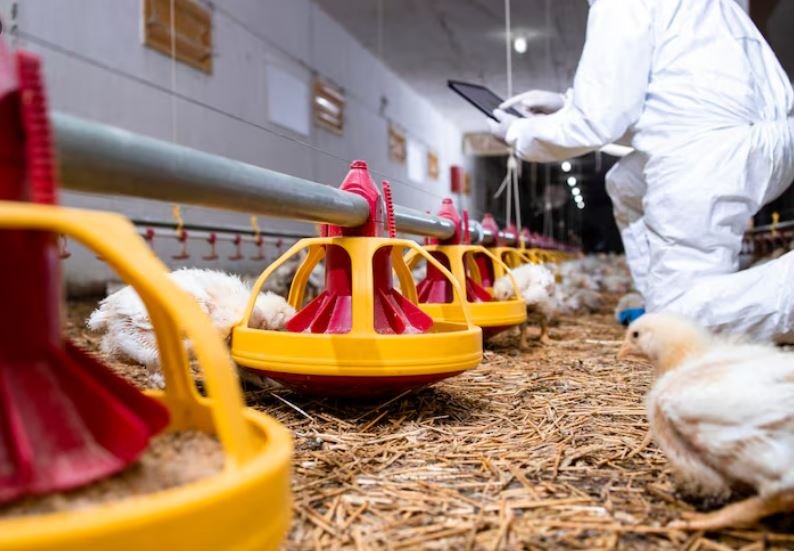
The sheer extent of vulnerability becomes nearly unbearable to contemplate when you enter a typical commercial poultry barn in rural England or the American Midwest. Tens of thousands of birds, all genetically susceptible to a virus that has recently wiped out hundreds of millions of their kind worldwide, are crammed under one roof. It’s an efficient agricultural setup, but regrettably, it also has the potential to spread catastrophically.
Researchers at the University of Edinburgh’s Roslin Institute and Imperial College London have been working in secret to find a solution to that issue. They might also be closer than most people think.
The research focuses on a single gene called ANP32A, which tells chicken cells to make a protein that the avian influenza virus basically needs to survive. The virus cannot efficiently replicate without it. The reasoning is almost elegant in its simplicity: you can break the chain of infection at the cellular level by eliminating the protein’s capacity to interact with the virus. Researchers precisely and subtly changed this gene in live chickens using CRISPR gene-editing technology. When the findings were published in October 2023 in Nature Communications, virologists who were not part of the original research teams took notice.
Nine out of ten gene-edited chickens showed no symptoms of infection in controlled exposure tests with about 1,000 infectious viral particles, a dose thought to be roughly equivalent to what a bird might encounter on a real farm. Every unaltered control bird became ill. That outcome is not insignificant. This is the type of figure that makes epidemiologists take notice.
However, it’s important to be open about the limitations in this situation. Half of the altered birds contracted the infection when the experiment was conducted under extreme circumstances, exposing birds to a million infectious particles—a dose that has no real counterpart in nature.
Even more concerning, the virus discovered in those groundbreaking cases had already started to change and adapt to use two related proteins, ANP32B and ANP32E, as substitute hosts. A few of those mutations demonstrated the ability to interact with the human protein as well. Even the optimists paused at that particular detail. In the words of Wendy Barclay of Imperial College, “We were not alarmed by the mutations, but the fact we got breakthrough means we need more rigorous edits going forward.”
Researchers now think that editing all three related ANP32 proteins at once is the best course of action. That triple-edit method completely stopped viral replication in early lab-grown cell tests. Trials are being planned to see if that holds true in live birds. The answer might be closer than the cautious academic language implies.
The permanence this research promises sets it apart from earlier attempts at disease resistance in poultry. There are bird flu vaccines, but they are costly and difficult to administer to commercial flocks due to the virus’s rapid evolution. If gene editing is successful on a large scale, resistance would be automatically passed down through the generations. Just the economics force the industry to take notice.
There are valid concerns about what widespread adoption would truly entail, including consumer acceptance, regulatory approval, and the real possibility that engineered resistance could cause viral evolution to take unexpected turns. These are serious issues. In contrast to earlier forms of genetic modification, gene editing allows for the introduction of changes that, given enough time, could theoretically occur naturally. However, scientific nuance is not always followed by public trust. Gene-edited fish can now be sold in Japan. The UK has made it legal to use gene-edited animals in farming. Gradually, the foundation is being established.
This research is important for deeper reasons that go far beyond agriculture. Cities are not where flu pandemics begin. They frequently begin in precisely the kind of high-volume, dense poultry operations that line the flatlands of Lincolnshire or the rural roads of Appalachia.
About 50 million people died from the Spanish flu in 1918. Despite being relatively mild in comparison, the 2009 H1N1 pandemic still claimed about 500,000 lives. Infectious disease experts are still concerned about the possibility of bird flu spreading to humans and changing into an airborne, contagious form. Despite their ordinary appearance, chickens are right in the middle of that risk chain.
It’s difficult not to feel that something truly significant is being constructed in these labs—carefully, imperfectly, and with all the uncertainty that comes with true science. The chickens are still susceptible to the flu. However, they are making progress.
