


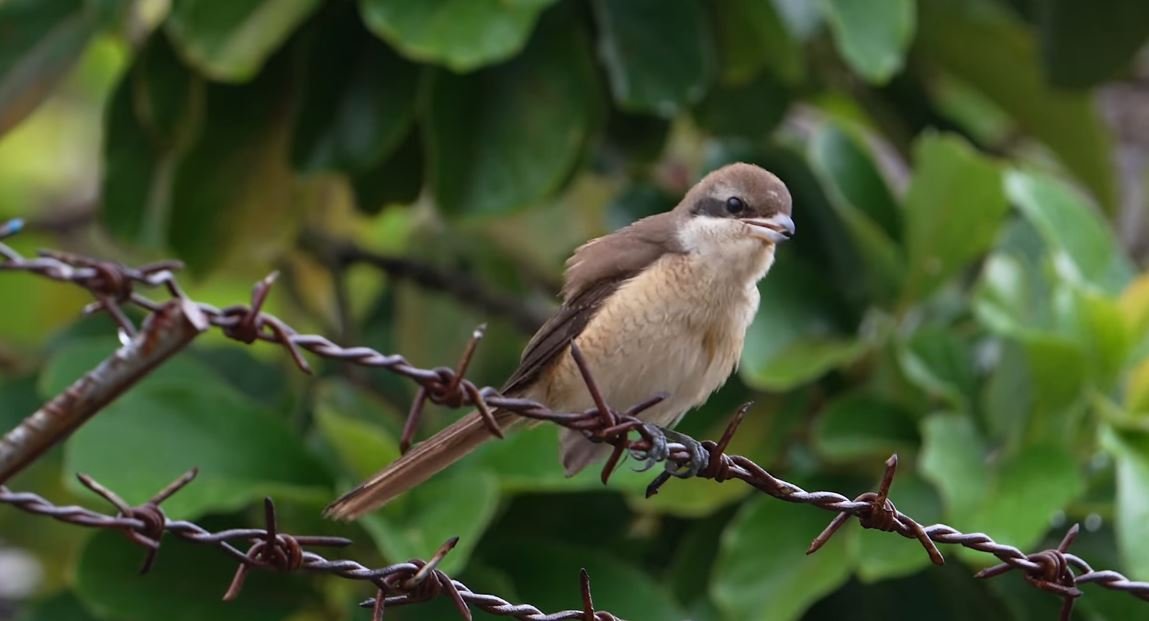
Somewhere between the rice paddies of the Philippines and the scrublands of Siberia, a tiny bird perches at the tip of a prickly bush and silently surveys the ground below. It doesn’t appear dangerous. It is about the size of a sparrow and is dressed in creamy whites and warm browns with a black stripe running across each eye, resembling a mask worn to a tiny crime scene. Then something on the ground below is dead as it moves swiftly, decisively, and without hesitation.
The Brown Shrike, scientifically known as Lanius cristatus, is one of the most interesting birds in Asia. The shrike truly earned the name Lanius, which translates to “butcher” in Latin. When there is an abundance of prey, these birds do something unusual for songbirds: they impale insects, lizards, and sometimes small birds on thorns or sharp twigs, creating what birders sometimes refer to as a larder. For an animal that is only six inches long, it is remarkably impressive, efficient, and a little grim.
The shrike has an incredibly wide range. Breeding populations disperse throughout temperate Asia, from the taiga forests of Siberia and Mongolia to China, Korea, and Japan. As fall approaches, they move south. Singapore, Taiwan, the Philippines, Thailand, India, and Myanmar. Some subspecies return to the same wintering areas year after year, traveling great distances with what researchers call remarkable consistency. This fidelity has been repeatedly confirmed by ringing studies, indicating a degree of spatial memory that is still not fully understood.
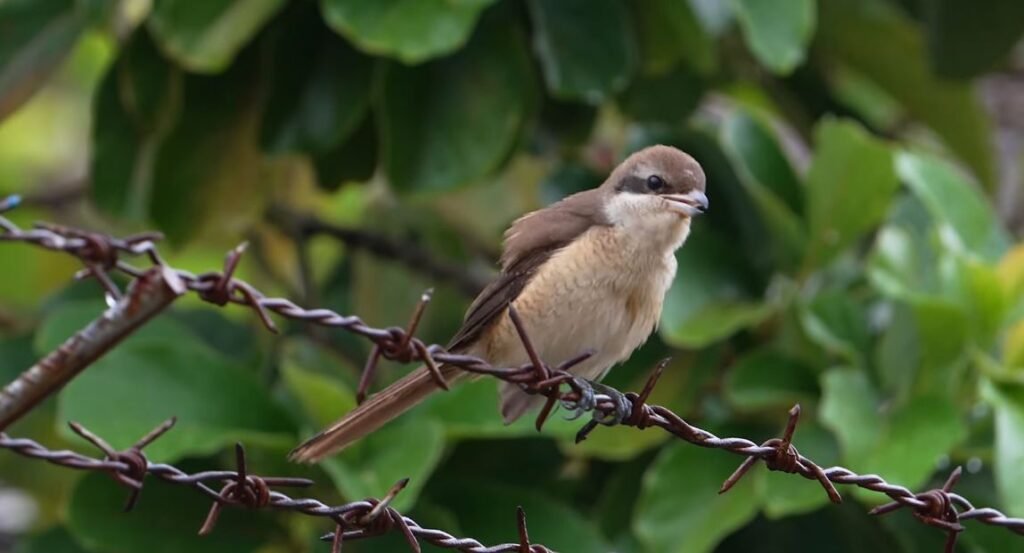
For serious birdwatchers, identification is a rewarding challenge because there are four recognized subspecies. The most popular form is the nominate form. Known locally in the Philippines as “tarat” or “pakis-kis,” the subspecies lucionensis is distinguished from its cousins by a characteristic grey crown. Then there is superciliosus, the Japanese shrike, which is by far the most ostentatious of the group. It has a richer reddish crown and a wider white eyebrow. It can be challenging to distinguish them in the field, especially during the winter when plumage softens and form overlap causes serious taxonomic problems. There have occasionally been disagreements among scientists regarding the boundaries between different subspecies.
Those who spend time observing these birds are struck by how purposefully territorial they are. Loud, rattling calls and the creation of feeding territories almost immediately follow arrivals in winter quarters, such as India in August and September. Due to their superior perches and more productive ground, early arrivals seem to have a significant advantage over latecomers. It has an almost businesslike quality. They show up, claim their space, and begin working.
In the winter, the Brown Shrike’s call is louder than its song. It’s a delicate, faint thing that has a faint rosy starling resemblance and frequently incorporates bird imitations. The bird’s method of producing it is peculiar: its tail wags slowly up and down, its beak is closed, and only faint throat pulsations are visible. It’s difficult not to find that both a little weird and a little amazing at the same time.
Most of the food is made up of insects, especially moths and butterflies. However, if the chance arises, this bird will take a small lizard or even another bird. A sobering reminder that in nature, size rarely determines who is in charge is the discovery of a white-eye in a shrike’s larder.
The IUCN currently lists the brown shrike as Least Concern, despite a declining population trend. Birdwatchers and conservationists tend to watch that combination with quiet unease because it is declining but not yet threatened. The species is still widely distributed. Every winter, it still appears in parks, gardens, and the edges of farmland throughout a vast portion of Asia, its chattering call announcing an arrival that seems almost timely. The next time a small brown bird wearing a bandit mask lands on a nearby prickly branch, it’s important to consider whether that dependability will still hold true decades from now.
