


Early in the morning, a certain sound can be heard throughout the Philippine countryside: a low, descending series of hollow notes that resemble a warning or a meditation. Birdwatchers can tell right away. Every day, farmers hear it without question. It is a member of the Philippine coucal, Centropus viridis, a big, long-tailed bird that has successfully established itself throughout an archipelago that hasn’t always been hospitable to its fauna.
The coucal is not attempting to win anyone over. It lacks both the striking silhouette of an eagle and the iridescent flash of a kingfisher. Its body, which is primarily jet black and has wings the color of dried rust, is designed for low, deliberate movement. It moves through tall grass and thicket edges with the leisurely assurance of something that is familiar with its surroundings. Certain races in Mindoro are completely black. There have even been reports of a rare white form on Luzon, which sounds like something a birdwatcher would discreetly share with another birdwatcher as though it were a small secret.
It is a member of the Cuculidae family of cuckoos, but it does not behave like the brood-parasitic cuckoos that most people think of. The Philippine coucal constructs its own nest, a large, unsightly globe of grass with a single side entrance that is nestled about a meter above the ground. A clutch of three dull white eggs is produced after breeding, which takes place from April to July. The allegedly dark-skinned chicks hatch into a world that their parents have discreetly prepared for them. It’s almost refreshingly simple.
The coucal is opportunistic in the best sense when it comes to diet. It mostly consumes insects, especially grasshoppers and beetles, but when the chance presents itself, it will also eat small reptiles, amphibians, and mammals. It thrives in grasslands and the edges of secondary forests because it feeds close to the ground. The coucal has not retreated in a landscape that is becoming more and more shaped by human activity, with farms expanding and forests thinning at the edges. If anything, it appears to have adjusted with little apparent stress.
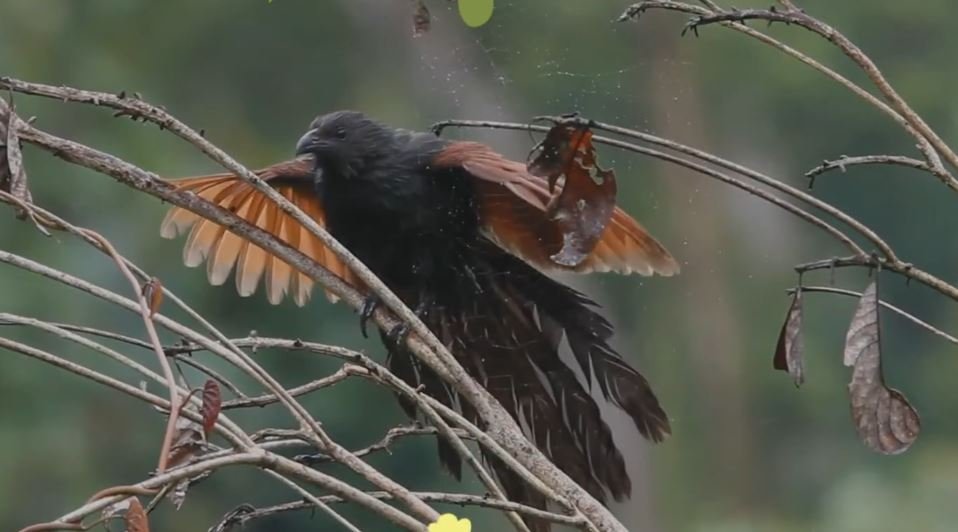
From a conservation perspective, this is where the Philippine coucal becomes truly fascinating. It is not merely a technicality; the IUCN currently classifies it as Least Concern. The species is thought to be common within its range, covering most major island groups from Luzon down through Mindanao, with an estimated extent of occurrence of 711,000 square kilometers.
Batanes, Babuyan, Mindoro, and the major island chains are home to four identified subspecies. Although the precise number of mature individuals has not been officially measured, the population trend seems to be stable. When the bird in question is conspicuously appearing in rice fields, campus vegetation, and mountain foothills without being asked, it’s the kind of data gap that feels less concerning.
The sensory reality of actually seeing one of these birds is something that is easily overlooked when observing the numbers from a distance. The call, whether it’s the slower, descending hollow notes or the short, explosive “jek-wok-wok!” has a quality that seems to belong to a particular light and time of day. Photographers crouching in grass waiting for better light, birdwatchers arriving at a new location before dawn, and field workers in the province all report hearing the coucal before they see it. It’s not shy at all. It just works along the ground instead of perching for admiration, preferring the landscape’s lower register.
There is only one Philippine coucal on the planet. The more pressing tales of critically endangered endemics, such as the Philippine Eagle, the Palawan Peacock-Pheasant, and its much rarer relative, the Black-faced Coucal, often overshadow this fact. However, there is something intriguing about a bird that is completely its own nation without being in danger of going extinct. It falls into the more subdued category of success: widespread, steady, flexible, and subtly vital to the ecosystems it passes through each morning.
