


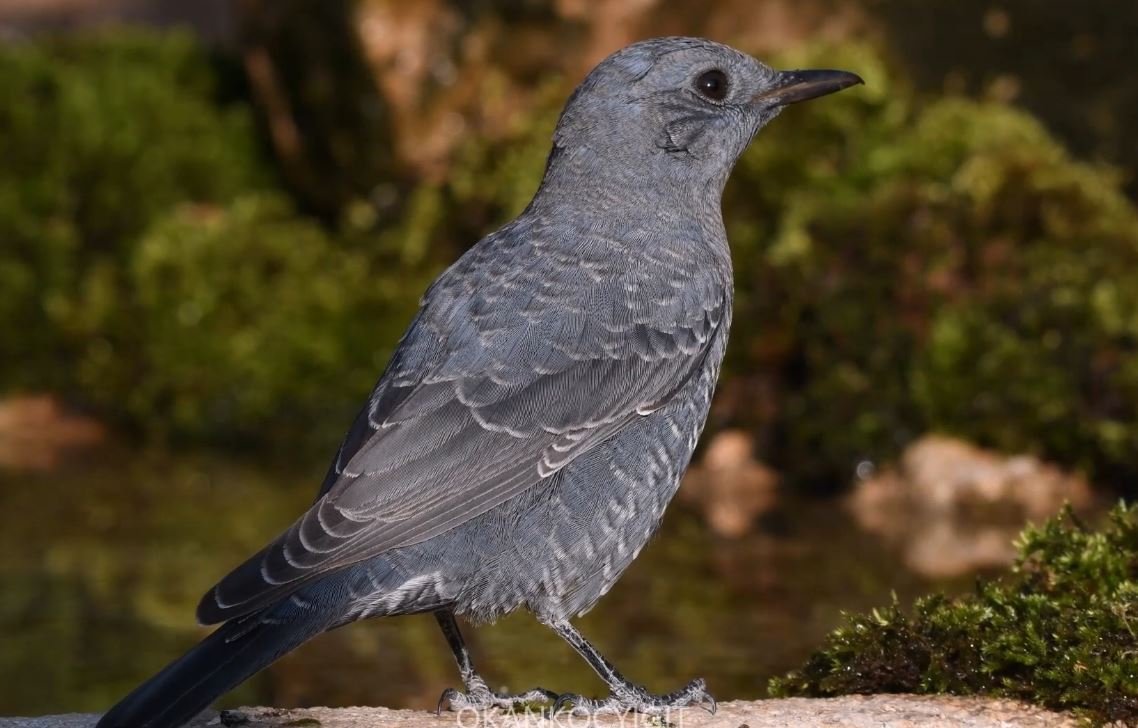
Sometimes, while standing close to the craggy sea headlands of the Mediterranean coast or the limestone cliffs of southern Europe, you notice a flash of deep blue somewhere overhead. Even so. observing. Then it was gone. That’s probably Monticola solitarius, the blue rock thrush, which has a tendency to vanish before you realize what you’re seeing.
You can infer something from the name alone. Monticola translates to “mountain dweller” from Latin. The sign of Solitarius is solitary. It is difficult to disagree with the binomial that Carl Linnaeus assigned it in 1758. This bird prefers rocky coastal outcrops, sheer cliff faces, and exposed crags over crowded or green areas. It usually surveys widely, perches high, and tolerates very little company.
The breeding male of the western subspecies has a different appearance. With the exception of its darker wings, it is all blue-grey, about the size of a starling but thinner, and has a long, thin bill that makes it appear slightly sharp against the rock. It can appear nearly black in low light from a distance, which is likely why casual onlookers ignore it completely. The rufous-chestnut belly of the eastern subspecies, M. s. philippensis, is bolder and more visually striking. In spring 2024, this variation appeared on California’s Farallon Islands, confusing birdwatchers throughout the West Coast who questioned whether it was the same individual seen in Oregon. Most likely it wasn’t. The 1997 sighting in British Columbia is most likely a completely different species of blue rock thrush, which normally only survives five to ten years in the wild.
The range over which the species breeds is nearly impossible. It covers ground like few birds do, including the Himalayas, China, Japan, the Philippines, Malaysia, Northwest Africa, Central Asia, and Southern Europe. While some populations migrate across continents, spending the winter in South and Southeast Asia or sub-Saharan Africa, others remain stationary throughout the year. In a study conducted on Hongdo Island in South Korea over the course of multiple breeding seasons, it was discovered that pairs were claiming territories on average of almost three hectares each, with a strong preference for exposed rocky cliff faces. A telling detail about the birds’ true instincts is that the researchers found that habitat structure was more important to them than food availability.
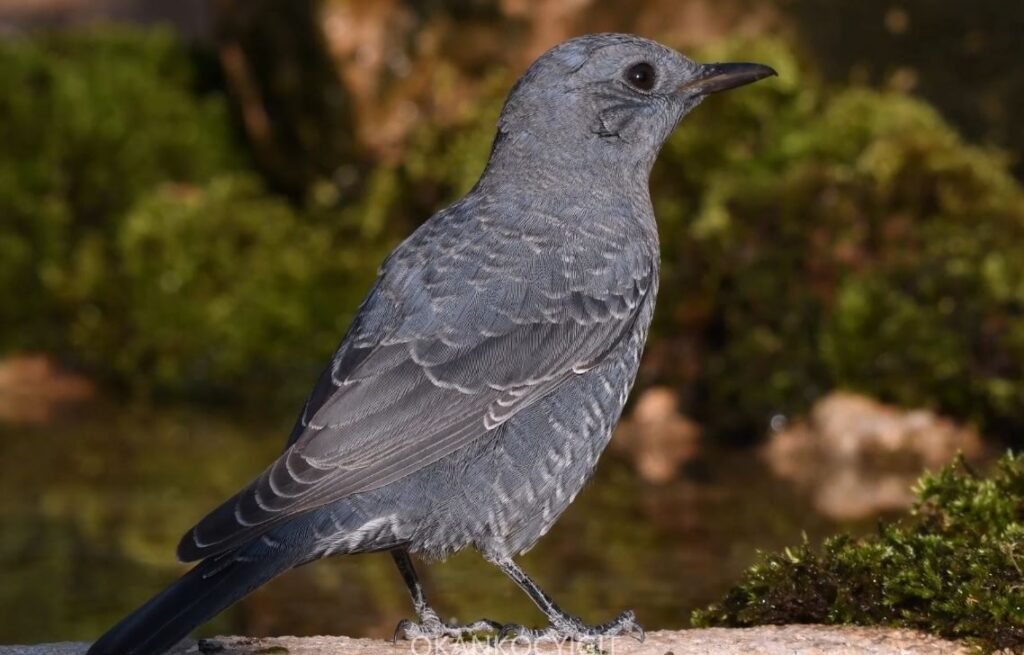
However, Monticola solitarius is not totally dedicated to the wilderness. In El Bouni, Algeria, which is as far away from a steep sea cliff as it gets, researchers recorded a successful urban nest in which a pair built their nest under the roof of a residential building for three consecutive breeding seasons. Pairs have occasionally been observed relocating to cities in Malta. The bird may be more adaptable than its name and reputation imply, but it still appears most comfortable in areas where the closest neighbor is far away and the wind is coming from open water.
Malta has a special bond with this bird. In 1971, the blue rock thrush was designated as the nation’s national bird. It first appeared on the old Lm 1 coins and permeated Maltese culture in ways that went far beyond ornithology, including place names, songs, stamps, and folk expressions. It’s known as the Merill in Maltese. There’s something appropriate about a small island nation using a bird that prefers lonely, high places to sing as its emblem.
It’s worth mentioning the song. Similar to the common rock thrush but louder and fuller, the male blue rock thrush makes a clear, melodic call. Both the long and short songs are composed of trills, whistles, and what one researcher called “burry notes.” Even though the birds migrate across drastically different landscapes, populations in Europe and Asia share enough acoustic overlap that the songs feel connected.
Ornithologists are still unsure about the taxonomy issue. Since 2010, a formal proposal to divide Monticola solitarius into two distinct species—a western group and an eastern one—has been discussed. As of early 2026, interbreeding is the problem. Any clear division is complicated by the five recognized subspecies’ ability to interbreed where their ranges converge. When or if an official consensus will be reached is still unknown.
The bird’s present situation is certain. Its global population is estimated to be between 1.3 and 3 million mature individuals, and the IUCN classifies it as Least Concern. The range is enormous. There isn’t thought to be a significant population decline. For the time being, at least, the blue rock thrush is still exactly what Linnaeus saw it to be: a lone mountain dweller who is comfortable on the edge of things and observes from a height that most other birds don’t bother to climb.
