

Ocean Science · July 2026
When an Orca Rams a Sunfish Hard Enough to Make It Explode
New research from the Gulf of California reveals a behavior nobody had documented before.
Size comparison
Weight in context
A sunfish weighs roughly the same as a mid-size SUV — and an orca weighs nearly three times that.
The moment of impact — click to replay
How the “ram-to-fragment” sequence works
sunfish by the tail
at full speed
mid-body
into pieces
The science behind the explosion
Kinetic force and mass
An orca weighing 3,000–5,000 kg moving at roughly 50 km/h generates enormous kinetic energy (½mv²). When that mass decelerates instantly against a dense bony target, the force transfer is catastrophic. Sunfish have no flexible cartilaginous skeleton — they are heavily bony, which means the energy has nowhere to dissipate gradually.
Sunfish anatomy works against it
Unlike most fish, the mola mola lacks a true tail fin — its back end is a fused structure called a clavus. This gives the holding orca a perfect grip point. The disc-shaped body, while massive, concentrates all impact stress into one plane, making fragmentation more likely than it would be for a longer, more flexible fish.
Cooperative precision
Both orcas coordinated roles — holder and rammer — requiring synchronized timing. Researchers note this level of cooperative precision suggests either learned behavior or culturally transmitted technique within this Gulf of California pod, similar to how different orca populations have developed distinct hunting strategies globally.
Why the fish was already dead
The sunfish was not being killed — it was already dead when found. This means the behavior served either as a food-preparation method (breaking a 2,000 kg carcass into juvenile-friendly bite sizes) or as play. Orcas are documented engaging in non-nutritive object manipulation, and researchers cannot rule out that this was simply fun.
Other known orca behaviors — for context
Wearing dead salmon as hats
Orcas in the northeast Pacific were observed balancing dead salmon on their heads. Purpose: unknown. Scientists consider it play or a transient social fad.
Wave-washing seals off ice
Groups create synchronized waves to destabilize ice floes and knock resting seals into the water — a cooperatively learned hunting technique.
Targeting sailboat rudders
Orcas near the Strait of Gibraltar developed a pattern of ramming and biting boat rudders, disabling vessels. Theories range from play to trauma response.
Extracting great white shark livers
Two orcas named Port and Starboard were documented surgically removing the liver from great white sharks with precise, minimally wasteful technique.
Ram-to-fragment on sunfish
The newly documented behavior. Two orcas use a hold-and-ram technique to shatter a dead sunfish into bite-sized pieces — first time this has been formally recorded.
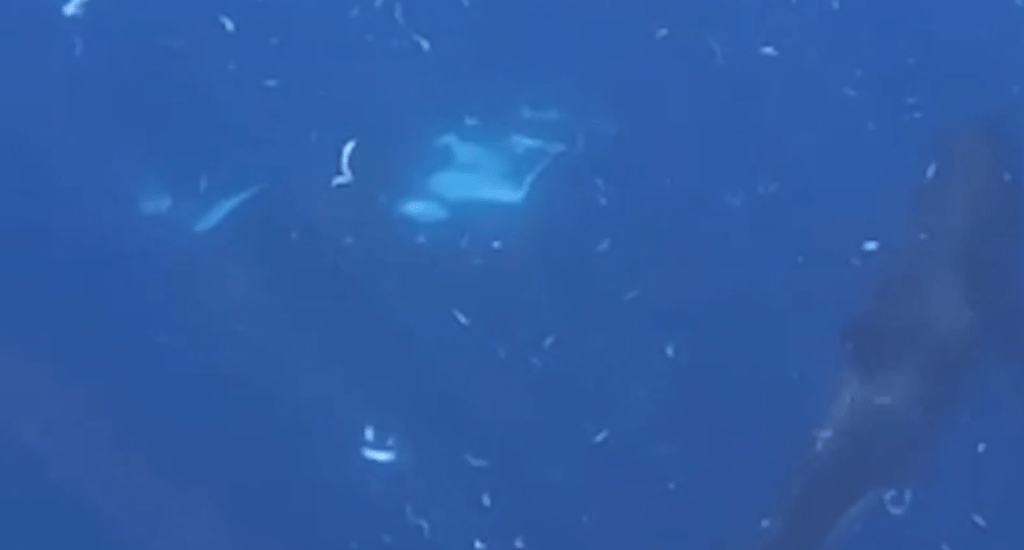
This week, underwater videos have been all over the science news, and it’s hard to forget them. One orca grabs the tail of a big sunfish while a second one speeds up from a distance and slams into the fish with enough force to break it into pieces that can be seen and felt. The sunfish goes off. And even reading that sentence doesn’t fully prepare you for seeing it happen.
Researchers at Beneath The Waves, a U.S.-based nonprofit that works to improve ocean health, took the video and wrote about it in a study that came out Thursday in the journal Frontiers in Ethology. Three separate events took place in 2024 and 2025, both off the coast of Mexico’s Gulf of California. The method being used by researchers is called “ram-to-fragment” behavior, which seems like a nice, scientific name for what is clearly an amazing act of force on a dead fish.
The sharp-tail sunfish, or Masturus lanceolatus, in question was not being chased. When they found it, it was already dead. That detail is important because it changes the whole meaning. It wasn’t a kill. It was something else, but scientists aren’t sure what it was.
Lead author Dr. Kathryn Ayres suggested two options: the orcas could have been playing, or they could have been breaking up the sunfish into smaller pieces so that the younger animals in the pod could eat them more easily. For many people, this is the part that sticks out the most. Ayres said, “Orcas are known to play with their food.” This statement is more important when the food in question weighs up to 2,000 kilograms. To give you some background, sunfish are the heaviest fish with bones in the world. They’re not little. Being reminded of how strong killer whales really are by seeing one break apart when an orca hits it is very moving.
Rebecca Wellard, a scientist at Western Australia’s Curtin University who wasn’t part of the study, seemed impressed even though she wasn’t. “They’re a heavy, bony fish,” she noted, “so it must be some severe ramming.” Not much can be said against that assessment. The video shows that the two adult orcas are very precise when they do what they’re doing—one is holding and the other is charging. This could be because they are using a plan or, at the very least, they have done this move many times before.
It has been known for a long time that orcas do things that aren’t quite clear-cut between hunting, playing, and what you might call culture. Different groups have developed their own techniques that have been passed down from generation to generation. For example, wave-washing is used to knock seals off the ice, strategic beachings off the coast of Argentina are used to catch sea lion pups, and in the northeast Pacific, orcas have been seen wearing dead salmon as hats for reasons that no one has been able to explain. Orcas have been seen going after the rudders of sailing boats in the Strait of Gibraltar. They hunt stingrays off the coast of New Zealand. Because each population seems to come up with its own method, this behavior that kills sunfish in the Gulf of California seems less like a one-off and more like an entry in a catalog of strange things that already exist.
Mark Peter Simmonds of OceanCare made a comparison that seemed to fit surprisingly well. He said it was like a fancy dinner for people, where the roast is carved at the head of the table and talking to each other is just as important as dinner. Frame might be too much of a word. But it has something in it. The way the whales are coordinating in the video—one is holding, one is ramming, and others are probably just hanging out nearby—indicates that this is more than just a feeding situation.
Unfortunately, it’s still not clear if this “ram-to-fragment” method will be used by many orcas or just by this group in the Gulf of California. Every time researchers get new video of orcas acting, it seems like the picture of what these animals are doing outside gets a little less clear. What about the sunfish? The study says that they don’t usually explode. Which, in most situations, would be a good thing to remember.