


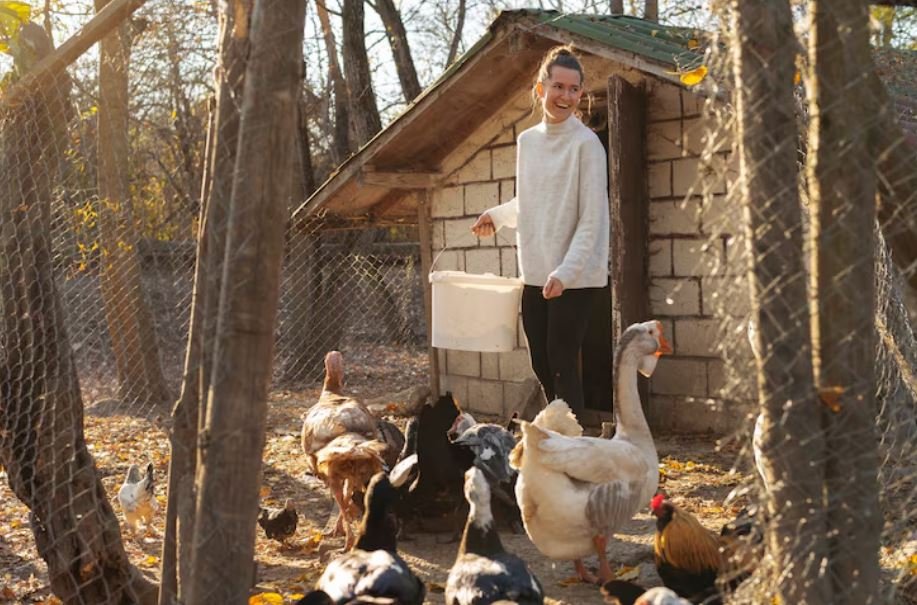
The concept of backyard chickens is genuinely appealing. It sounds like a sensible, even healthful project: a small flock, a well-built coop, and fresh eggs in the morning. And it has been precisely that for many. Over the past ten years, backyard chicken farming has steadily expanded from rural homesteads into neighborhoods where the closest tree line may be forty feet from the property fence in American suburbs and small towns. It turns out that most chicken keepers don’t realize how important that proximity is.
When discussing backyard flocks, people tend to talk about the birds themselves, the coop’s biosecurity, and preventing children’s hands from coming into contact with salmonella.
That’s all real. What happens at the edge, where the backyard meets whatever wild or semi-wild land sits just beyond it, is a more subdued issue that receives far less attention. A creek corridor, a forest, and a green belt. These aren’t enclosed spaces. Through the surrounding neighborhoods, they breathe in and out.
Predators are drawn to coops. Anyone who has raised chickens for more than a season will not be surprised by this. Rats, foxes, fisher cats, raccoons—they locate feed bins, smell birds, and come. What follows is something to consider more carefully. When a raccoon discovers there is food in your yard, it stays on your property. It returns to the forest with a different behavioral pattern, one that is bolder and more used to human surroundings.
Additionally, rats that build colonies close to a poorly maintained coop do not remain neatly contained within the yard. They disturb ground-nesting birds, push into the underbrush, and change small-mammal populations in ways that spread. It’s possible that many chicken keepers have never given this series of events any thought at all—not because they don’t care, but rather because it’s just out of their line of sight.
The other thread here is disease, and it has the most documented weight. Influenza in birds spreads. Different influenza subtypes are carried over great distances by migratory birds and wild waterfowl, and when they come into direct or indirect contact with domestic flocks, the exchange is reciprocal. In the absence of robust biosecurity protocols, a backyard coop could serve as a mixing point. For many years, the University of Minnesota Extension has observed that common worries about backyard chickens include disease vectors that spread far beyond the home.
For example, Mycoplasma gallisepticum damages both wild songbirds and domestic chickens. Due to this pathogen spreading from domestic sources, house finches in particular have experienced severe eye disease at the population level. It is impossible to determine whether any one coop has contributed to that. However, there is a pattern.
All of this does not imply that the pastime is inherently careless. A far lower risk profile is presented by well-managed flocks housed in safe coops with true attention to biosecurity, such as frequent cleaning, protection from wild bird contact, and appropriate feed storage. The coop that isn’t cleaned as frequently as it should be, the feed that is left out overnight, and the wire that develops a gap in the corner are all examples of flocks that begin with good intentions and gradually drift. These issues are not with chickens, but rather with human nature.
Observing the growth of this trend gives the impression that the discourse hasn’t quite kept up with its scope. The overall impact on local predator behavior is negligible when a small number of homes in a neighborhood raise chickens. The effect intensifies when twelve households within a quarter-mile engage in this behavior, which is becoming more widespread in places where zoning permits it. This is not experienced as twelve distinct little coops in the forest next door. It perceives it as a persistent shift in the eating and behavioral environment at its periphery.
Stopping raising chickens is probably not the solution. Instead of treating the coop as a weekend project, it should be treated seriously as infrastructure. Fill in the spaces. Keep the feed in storage. Make the area tidy. Perhaps occasionally glance over the fence and consider what else might be out there.
