


In the Midwest of the United States, if a farmer discovers even one sick bird in a poultry house, the entire flock is immediately and brutally culled. Not only the ill bird. Each and every one. It’s the kind of loss that is difficult to quantify in a spreadsheet: hundreds of thousands of birds, years of hard work, destroyed in a matter of hours. More times than most people realize, H5N1 avian influenza has forced this result on American producers in recent years, subtly raising the cost of eggs and chicken at the grocery store while the general public is still largely ignorant of how precarious the supply chain truly is.
In the US alone, the virus has now impacted about 166 million commercial birds. The fact that H5N1 is living in the wild between outbreaks—moving through migratory flocks of snow geese and other species, traveling thousands of miles each season, and returning each year with the birds—may be even more concerning than that startling figure. The barn door is no longer a major issue. It’s the sky.
This is the reason why the growing discussion about immunizing wild bird populations is both urgent and complex. For many years, vaccinating wildlife was a novel concept that was mostly ignored and only discussed at academic conferences. Then rabies struck. In the 1960s and 1970s, researchers started experimenting with bait-delivered oral vaccines because they were dissatisfied with culling programs that were killing hundreds of thousands of foxes and coyotes to little effect.
It was successful. In order to prevent raccoon rabies, the US Department of Agriculture eventually developed whole aerial distribution programs based on the concept, dispersing vaccine-laced baits throughout Eastern states. In 2007, the canine form of rabies was declared officially eradicated in the United States. That is a proof of concept for something that most people still believe is impossible, not just a small footnote.
It’s important to admit that the bird flu problem is more difficult. Only snow geese breed in the Arctic, and they cover the entire continent in infected migratory corridors as they migrate as far south as Mexico. Widespread vaccination of populations of free-ranging wild birds is deemed unfeasible with current methods, according to a 2023 World Organization for Animal Health report. That is an important disclaimer. The scientific community is no longer viewing this as a purely theoretical endeavor, as evidenced by the same organization’s description of it as an urgent research priority.
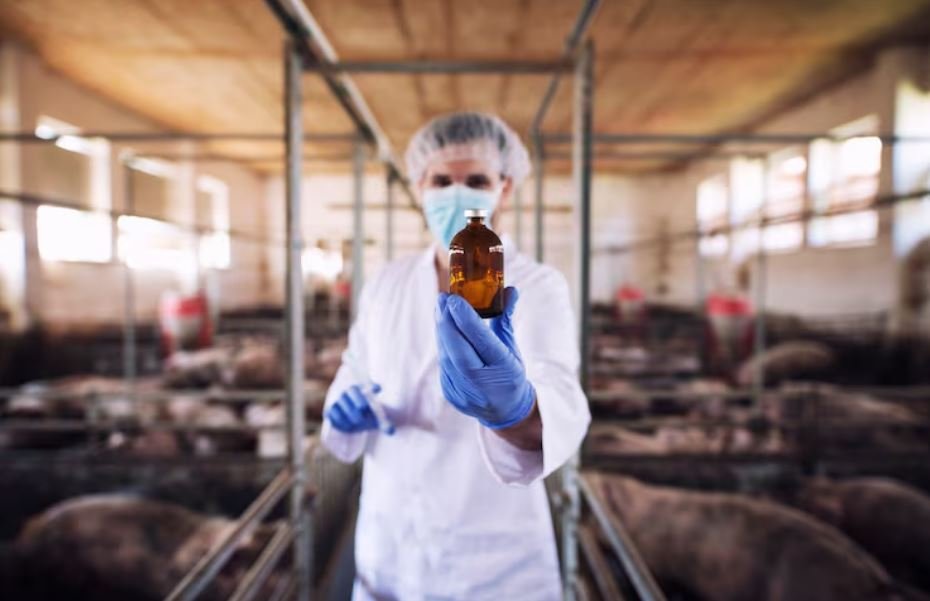
One could legitimately argue that the commercial meat industry has been slow to acknowledge this fact. Biosecurity, which involves keeping wild birds away from commercial flocks through netting, controlled ventilation, and stringent sanitation, has been the standard response to bird flu. No one is arguing that those measures don’t matter.
However, a farmer cannot completely protect a building from a virus that spreads covertly through boots, equipment, and wind-borne particles. At some point, it is more of an act of optimism than a strategy to think that biosecurity alone can stop a pathogen that is circulating in almost 500 wild species worldwide.
Commercial poultry vaccination is already widespread in many nations, and the US has been gradually moving in that direction. Due to worries about the spread of disease from vaccinated but infected animals, some trading partners have restricted the import of vaccinated birds, which has contributed to the hesitancy. It’s a serious problem, but as outbreaks get longer and more destructive, it’s possible that the calculations are changing. A year without eggs is a trade issue in and of itself.
The movement to expand vaccination beyond the barn and into the wild is more recent and truly fascinating. A minor but significant precedent is provided by the California condor, which is endangered. Before vaccinating condors, a population that had recovered from fewer than two dozen individuals in the 1980s, scientists tested an H5N1 vaccine on black vultures. Even though condors receive an unusual level of individual human attention that wouldn’t scale to snow geese, the condor population seems stable for the time being, which is encouraging.
The problem is precisely scaling. Whether any bait-delivery technique could reach enough wild birds over a sufficient geographic area to significantly reduce transmission is still unknown. The cost is real, the logistics are difficult, and the regulatory frameworks are still in their infancy.
This issue cannot be resolved by the meat industry alone. Researchers, wildlife organizations, international cooperation, and likely a good deal of political will—which is currently lacking—will all be necessary. The game is one of waiting. Additionally, the window of opportunity may be closing given how bird flu has changed over the last four years.
