


Anyone who has trained a macro lens on a hummingbird feather will remember a specific moment: the moment the color changes. What was black turns magenta when you tilt the subject by a fraction of a degree. Green flames turned into gold. It now appears to be a material that has not yet been created rather than a bird.
It’s not pigment, and it’s not an accident. At a scale that is invisible to the human eye, physics is at work. The reason hummingbirds are the most colorful family of birds on Earth is not because of what they absorb, but rather because of the way they scatter light through a collection of microscopic structures that scientists have only recently started to fully map. To actually record it on camera, you must first comprehend that.
Melanosomes are the structures in question. These cellular components are comparatively simple and rod-shaped in the majority of birds. They resemble flattened discs in hummingbirds, which researchers frequently describe as pancake-shaped. They are also filled with tiny air pockets.
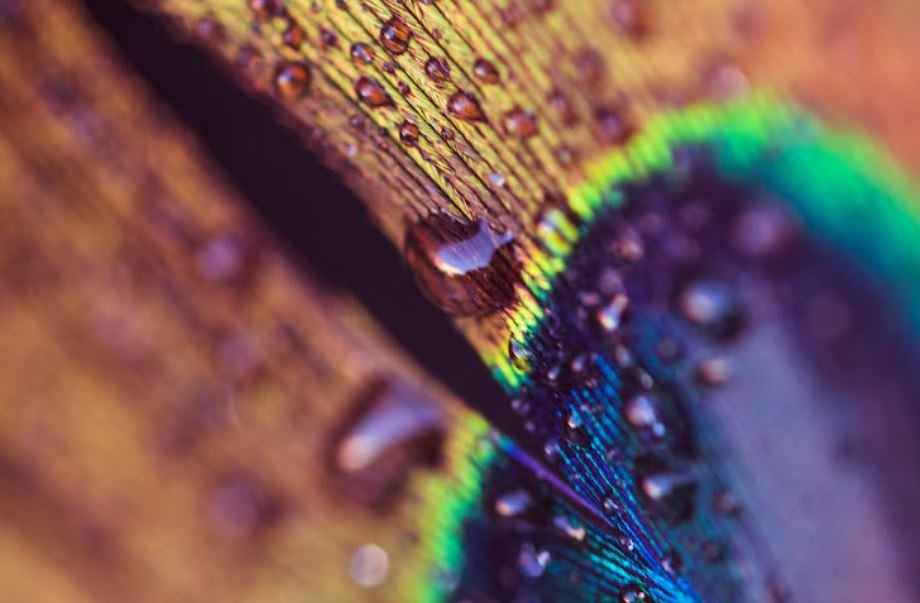
Not only do those pockets reflect light, but they also reroute particular wavelengths based on the angle of incidence, creating interference patterns similar to those produced by oil on water but with far more precise engineering. One feather can contain 100 million of these melanosomes, according to a 2020 study that looked at feathers from 34 different hummingbird species. It’s hard to imagine that number. What they create is easier to visualize: colors that change constantly, colors that are not visible to humans, and colors that can completely disappear in the wrong light.
This presents an intriguing challenge for photographers. In this case, standard wildlife techniques—long telephoto, quick shutter, and soft ambient light—actually work against you. Directional light is necessary for the activation of iridescence. In flat shade, a hummingbird appears lifeless and occasionally nearly black at the throat. The gorget and crown are illuminated by the angled light. The architecture beneath can be seen when a single off-axis light source, whether artificial or natural, is used to shoot macro or semi-macro.
The equation is significantly altered by a 100mm macro lens. Hummingbirds need distance, as most photographers believe, and this is true for behavioral shots. However, you want to be close to the feather detail—that is, the actual texture and surface geometry that produce the color—and you want shallow depth of field to work in your favor rather than against you. Extension tubes or specialized macro setups on molted feathers acquired from banders and researchers have been used by some photographers working in studio settings. The outcomes resemble abstract material science more than bird photography. Prismatic, layered, almost architectural.
The discipline of macro birding seems to be gradually gaining traction. It requires a different kind of patience and occupies a strange space between scientific illustration and nature photography. For a focus stack, a Ruby-throated Hummingbird will not remain motionless. In the field version of this work, one must anticipate movement, bracket your angle instead of your exposure, and accept that most frames won’t show the color at all. Eventually, one will unintentionally catch the gorget in the precise orientation that gives it the appearance of being lit from within.
How much of what hummingbirds exhibit is actually visible to human observers in the field is still unknown. According to research, birds may be able to see ultraviolet wavelengths and other color combinations that humans are unable to perceive. In other words, what we capture on camera is probably only a portion of what is truly occurring. That is a humble thing. Depending on your perspective, it’s also a valid reason to keep trying.
It truly took decades for researchers to unravel the structural complexity of the feather, that tiny, curved, weightless object. Almost every aspect of the conventional approach to wildlife photography must be modified in order to get close enough to capture any of that in a picture. The timing, light, angle, and distance. When it succeeds, however, the result is a record of something that would not otherwise be visible: the hidden geometry that transforms a few grams of bird into what appears to be a living gemstone.
