


Not too long ago, the wetlands surrounding Zapotlán el Grande used to fill every winter with the kind of noise that would stop you in your tracks and just listen. clusters of pink-flushed roseate spoonbills. At dusk, ducks fly low over the surface of the lagoon. In the shallows, storks stood motionless as if they owned the area. Researchers at the Universidad de Guadalajara claim that this period is diminishing, and the causes are more related to decades of cumulative harm to the environment these birds rely on than to chance.
Carlos Palomera García and Jesús Alberto Espinosa, two biologists who have been monitoring this change, describe it as a more subdued and, in some ways, more difficult to deal with than a dramatic single event. Simply put, species are not coming back. The American grebe, which was common during the 1980s and 1990s, is now hardly ever seen. In the vicinity of Zapotlán, the roseate spoonbill has virtually ceased to occur in any significant quantities. To put it simply, Espinosa stated: “There are species that are not coming back.”
According to Palomera, the main issue is water, or rather, its disappearance. The wetlands that migratory birds from the United States and Canada depend on as rest and feeding stops during their yearly journeys south have evaporated due to a protracted drought in western Mexico. Due to insufficient rainfall, the Sayula Lagoon, which normally could support thousands of birds during the winter, was mostly dry this past year. Everything that makes these stops worthwhile, including fish, aquatic insects, and food chains, disappears when the water does.
Many people who live close to these lagoons may have observed the absence without fully understanding its significance. A more peaceful morning. At dawn, fewer birds are rising from the water. When someone with decades of field experience tells you that these seem like minor changes, they actually signify the disintegration of a migration pattern that took thousands of years to establish.
The disruption is being exacerbated by rising temperatures. Before migratory birds arrive, insects are hatching earlier in the season. The food supply has already peaked and begun to decline by the time flocks arrive at their customary wintering grounds in Jalisco. While the timing mismatch is not disastrous in a single year, it gradually reduces reproductive success and survival rates over several seasons, causing populations to decline to a fraction of their former levels.
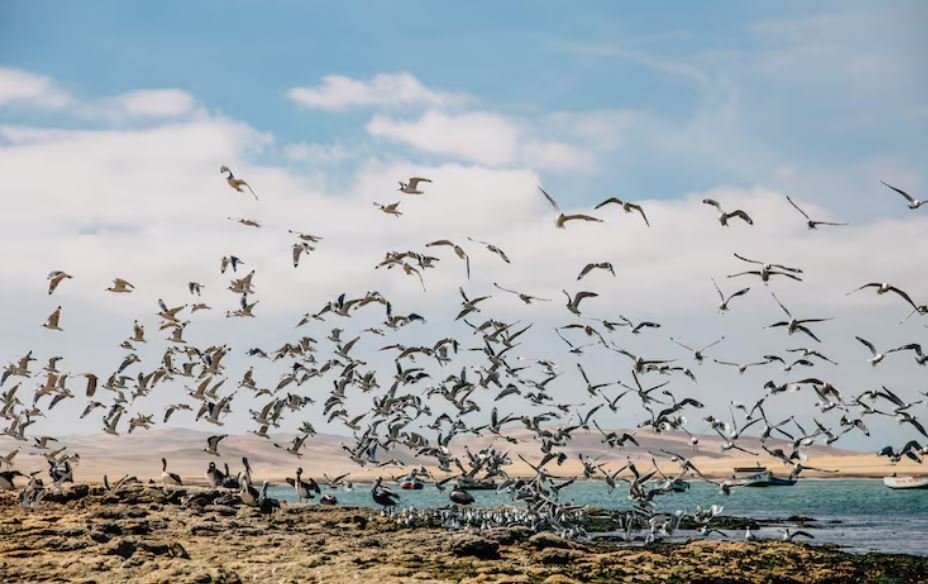
The birds themselves are not the only ones affected. Throughout Jalisco’s agricultural zones, migratory species serve as organic pest controllers, controlling insect populations. They are pollinators. They spread seeds. About 360 families rely on fishing and crafts related to the wetland ecosystem in the Zapotlán Lagoon alone. The economic and ecological ties that link these birds to human livelihoods are real and quantifiable, so when UdeG researchers refer to this as “a silent and growing imbalance,” they are not using metaphors.
Instead of presenting these results in a conference room, Espinosa and Palomera did so at the opening of the “Glimpses of Nature” photo exhibit at the Juan José Arreola State Public Library in Zapopan. It serves as a reminder that, occasionally, art galleries—rather than journal abstracts—are the means by which the public learns of the most pressing scientific warnings. The exhibit is scheduled to run through late February, and it seems that the researchers are hoping that visuals will achieve what data alone has not: a real change in public awareness of what is being lost.
The Jalisco situation is worth closely observing because it is a reflection of something that is occurring on a much larger scale. Significant declines in the amount of bird biomass traveling through the skies each spring have been noted by studies monitoring radar data across North American migration corridors. According to UN estimates, about 44% of migratory species are declining globally. The situation in Western Mexico is not unique. It is one obvious component of a pattern that is getting harder to ignore.
Theoretically, the wetlands can be restored. These birds may be encouraged to return by water management, decreased urban light pollution, and habitat preservation near important lagoons. However, the kind of long-term institutional commitment needed for that work has so far progressed more slowly than the droughts. The Sayula Lagoon is currently silent, and the birds that should be there are either not migrating at all or are somewhere else.
