


Something will eventually cut across the glow if you stand on the 86th floor observation deck of the Empire State Building after dark. It will be swift, intent, and not a pigeon. The silhouette is easily recognized if you know what to look for: long, tapering wings, a narrow tail that spreads out in the middle of a turn, and a controlled arrogance in the way it controls the airspace. It’s a peregrine falcon, and it must be somewhere.
Seeing this take place over one of the world’s most illuminated, crowded cities is subtly amazing. Not precisely because it’s weird. However, it was not feasible sixty years ago. There was not a single peregrine falcon east of the Mississippi River by the middle of the 1960s. They had essentially disappeared from the eastern United States due to chemistry rather than hunting or habitat loss in the traditional sense. The pesticide DDT, which was sprayed on fields of crops until the middle of the 20th century, found its way up the food chain and into the tissues of raptors. Adult falcons were not killed by it. Slower and more thorough, it thinned their eggshells until brooding females crushed their own eggs beneath them by simply settling onto their nests. Entire generations did not hatch. The peregrine had already experienced the quiet that Rachel Carson had foreseen in 1962.
One of the most bizarre periods in American conservation history is the subsequent recovery. The Peregrine Fund was founded in 1970 by a loose coalition of scientists and falconers led by ornithologist Tom Cade at Cornell University.
After DDT was outlawed in 1972, they started releasing fledglings into the wild after breeding falcons in captivity using birds from Chile, Scotland, British Columbia, Alaska, Australia, and any other location where viable specimens could be found. The work was not glamorous. During the winters in upstate New York, early employes lived illegally in the breeding barn, cooking on hot plates, taking garden hose baths, and remaining near birds that required constant care. From just three fertile pairs, they had raised 21 young by 1973. They knew it could work at that point, according to Cade later.
Where the birds would finally decide to settle was something no one could fully predict. At first, the Peregrine Fund focused on wild habitat, such as the rocky cliffs of the Adirondacks and Acadia, where peregrines had lived for centuries. A few birds did make their way back there. However, a startling number went in a completely different direction. New York City was discovered.
Even tho it still seems counterintuitive, it makes some ecological sense. Cliff nesters by nature, peregrine falcons are attracted to high, exposed ledges with dependable wind and clear sightlines. All of that is available in a Manhattan skyscraper, along with something that a natural cliff seldom offers: an almost limitless supply of starlings and pigeons within easy striking distance. The city did more than just host the falcons. It provided them with better sustenance than the wilderness could.
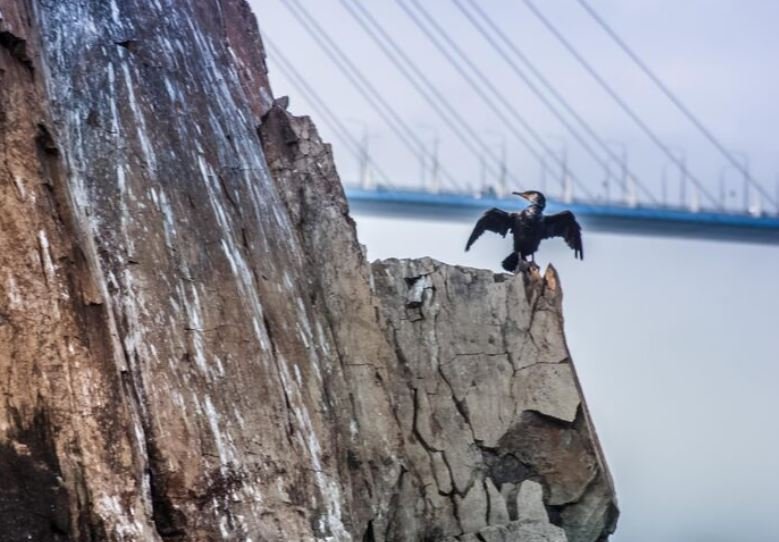
One of the world’s densest populations of urban peregrines is currently found in New York. There have been reports of at least 25 breeding pairs nesting all over the city, including on hospital roofs, bridge towers, church ledges, and towers with views of Park Avenue.
They have been tracked for years by researchers and wildlife filmmakers. Scientist Christopher Nadareski of the New York State Department of Conservation has fitted more bands on peregrine chicks than he can likely count. In the process, he has had several body parts signed by the talons of protective mothers, he said with a hint of humor. A pair has been known to make more than 100 hunting attempts in a single season at the Empire State Building, with significant success. They hunt at nite, using the building’s lights’ upward wash to create silhouettes of migratory songbirds flying overhead.
It’s difficult to explain what it’s like to watch a peregrine stoop—that dedicated, almost vertical dive it makes when pursuing prey—without coming across as exaggerated. They can reach speeds of over 200 miles per hour when they fold their wings tightly against their bodies and fall. Football teams and fighter jets have appropriated the name for a reason. In a split second, the hunting is over: a talon and pigeon collide in midair, the bird flips quickly, and the prey is taken away before most onlookers have had time to comprehend what just transpired.
The extinction-level collapse, the improvised breeding barns, the global search for surviving birds, and the years of releases into a landscape that had no memory of them are all difficult to ignore. The peregrines did not return to the cliffs. They returned to the cities, and they appear to be quite happy with the arrangement. As it happens, Manhattan has always been a suitable location for an apex predator. Before they could prove it, the falcons just needed someone to give them another chance.
