


Ornithologist Simon Hugheston-Roberts was walking the shoreline at Y Foryd, a tidal bay close to Caernarfon in North Wales, on a calm Saturday morning in early June. He was carrying out the kind of routine bird count that most people never give much thought to. Then he noticed something. A tiny, black heron. Low above the coast. Moving in a way that was a little strange, a little strange.
He came to a halt. looked more closely. Silently, he realized that what he was witnessing had never been documented in Britain.
About three hundred people had reached Caernarfon by the afternoon. The bird was a Western Reef Heron, or Egretta gularis as it is scientifically known. This species’ natural range extends from West Africa to the Indian subcontinent. Wales is not the right place for it. Wales has never been the right place for it. And yet there it was, seemingly unfazed by the increasing number of people holding binoculars to their faces, feeding peacefully among the boats in Caernarfon harbor, with the town’s medieval castle towering in the distance.
Hugheston-Roberts, who has spent time birdwatching throughout Africa and the Middle East and has decades of field experience, talked about going through a meticulous process of elimination before he was certain. He got a direct size comparison when a small egret landed close by. That supported what his instincts had already told him. He informed a group on WhatsApp about birdwatching. Word spread quickly, as it only does when something truly exceptional occurs.
In a way, contemporary twitching, which is the British term for traveling expressly to see a rare bird, functions as a highly specialized yet highly effective emergency response network. In a matter of hours, people were traveling by car from Essex, London, and other parts of England and Wales.
It was a long drive, but worth every mile, according to Ian Lycett, who traveled up from London on Sunday morning. He pointed out that the heron provided up-close, unobstructed views while feeding close to the harbor walls, with Caernarfon Castle serving as a backdrop that most wildlife photographers could only imagine.
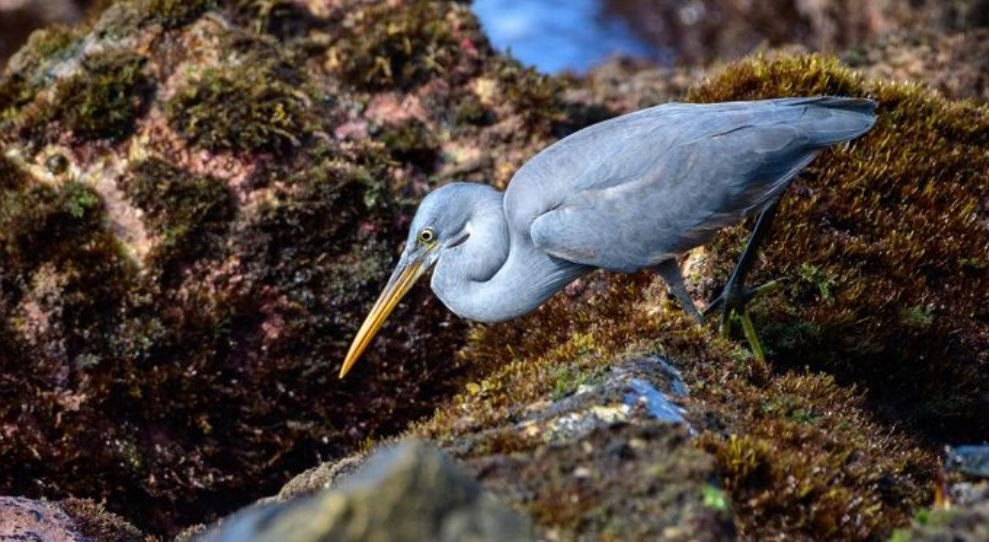
Richard Partis, an artist and ornithologist, had been following the heron for almost twelve hours when he saw it close to the Anglesey Wall with a sketchbook in hand. Partis acknowledged that it was difficult to capture the heron’s long neck because it kept tucking it into its feathers. He also observed the crowd: they were courteous, patient, and kept their distance. He said that some tourists had already made plans to drive to Orkney, where there had been reports of another rare bird. One rarity seems to inevitably lead to another for serious twitchers.
The first-ever British record of the species was confirmed by naturalist and broadcaster Iolo Williams, who was filming for Springwatch at the time. He thinks the heron was probably driven out to sea by warm, southerly winds before it drifted north along the European coast. In 2026, Western Reef Heron sightings were reported unusually far north in France, close to La Rochelle, suggesting that the bird may have already been traveling through Spain or France. In late May, one had even been discovered in Galicia. In hindsight, the direction of travel made some sense.
There are more nuanced answers to the question of whether climate change is to blame. Williams himself refrained from drawing that link, emphasizing that birds have always been blown off course for a variety of reasons. A more comprehensive perspective, however, was provided by Nick Moran of the British Trust for Ornithology: species that previously couldn’t withstand the cold are now able to survive in Britain thanks to milder winters. There is no longer any regular freezing of shallow water bodies. For wading birds like egrets and herons, that is important. It’s not overly dramatic. It’s merely a quiet, gradual change in what’s feasible.
For its part, Caernarfon accepted the whole situation. For a brief period, a small Welsh town became the epicenter of birdwatching, and the bird itself appeared completely unconcerned. It nourished. It took up residence. It passed over the castle at a low altitude. As the tides changed, it moved between Foryd Bay and the harbor, attracting its audience wherever it went.
Moran took care not to exaggerate the situation. By the following year, he does not anticipate dozens of Western Reef Heron records in Britain. However, he believes there will be more. It’s difficult to disagree.
