


If you spend enough time standing close to any working port, you will begin to notice things. The diesel odor. Cranes’ low mechanical hum. And the birds, or where they once were, if you look up. Some sections of the coast that were formerly teeming with shearwaters and storm-petrel colonies are strangely silent now. It’s not overly dramatic. It doesn’t garner media attention. However, it’s the kind of silence that is hard to ignore once you notice it.
The magnitude of the seabird decline, which has been going on for decades, is truly unsettling. Between 1950 and 2010, the global population under observation decreased by about 70%. That figure, which is derived from WWF research on marine birds, usually lands with the weight you’d expect for a short while before people move on to the next environmental statistic. However, comparatively little attention has been paid to what that number might mean operationally in the shipping and maritime trade industry, where vast resources are spent modeling weather systems, charting sea routes, and forecasting fuel costs.
Seabirds are unique in that they are not limited to the ocean. They serve as a living index of sorts. Seabirds are officially recognized as Essential Ocean Variables by the Global Ocean Observing System, which is supported by UNESCO and other international organizations. That language isn’t poetic. This indicates that these birds are accepted scientific tools for assessing the condition of marine ecosystems. When their numbers decline, they send a signal that the ocean’s fundamental conditions—such as the availability of prey, the stability of the water’s temperature, and the structure of the food web—are changing in ways that are sometimes difficult for instruments to detect fast enough.
These conditions are a prerequisite for shipping. The ocean that supports the marine trade must be biologically stable, reasonably predictable, and free from the cascading disruptions that occur after ecosystem collapse. The ecological fabric encompasses fisheries, coastal economies, and industries near ports. The declines in seabird populations caused by pollution, fishing net bycatch, and climate change are not limited to bird populations. They indicate a pressured marine environment, which is not a stable operating environment for international trade.
The fact that shipping itself adds to the issue is particularly ironic. The effects of ship traffic on seabirds are still poorly understood, which is a problem in and of itself, according to research published through ResearchGate. Large ships’ underwater noise interferes with prey behavior and marine communication.
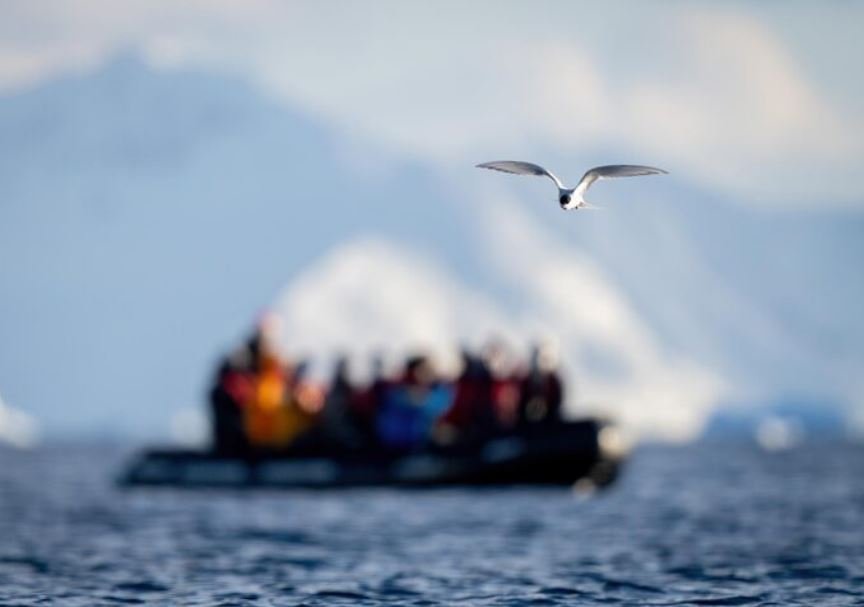
Nocturnal seabirds are drawn off course by artificial lighting on offshore platforms and industrial coastal facilities; a 2024 study discovered that lowering lighting at a seafood processing facility close to one of the biggest storm-petrel colonies in the world reduced strandings by more than 57% in a single season. The birds were literally crashing into the commercial margins.
One of the most enduring threats to seabird populations worldwide is bycatch in fishing gear. Through targeted mitigation, some fisheries have already reduced seabird bycatch by 80%. Some have not moved at all. Because seabirds breed slowly—many raise a single chick every year or two—population recovery from even minor pressures takes longer than most industries anticipate. Complacency is not favored by the math.
It’s possible that the shipping and maritime industry has just ignored the health of seabirds, viewing them as a conservation issue rather than an operational one. It seems harder and harder to defend that framing. Reduced coastal seabird populations are more indicative of systems than sentiment when it comes to the marine trade. These birds are actually measuring something. Data is their absence. Additionally, the data indicates that the ocean, which is essential to international trade, is currently under stress in ways that are quick to regret and difficult to reverse.
There is a perception that the industry is at a point where accountability and monitoring regarding the health of marine ecosystems may become required rather than optional. This is due in part to regulations and in part to the kind of long-term risk analysis that sophisticated logistics operators are starting to take seriously. Offshore permitting is beginning to incorporate biodiversity monitoring frameworks. Ecological data is becoming more and more necessary for environmental impact assessments. In one way or another, the birds are being counted.
It is genuinely unclear whether that counting has any real implications for shipping routes, port operations, or how the industry interacts with the coastal ecosystems it passes through. However, compared to earlier times, the coastlines are now quieter. That is not insignificant.
