


Every few hundred meters along Putah Creek in Yolo County, west of Davis, nestboxes are affixed to orchard trees and fence posts. Every week, volunteers measure the chicks, count the eggs, and record the dates. Since 2000, this meticulous and patient work has been ongoing. Researchers are now learning something they didn’t fully anticipate from the data those boxes generated.
Birds are arriving early. Not a couple of days. In certain instances, they are almost a month ahead of where the historical record indicates they ought to be. Even though it seems insignificant, that change has a significant impact on how well those birds raise their young.
Four cavity-nesting species—western bluebirds, house wrens, tree swallows, and ash-throated flycatchers—are being impacted by shifting precipitation and temperature patterns, according to a UC Davis study published in January 2023 in the journal Biological Conservation. The study used eleven years of nesting data from the Putah Creek Nestbox Highway. The results of more than 2,300 nesting attempts and more than 7,100 nestlings were not promising.
In house wrens, tree swallows, and western bluebirds, wetter nesting conditions resulted in lighter nestlings and reduced reproductive success. All four species experienced a similar dampening effect at higher temperatures. According to lead author Jason Riggio, a postdoctoral scholar at the UC Davis Museum of Wildlife and Fish Biology, “across these results, it appears the effects of climate change in California’s Central Valley are likely to have broad and mostly negative impacts on cavity-nesting songbird reproduction.”
Birds breeding earlier isn’t the only issue. The spring itself is now a moving target. Warmer years cause plants to bud earlier, insects to appear earlier, and the limited window of mild weather that birds have traditionally depended on begins to change in ways that don’t always match what the birds are doing. Numerous species, such as bluejays, yellow warblers, and field sparrows, are now laying their first eggs about 25 days earlier than they were a century ago, according to a different study from the Field Museum in Chicago that used egg collections dating back to the 1880s. That’s a startling figure that closely corresponds with increasing atmospheric carbon dioxide concentrations.
The seasonal nature of California’s Mediterranean climate makes the situation in the Sacramento Valley especially delicate. Here, spring has always been a fleeting sweet spot that is both cool enough to avoid the intense heat that sets in by midsummer and warm enough for nesting.
According to climate models, the window is being squeezed from both sides. Maximum temperatures could rise by more than five degrees Fahrenheit by 2100, and rainfall is predicted to continue into the February–April breeding season. Those are not abstract projections for birds that are already operating close to their thermal limits.
However, there is some subtlety that is worth clinging to. In the orchards next to Putah Creek, western bluebirds and tree swallows were found to be doing fairly well, on par with birds nesting in natural riparian habitat. Ecologists didn’t initially anticipate that. Orchards were thought to serve as ecological traps, which are places that draw birds but are unable to sustain their reproduction. That hasn’t proven true for these two species thus far, at least not conclusively.
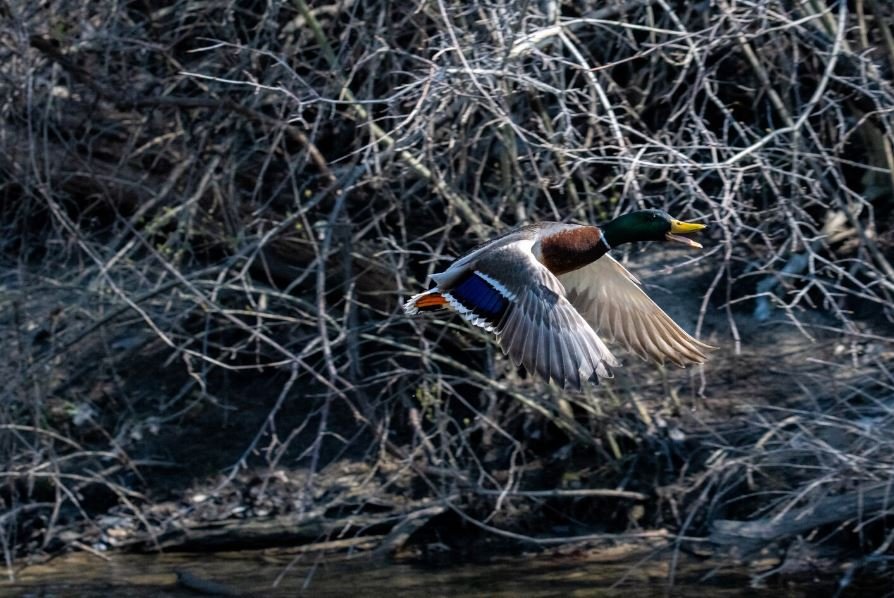
The Nestbox Highway initiative started out as a conservation test. As a graduate student in 2000, Melanie Truan—now a research ecologist at the UC Davis Museum of Wildlife and Fish Biology—installed the first hundred boxes, in part to restore western bluebirds to a section of creek where they had virtually disappeared.
One family of bluebirds moved in during that first season. Currently, hundreds of bluebirds and several other species visit the area thanks to more than 200 boxes. What began as a restoration effort has quietly evolved into one of the Central Valley’s more valuable long-term ecological datasets.
It’s difficult to ignore the disparity between how quickly these changes are occurring and how slowly the larger discourse typically progresses. Every year, birds change the way they behave. The information is growing. Whether these early-breeding changes are a sustainable adaptation or merely a delay before the costs become unmanageable is still genuinely unknown.
