


Inside a photography blind, there’s a certain silence. It’s not the cozy quiet of an empty room or a stroll through the forest, but something more demanding—a quiet you have to keep, sometimes for hours, sometimes for days. Without fully extending your arms, you can touch the tent’s fabric on both sides. Outside, the light changes. The birds never show up. You wait.
This is something that most people will never encounter. Most people wouldn’t decide to. However, living in the blind is just the approach for a small, strangely committed group of wildlife photographers. The only one that functions.
The idea itself is incredibly straightforward. A blind is a small, low-profile tent that is placed in or close to the animal’s habitat that the photographer is attempting to photograph. The fabric’s construction, which utilizes the difference in light intensity between indoor and outdoor spaces to produce one-way visibility, consists of a dark inner layer and a reflective outer surface.
The surface of the tent reflects its surroundings from the outside. The wolf, the nesting crane, and the elk all fail to notice a human. Everything is visible to the photographer from within through a mesh panel that appears to be almost transparent. It’s a cunning physics trick. However, it demands more brutality and less cunning from its user.
This type of photographer describes a process that starts weeks before the shutter is even pressed. In order for animals to become accustomed to the blind’s presence and not associate it with human intrusion, the blind itself must first be introduced to the landscape gradually, moving closer to the subject over the course of days or even weeks. A blind person can be moved three feet closer every other day, according to some photographers. Some people talk about setting up a makeshift tent next to a nest for a whole season before ever entering it. More important than the photographer’s schedule is the comfort of the animal.
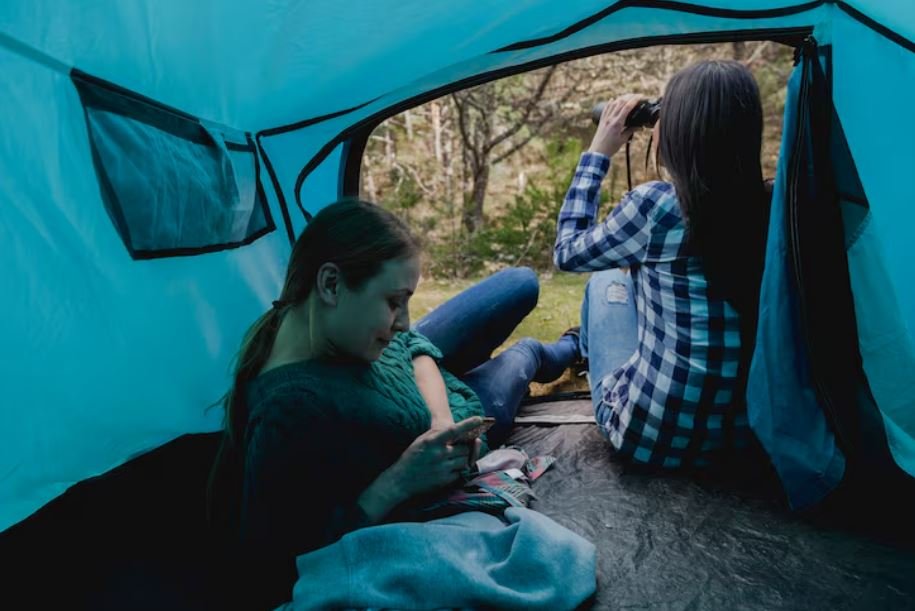
The rules are harsh once you’re inside. No abrupt motion. No overpowering smell—that is, no coffee, occasionally no deodorant, and occasionally a particular type of soap applied days in advance. Most people don’t realize how sound travels through still air and across open water until they’re sitting in a three-foot-wide tent and trying not to sneeze. A riverbank can be emptied in a matter of seconds by a single incorrect weight shift. Weeks of tolerance are gone.
The phrase “weeks of patience” is worth pausing over because, like all extreme dedication, it eventually becomes romanticized. The actual situation is more tiresome. Photographers who have worked in blinds for extended periods of time describe waking up at four in the morning, making their way through the dark to get to the spot before any light disturbs the animals, and then spending eight, ten, or twelve hours sitting mostly still. Food preparation is meticulous. There is a level of logistics involved in bathroom arrangements that is not covered in the final gallery article. The real circumstances behind photos that appear effortless on magazine covers include chilly nights in early spring or the unique suffering of a hide that has been sitting in July sun.
The pictures that result from this process have a well-known quality. Something that sets them apart from distant photos taken with a long lens from a platform or a car window. The animals start acting as though there are no humans at all when a photographer has spent enough time in the habitat. At four feet, a fox passes by. A heron lands in the blind person’s arm’s reach. Not because the photographer was fortunate, but rather because they earned the animal’s apathy, the resulting photos have an intimacy that is nearly impossible to create in any other way. It’s a subtle but important distinction.
This type of photography can be distinguished from something more akin to obsession, though it’s not always easy to do so. It appears that those who perform this work recognize that waiting is part of the job and not a hindrance. Just one frame. three weeks later. For them, that is a fair deal.
If all goes according to plan, a single image emerges from the tent. Silent. Exact. It was alive in a way that reflected the degree of stillness necessary for its existence.
