


Observing a wall rise through a forest has a subtly ridiculous quality. The trees remain stationary. The bison are unable to comprehend it. However, the repercussions are very real, both for the animals and ultimately for us.
One of the more striking recent examples of what happens when political and ecological crises collide is Poland’s border wall through the Błowieża Forest. The 186-kilometer steel barrier, which was constructed to prevent human migrants from crossing the Polish-Belarusian border, passes directly through one of Europe’s last remaining ancient forests, where wolves, lynx, and European bison have been free to roam for centuries. A 37-square-kilometer strip of land between two fences ended up trapping some animals. Others were unable to relocate eastward as they once could, and this is more significant than it may seem. Up to 700 square kilometers can be covered by lynx territories. The forest’s Polish portion is insufficiently large. Inbreeding is a concern for researchers. Then famine. Local extinction comes next.
Ironically, there were discussions about further border openings prior to the current migration crisis, particularly to allow bison to travel freely between nations. Now buried under geopolitics, that possibility has vanished. Both sides’ scientific institutions have been told to sever ties. One Polish researcher told a journalist, “It’s very difficult,” which may be the most understated way to describe the situation.
This is not a problem specific to Europe. Really, it’s hardly even a border issue. When animals that have evolved over millions of years to follow water, grass, weather, and instinct collide with the infrastructure of contemporary human civilization, this is what occurs everywhere. Agricultural pressure is causing the Serengeti-Mara ecosystem, one of the world’s greatest wildlife spectacles, to fragment. Roughly 100,000 wildebeest are thought to have vanished from Kenya’s Loita Plains over the past 40 years due to the conversion of rangeland into cropland rather than poaching. The migration path just got smaller.
According to WWF data, infrastructure and land-use change have already destroyed almost 70% of Kenya’s wildlife corridors in East Africa. Pollution and changing water levels are interfering with flamingoes’ ability to travel freely between Tanzania’s Lake Natron and Kenya’s Rift Valley lakes. In Kenya, forest elephants follow paths that have been used for generations to travel between mountain ranges and national parks, but these paths are now obstructed by roads and private property lines. Elephants do not quietly vanish when those corridors close. They invade farms. Conflict escalates. The animals continue to lose.
Nearly half of all migratory species officially recognized as requiring international protection have declining populations, according to a UN report from early 2024 that receives insufficient attention. For many years, the Convention on Migratory Species has been coordinating conservation policies in dozens of nations. However, it does not include the United States, China, Russia, and Canada, four nations whose territory encompasses extensive migration corridors. That’s a big disparity, and it’s difficult not to interpret it as a kind of collective shrug toward an issue that doesn’t neatly fit into trade talks or election cycles.
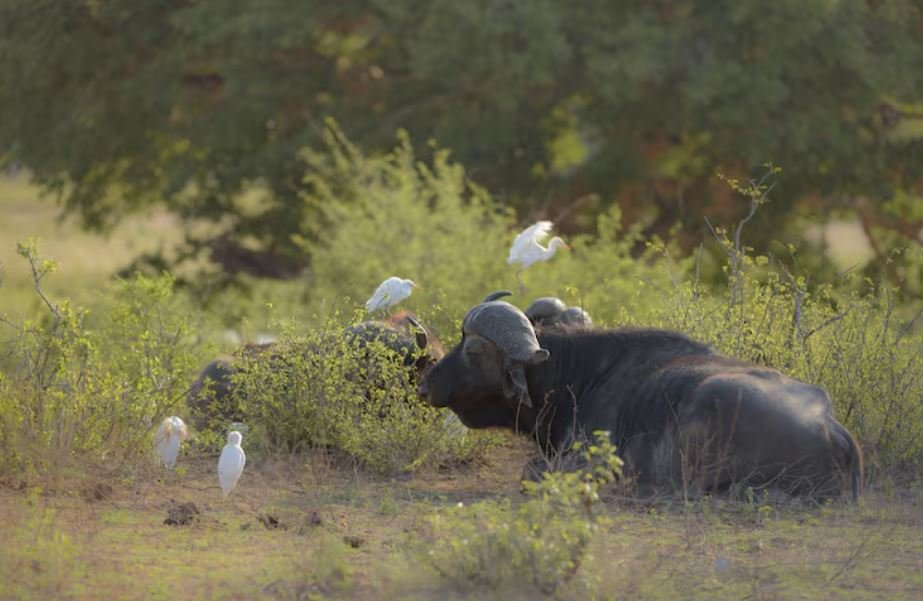
There are also more subdued challenges that go unreported. Along major flyways, migratory birds are electrocuted by power lines in nearly every country. Less than 250 great Indian bustards remain in the wild, and collisions with overhead cables are contributing to their extinction. The margins, transitional zones, and corridors between protected areas that animals actually use are being consumed by agricultural expansion. Furthermore, these ancient routes are starting to diverge from the food sources they were designed to reach due to climate change. The grass isn’t yet there when animals arrive. Or it has already vanished.
It’s worth taking a moment to consider that. These migrations are not picturesque occurrences. They are ecosystems’ load-bearing structures. Wildebeest are not acting for the cameras when they cross the Mara. They are forming vegetation, transferring nutrients, and establishing environments that sustain hundreds of other species. When that ceases, a structural failure occurs, first gradually and then suddenly.
Animals on the move don’t give a damn about trade disputes, territorial disputes, or which government is currently in control of a given area. Water, food, and genetic ties to other members of their kind are important to them in the most biological sense of the word. For a species whose migration routes predate most human civilizations, the boundaries we have drawn over the past few centuries are meaningless. Before the silence on the plains lasts forever, it’s still unclear if enough nations are prepared to address that as the issue it truly is.
