


The figures initially appeared to be encouraging. For years now, bald eagles have been making their way back to Minnesota in increasing numbers. They are nesting along the Mississippi, visiting suburban lakes, and attracting attention at wildlife refuges where they were previously unseen for years. Minnesotans have witnessed one of the most amazing conservation tales in recent American history—the recovery of Haliaeetus leucocephalus—in their own backyards. However, the employees at the University of Minnesota Raptor Center in St. Paul weren’t having a good time. They were becoming increasingly busy, which alarmed them.
Operating out of a small building on Fitch Avenue, the Raptor Center admits between 150 and 190 bald eagles annually, more than nearly any other similar organization in the nation. You can tell something from that volume alone. Even as the number of birds in the wild increases, the birds continue to arrive injured, poisoned, confused, or dead. When most people hear the phrase “bald eagle recovery,” they envision a successful tale with a neat conclusion. It’s more complicated than that, as those who actually care for these birds are aware.
A recent surge in eagle admissions that appeared to follow a particular pattern—one that consistently pointed, surprisingly, toward waterfowl—was of particular concern. Specifically, migrating geese. Once you know how these birds actually live, the connection isn’t as bizarre as it seems. In Minnesota, bald eagles are opportunistic. Eagles switch to scavenging when fish vanish under winter ice and deer hunting season leaves gut piles all over the place. They go after food. Additionally, eagles follow large groups of migrating geese as they pass through the area, stopping at rivers, reservoirs, and agricultural fields to either hunt down weak birds or consume their carcasses.
Researchers started to suspect that what those geese were carrying was the issue. Waterfowl populations in North America have been experiencing unusual persistence in the spread of avian influenza, specifically H5N1. Canada geese and other migratory birds are effective virus carriers because they frequently show no symptoms while spreading the virus along their flight paths. An eagle is directly exposed when it scavenges a dead or dying goose. Eagles also have a tendency to become ill quickly, in contrast to geese.
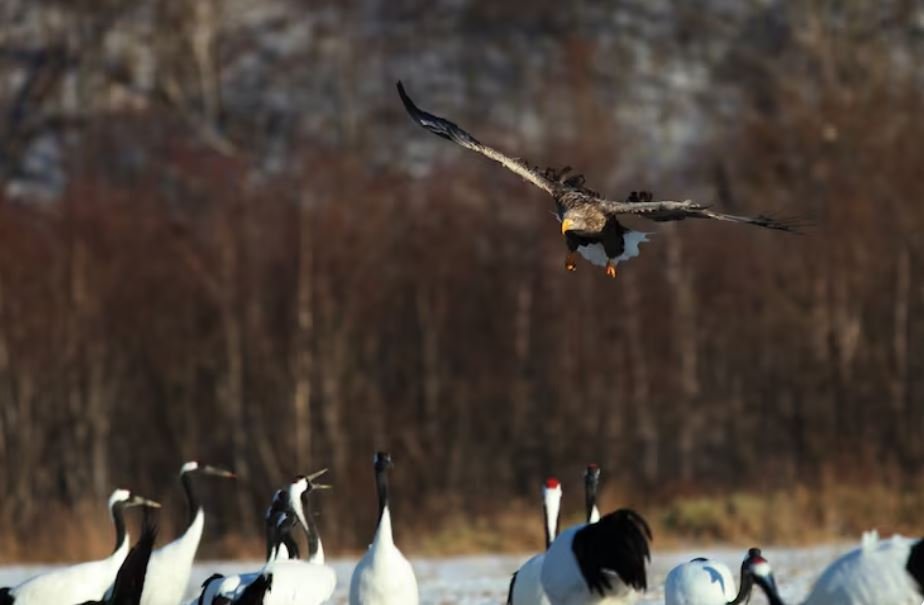
It’s still unclear how many of the recent Minnesota eagle deaths can be directly linked to this pathway as opposed to the older, more well-known killers; lead toxicity is still astounding, with the executive director of the Raptor Center pointing out that 85 to 90 percent of eagles admitted have some degree of lead in their blood. However, the temporal clustering of some admissions, which regularly occur around waterfowl migration windows, has provided researchers with sufficient motivation to investigate further. The employees feel as though they are witnessing the real-time development of a disease warning system, one dead eagle at a time.
Few organizations can claim to be at the nexus of clinical care and ecological surveillance, which is what makes the Raptor Center’s position unique. Each bird that is admitted is a piece of data. Additionally, patterns that may take years for other researchers to notice appear when you’re admitting close to 200 bald eagles annually. Recently, the center started giving rehabilitated juveniles GPS tracking devices. This initiative shows how seriously the team takes the issue of what happens to these birds after they leave the hospital. Where do they end up? What do they consume? Do they make it?
The irony in all of this is difficult to ignore. When the bald eagle was taken off the list of endangered species in 2007, it seemed like the end. Rather, it resembled a checkpoint more. The threats of lead ammunition, car crashes, and habitat pressure persisted. An already precarious situation is becoming even more complicated due to avian flu and the ecological repercussions of mass waterfowl migration.
The Minnesota Eagles have returned. That is accurate. However, the intake records of the Raptor Center indicate that the story is still being written and is not yet wholly optimistic.
