


When a reaction doesn’t work, there’s a specific type of frustration that arises. This type of frustration doesn’t make a big announcement; instead, it quietly takes hold after the third or fourth attempt fails. That frustration took Payal Joshi, a research chemist who spent her days meticulously following protocols and organizing organic reactions, in an unexpected direction: up to a terrace with a camera, watching birds.
It’s difficult to describe what transpired next without coming across as overly metaphorical. However, there have always been instances in science where the solution comes from an unexpected source.
Joshi’s interest in bird photography began quite simply: he was captivated by the stillness and detail of the bird photos that photographers posted on social media. She grabbed a camera. She began to notice details, such as the precise curve of a wing, the texture surrounding an eye, or the way a bird held its body motionless before making an abrupt, precise movement. It was an observational discipline that was somewhat similar to laboratory work. Be cautious, patient, and wait for the ideal opportunity.
The egret then appeared. On a typical evening, she was taking a step back from an unsolvable problem when she saw a white-winged bird glide in and start methodically gathering twigs, bending and breaking each one with a kind of deliberate grace. She was hit by the neck’s movement and arcing sweep. It resembled the coordinated mechanism of a Diels-Alder reaction, she thought. She took a picture of it. She returned to her desk. She also knew what to try next for the first time in days.
It may sound like a leap. However, the brain doesn’t always unlock itself with more effort, as anyone who has spent time delving deeply into a technical issue will attest. Sometimes a different kind of seeing is required.
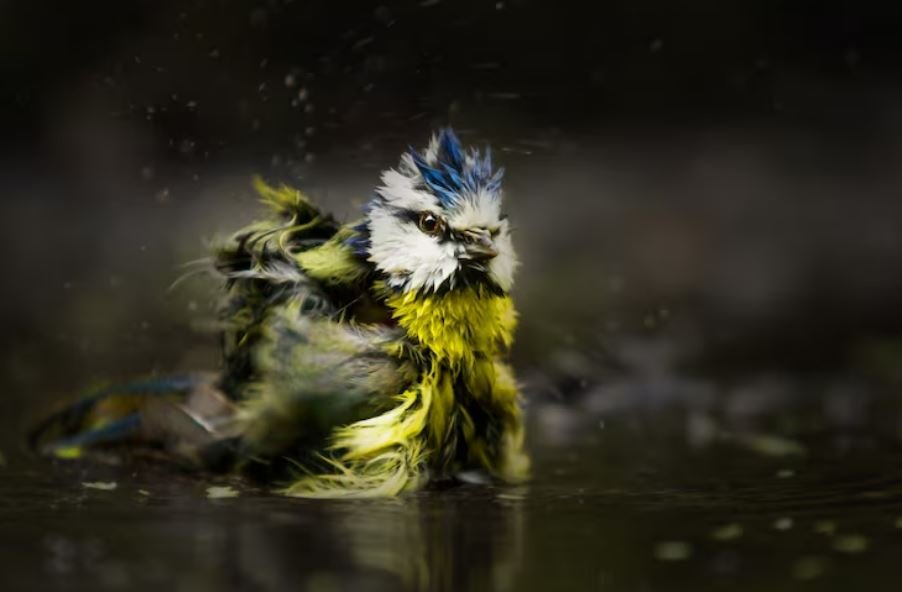
From then on, Joshi started mapping the visual world of birds onto the conceptual world of chemistry—not as ornamentation or diversion, but as a real tool for thought. In the elevated crest of a Javan Myna, she observed chiral centers.
Similar to how OH or NH2 groups change the distribution of electrons throughout an aromatic ring, she discovered functional group substitution effects in the white occipital plumes of a black-crowned night heron. She was reminded of conjugated pi-systems, the type present in organic pigments and azo dyes, by the bright plumage of blue-and-yellow macaws.
It’s possible that what she found was a new method of accessing what she already knew rather than a novel approach to chemistry. There were always patterns. She had the visual patience to see them thanks to bird photography.
This is a larger theme that is worth pursuing. For more than a century, photography has influenced how scientists study the natural world. Photographs were used by early ornithologists not only as documentation but also as arguments for conservation, behavior understanding, and raising public awareness of species that most people would never see in person. A different kind of attention was compelled by the camera: slow, framed, deliberate. Scholars such as Dr. Karla McManus of the University of Regina have examined how the practice of ornithology itself was altered by these archival photos, moving the field away from the study of dead specimens and toward the documentation of living animals in context.
Joshi’s experience is not all that dissimilar from that transition—from the preserved to the present, from the controlled environment to the field. There is a great deal of control in the lab. Whether on a rooftop terrace or the edge of a forest, the field offers something different: movement, unpredictability, and the kind of complexity that is difficult to quantify.
As this develops, it’s difficult to ignore how infrequently scientists are encouraged to look outside of their field for solutions. There is no clear overlap between chemistry and ornithology. However, both are responsible for the practice of careful observation and the readiness to wait for a problem to change.
Using programs like ChemSketch, Joshi started fusing her bird photos with chemical structures, making the connection tangible and visual rather than merely intuitive. It didn’t coexist with her science as a hobby. It started to permeate her thoughts.
There isn’t a clear lesson to take away from this, nor is there a neat formula for innovative problem-solving. However, there is a persistent quality to this tale. A chemist takes a camera outside. A bird has a specific gait. There is a reaction mechanism. It’s a brief moment, but it’s also subtly important.
