


Rebecca Norris Webb engages in a grief-related game. When she spots a belted kingfisher while birdwatching in South Dakota, she is reminded of her brother Dave—his eccentric sense of style and his half-smile when making fun of her. She recognizes Mike as the Townsend with the intricate yet memorable song when she spots a Townsend’s solitaire. The two brothers are no longer with us. Twenty years ago, one person passed away from heart failure. The other, more recently, committed suicide. Webb continues to carry her camera with her. The birds are still present.
She finds it extremely difficult to look away from this. Before switching to photography, Webb trained as a poet at the University of South Dakota. Over the years, he has developed a visual language that falls somewhere between elegy and field journal. Her years-long project, My Dakota, which was eventually displayed at the Cleveland Museum of Art and published by Radius Books, started out as something more straightforward in 2005: a personal effort to take honest photos of her home state in order to challenge the grand heroic myth of the Western landscape. Her brother passed away after a year. And the project as a whole took on a new form.
Those initial months of grief, according to her, were a blur. rooms at motels. back roads. She can’t quite shake her dreams. The Badlands themselves, that sculpted, wind-scoured landscape that offers more scale than comfort, may have saved her, at least in part. There’s something reassuring about a landscape that seems to have endured worse when your own loss feels oceanic. Webb went through it in his car. She took pictures. She continued.
Nearly by accident, the birds showed up. She came upon a flock of about a thousand blackbirds traveling through a stormy sky one cloudy afternoon on a deserted road in the Missouri River valley. They were a single, dark, undulating mass that swept over the last of the autumn corn and sunflower fields. She was unable to catch them quickly enough.
Before she could raise her camera, the flock disappeared. For days, this kept happening repeatedly. Then, as the birds hovered just above the field, she crouched behind a massive sunflower near a small town called Gray Goose, edged close enough, and then clicked the shutter. One of the most striking pictures in My Dakota is this one, which features dark shapes against a chilly grey November sky. Grief is not explained by it. It simply illustrates what grief looks like when it shifts.
Looking at Webb’s work from this era, it seems as though the palette itself was grieving. The tones became more subdued. The pictures had an autumnal vibe. During one of their talks at a ranch house close to Hermosa, Webb’s friend Linda Hasselstrom, a writer, said something that Webb has brought up repeatedly in interviews: “When you’re grieving, there isn’t any spring.” It’s the type of line that seems straightforward until you sense it settle. Webb had observed that her photos showed summer, fall, and winter. But not in the spring. What she had already felt was confirmed by Hasselstrom.
Webb never allows her photos to become representations of grief, which sets her apart from photographers who merely capture it. Her shots do not use the Badlands as a backdrop. They take part. Perhaps this is what the landscape has always done for people who don’t know where else to put what they’re carrying: it holds the emotional weight without advertising it.
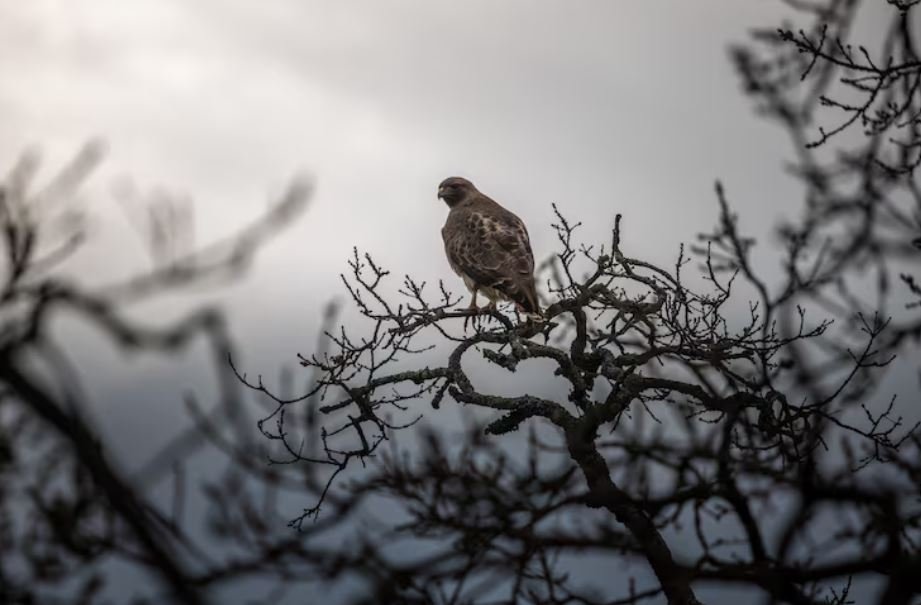
Her connection to birds and grief has only grown since My Dakota. She has written about continuing to take pictures after the death of her second brother, describing how grief once again deprived her of words and returned only the camera. Her use of bird silhouettes as symbols is not intentional. They are more truthful than that. When she looks up, she truly sees them. A wire-mounted kingfisher. In the brush, a solitaire. Her half-smile continued as her brothers continued to move through the South Dakota sky.
The most serious photography seldom makes an announcement, as Webb’s work serves as a reminder. It simply keeps leaving. It continues to hide behind sunflowers on the property of strangers. Until the flock chooses to stay, it remains in the field.
