


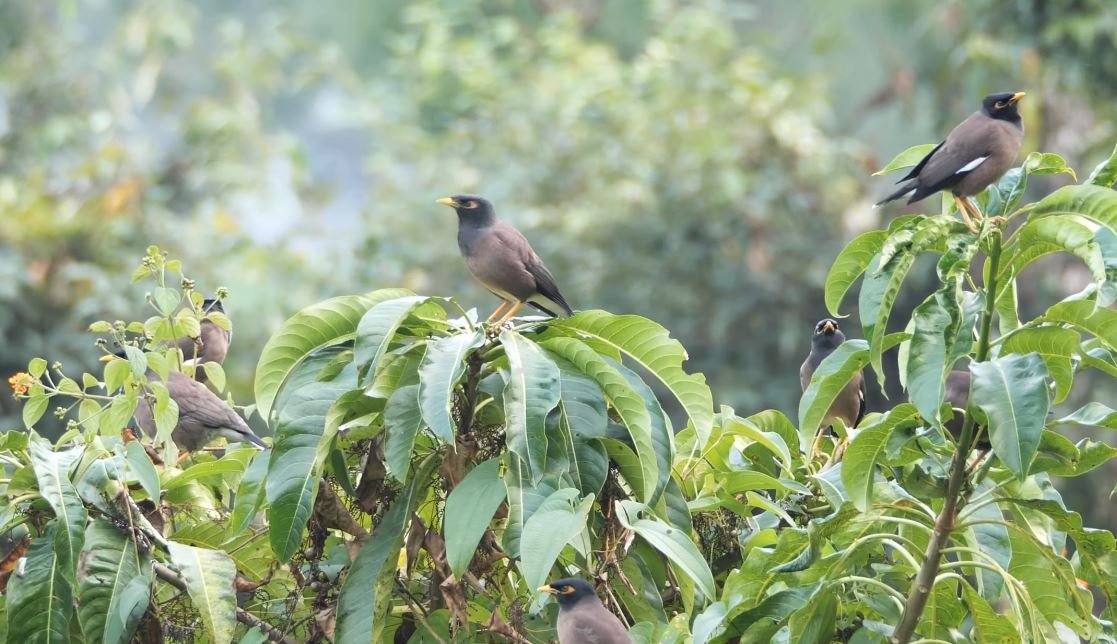
A bird that can mimic a human voice is subtly amazing. Not even close to it. not generate a hazy jumble that listeners willfully mistake for words. Reproduce the exact cadence of someone’s name being called across a room, including the syllables, tone, and pitch. Because of its ability to do just that, the hill myna is one of the most prized and endangered birds in the Philippines.
There are several varieties of myna in the Philippines, and the differences are important. When most Filipinos refer to the “talking bird,” they mean the Palawan Hill Myna, a subspecies of the common hill myna known scientifically as Gracula religiosa palawanensis. It is only found on Palawan, a long island in the southwest that conservationists frequently refer to as the Philippines’ last frontier. Even when it doesn’t speak, this all-black bird with an orange-red bill, yellow legs, and a bare yellow patch of skin curving from below the eye toward the nape is striking. It’s completely different when it speaks.
The hill myna does not genuinely mimic other birds in the wild. It turns out that this widely held belief is incorrect. At dawn and dusk, wild birds use their own complex vocabulary, which includes whistles, wails, gurgles, and descending screeches that reverberate through the forest canopy. Two birds that live fifteen kilometers apart may not share any calls at all because each individual has a unique repertoire of call types, learned young, and dialects that change so drastically over distance. Things are altered by captivity. The myna transforms into a different kind of performer in a cage when exposed to human voices and everyday noises. It is one of the most accurate vocal mimics in the animal kingdom, possibly comparable to the African grey parrot.
The bird’s gift and its problem is this ability. For many years, pet mynas have been in high demand throughout Southeast Asia. Over 170,000 wild-caught individuals were exported from range states between 1994 and 2003. Although it is more difficult to determine the exact numbers behind the Philippine population, the pattern has been consistent: birds are taken from the wild, transported through unofficial trade networks, and then sold into private ownership. In the Philippines, keeping Palawan Hill Mynas as pets is prohibited. That hasn’t fixed the issue.
The Apo Myna, scientifically known as Goodfellowia miranda, is a completely different species found in Mindanao outside of Palawan. This one is silent. It is a fairly large, glossy black bird with a tall, wispy crest, a white patch on the back, and the same yellow bill and bare eye skin that identify its relatives. It forages in pairs or small groups for fruit and insects in the montane forests of the Kitanglad Range and a few other high places.
Birdwatchers who have hiked the Intavas Trail in Bukidnon say that once they see it, the crest is unmistakable because it is so different from anything else in those forests. The Apo Myna is classified as Near Threatened, a designation that can be subtly concerning to those who know what it means: the species isn’t in immediate danger, but its future is not promising.
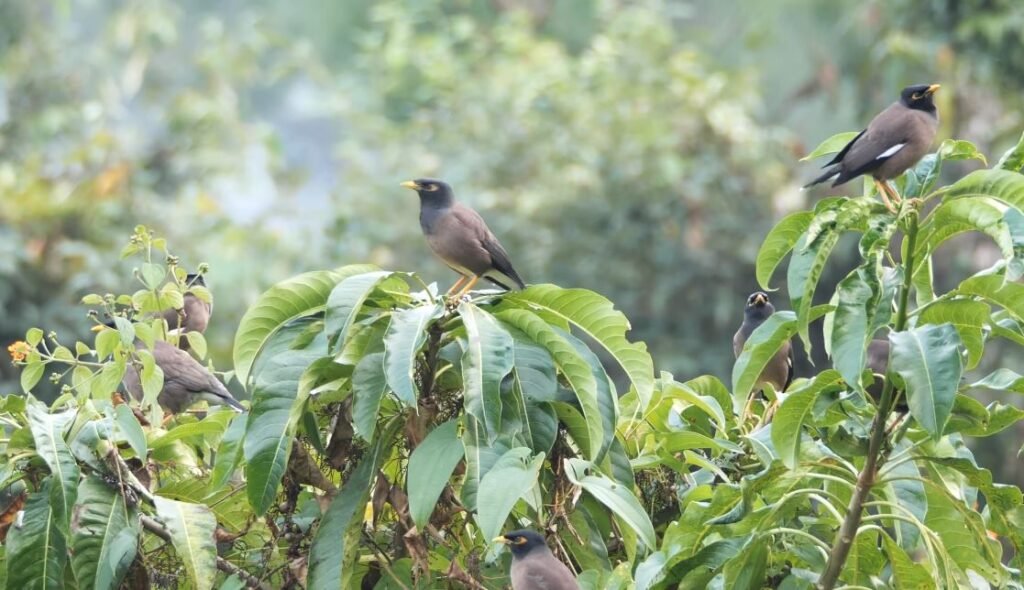
In the Philippine bird tale, the common myna, Acridotheres tristis, holds a distinct position. Originally from South Asia, this is the well-known, versatile, slightly strutting bird that can be found in both urban parks and rural areas. It is now found almost everywhere. It lacks the hill myna’s vocal range. Because introduced populations of common mynas have a tendency to outcompete native species for nesting sites and food, it does possess the kind of ecological resilience that worries conservation biologists. It is regarded as intrusive in some areas. Sightings have been reported in Batanes, in the Philippines’ far north, which raises unanswered questions about the origin of those birds and whether the population is established.
All of this—the Palawan Hill Myna in its towering forest trees, the Apo Myna on Mindanao’s montane slopes, and the common myna traversing roadsides and rice paddies—raises a larger question about how seriously the nation takes its avian biodiversity. Birds are among the most obvious indicators of the biological diversity of the Philippines, one of the world’s most biologically diverse nations. The myna is not an uncommon exotic that only experts are aware of. People have grown up with this bird in ways that conflate its presence in the home with that of a wild animal, kept it in their homes, and heard it talk in street markets.
Whether enforcement regarding the illicit pet trade has significantly improved in recent years is still up for debate. It appears more obvious that the birds that are still in the wild, especially in Palawan, are under actual pressure from habitat loss as forests shrink and from demand that doesn’t go away just because a law says it should. The Palawan Hill Myna is remarkably accurate at mimicking human speech. It’s worthwhile to find out if anyone is listening.
