


Somewhere along the coast of Palawan, there is something subtly striking about seeing a small flock of blue-naped parrots moving through the tree canopy. They are almost completely green, fast, and noisy in that specific high-pitched parrot manner, making them surprisingly difficult to spot unless you’re looking. Most people aren’t. That could be a contributing factor.
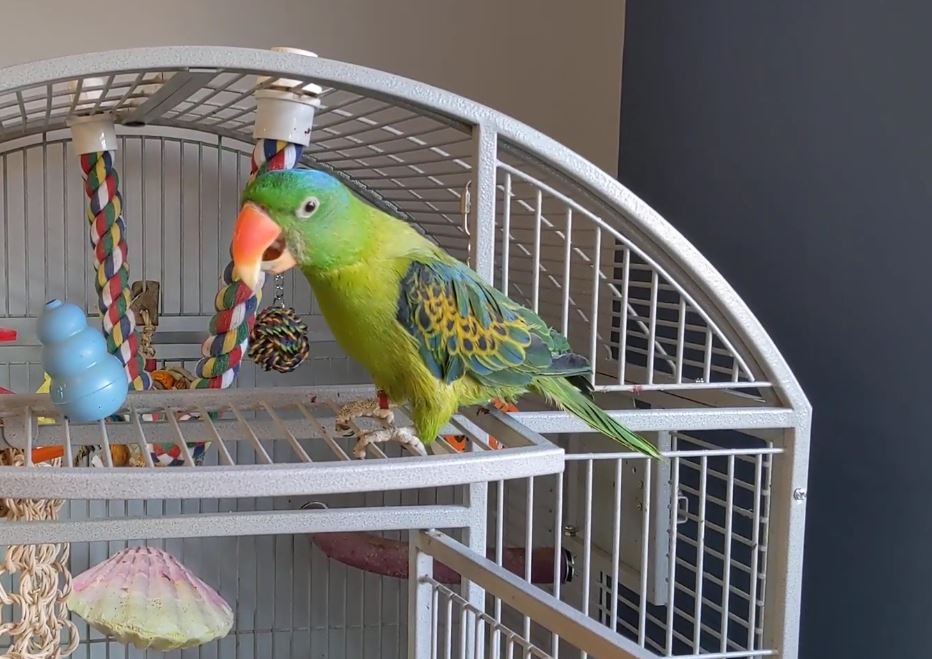
When most Filipinos imagine a green parrot in the Philippines, they picture the blue-naped parrot, or pikoy as it is known locally. Tanygnathus lucionensis is its official name. Depending on who you ask, it is also known as the blue-crowned green parrot, the Philippine green parrot, or the Luzon parrot. Regardless of its name, it is a medium-sized bird, about 31 centimeters long, with a bluish lower back and a characteristic pale blue cap across the back of its head. The bills of males are typically orange. These birds appear truly lovely in the dappled light of a secondary forest in the Philippines, even though their coloring is not as striking as, say, a macaw.
Many Filipinos may have seen this bird without realizing what they were seeing. The pikoy is found throughout the archipelago, including the Sulu Archipelago, Mindoro, Palawan, the Visayas, Mindanao, and Luzon. It travels in small flocks, rarely more than a dozen, and feeds on mangoes, berries, seeds, and grains. It builds its nests in tree holes. In certain respects, it resembles a typical bird living a typical life in the forest. However, its numbers are quietly declining.
The blue-naped parrot is classified as Near Threatened by the IUCN, with an estimated 1,500–7,000 mature individuals left. That range is sufficiently broad to imply genuine uncertainty, which is never a sign of comfort. The species has virtually disappeared from its historical range in Negros and Siquijor. The pikoy depends on lowland and secondary forest cover, which is gradually being replaced by agriculture and development, and habitat loss is a factor. Forests continue to shrink. However, conservation organizations consistently bring up the topic of trapping for the pet trade, and with good reason.
The fact that this bird is illegally traded in Palawan and other markets while also appearing on the Philippine five-hundred peso note, a sort of national honor, is unsettling. It is specifically forbidden to hunt, capture, or own a blue-naped parrot in the Philippines under RA 9147. There are actual penalties. However, reports from birdwatching groups and the Katala Foundation indicate that illegal trade on Palawan has been rising rather than falling. The law is in place, but enforcement is, for the most part, a different story.
There are a few protected areas that offer some safety. The bird’s range includes Puerto Princesa Subterranean River National Park, Quezon Protected Landscape, and Bataan National Park. However, protection in practice and protection on paper have never been the same in the Philippines, and people who are familiar with the situation typically characterize enforcement inside these zones as, at best, uneven. Even in areas that are officially protected, deforestation and trapping persist.
It’s also interesting to note that the bird on the 500 peso note has a peach-colored beak, which is just wrong. The female’s bill is horn-colored, while the male’s is orange-red. Perhaps a minor detail, but it illustrates how little attention the bird itself gets, even from those who use its image.
The pikoy won’t go extinct tomorrow. However, the trajectory is not promising, and the window of opportunity for significant intervention is often smaller than it appears from the outside. Anyone who has ever witnessed a small flock of these green parrots slicing through the canopy of a Philippine forest would consider it a loss worth considering.
