


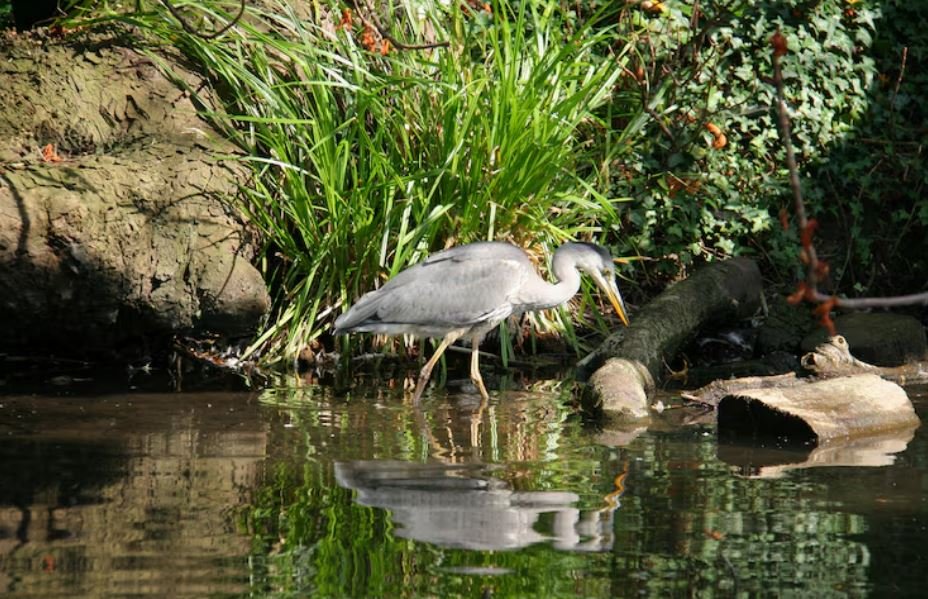
Over a degraded wetland, a certain silence descends. Not the tranquil kind, but rather the absence of something. You begin to understand what ecologists mean when they say the Everglades are broken when you stand at the edge of a sawgrass marsh in South Florida and watch a lone Great Blue Heron make its way across water that should be teeming with birds.
There used to be so many wading birds in Florida, including Roseate Spoonbills, Wood Storks, White Ibises, and Great Egrets, that early naturalists referred to nesting colonies as “living storms of pink and white.” Early in the 20th century, hundreds of thousands of birds are thought to have bred throughout South Florida. That population has now decreased by almost 90%. Furthermore, fewer and fewer of the surviving birds are building their nests where they used to.
Water is at the core of all the complicated reasons. In order to create space for farms and development, about half of the Everglades’ original four thousand square miles have been drained over the last century. Once flowing south from Lake Okeechobee, the broad, slow-moving sheet of water has been redirected via a network of dikes, pumps, and canals. As a result, the system receives water in the wrong locations, at the wrong times, or not at all.
Timing is crucial for wading birds. Unlike herons, wood storks and white ibises do not hunt by sight. They use their bills to sweep through shallow water, snapping shut when they come into contact with prey. Only when fish and crayfish are concentrated—packed into smaller seasonal pools as dry-season water levels drop—will that feeding strategy be effective.
The birds simply cannot gather enough food to raise chicks when hydrology goes wrong and wetlands remain either flooded or bone-dry during the breeding season. They either don’t try to breed at all or abandon nests in the middle of the season.
After a challenging 2019 season, Mark Cook, an avian ecologist with the South Florida Water Management District who has been monitoring wading bird nesting for years, gave a straightforward account of the situation. He claimed that the birds had effectively lost their eateries. There was still food, but it was dispersed over a large area with no concentration, no dependable feeding spot, and nothing a parent bird could go back to repeatedly to feed its young. That year’s numbers dropped to 72% of the ten-year average.
There have been better times. Following an exceptionally wet summer, the 2018 nesting season produced scenes that seemed almost historical: Wood Stork nest counts more than doubled the decade average, and ibis colonies of 18,000 pairs in the central Everglades. In order to count nests in quantities not seen since the 1930s, biologists flew survey aircraft over broccoli-colored willows dotted with white dots. With the correct water conditions, recovery might still be possible. However, a century of harm cannot be undone by a single successful season.
The fact that water management is no longer the only factor makes this more difficult. Now widespread throughout much of South Florida, Burmese pythons have wiped out small mammal populations and are increasingly being observed close to nesting colonies, where they prey on the birds. Due to changes in Florida Bay’s coastal habitat brought about by rising sea levels, Roseate Spoonbills are probably being driven from the shorelines they have depended on for decades. A system that is already functioning at the edge of its tolerance is under additional strain due to climate change.
Scientists believe that the window of opportunity for significant restoration is still open, but not forever. Wading birds react swiftly to better water conditions, which is why their decline is so obvious and why they are useful indicators of ecosystem health. Birds notice when the southern Everglades receive more freshwater due to restoration efforts. Despite a decline in overall numbers, nesting on historic grounds in Everglades National Park and the southwest coast reached its highest share since 1986 in 2019. It appears that things are gradually moving in the right direction.
However, slow might not be fast enough. Over the past century, birds have left the Everglades, but it wasn’t because they wanted to. The system ceased to function for them, so they departed. In addition to managing pythons, keeping an eye on the effects of sea level rise, and making adjustments as circumstances change, bringing them back requires getting the water right—the right amount, in the right places, at the right time of year—and maintaining that standard consistently for years. It’s a complex request for a complex location. It is still genuinely unclear whether there is the will to carry it out.
