
You can convince yourself that the bird in one of Carolyn Monastra’s photos is real. The glacial lake shimmers blue-green in the distance, the Pine Grosbeak perches on its branch, and the light has a certain morning quality that is hard to replicate. Then something changes. A bit too clean of an edge. A silence that transcends endurance. It dawns on you that you are staring at a paper cutout, a replica set in a setting where the real bird might eventually vanish.
That is the Divergence of Birds project’s entire architecture, and it functions precisely because it doesn’t make an announcement.
After reading a 2014 National Audubon Society climate report, Monastra, a photographer and educator from Brooklyn who has taught at Nassau Community College for more than 20 years, began working on this project. The results weren’t abstract. According to the report, by 2080, 314 bird species in North America would have lost more than half of their climatic range. That figure increased to 389 species by 2019. After reading those figures, Monastra seemed unable to put them down. She began purchasing used bird books, first to learn more about building nests, and then, almost without warning, she started cutting the birds out of the pages. From there, the project expanded.
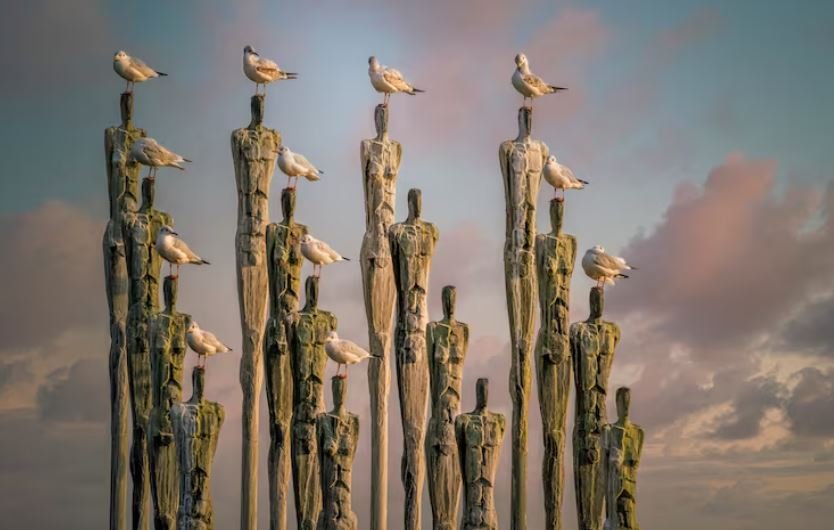
The conceptual reasoning is surprisingly straightforward. Monastra visits the current habitats of climate-threatened species, places them in the real world as paper cutouts, and takes pictures of them. She reconstructs the habitat herself when travel is not feasible. Eventually, all 389 species on the Audubon list are to be photographed. She has already traveled from the Rocky Mountains of Alberta to the Atlantic coast’s dunes and, most recently, to the Santa Fe arts community, where the work was evaluated at CENTER’s Review Santa Fe in November 2025.
One could be tempted to characterize this type of work as metaphorical. However, Monastra appears to be more interested in something more visceral than metaphor; she wants the ambiguity. According to her, she wants viewers to be aware that they are looking at cutouts as soon as they come across them and to pay attention differently than they might with a simple wildlife photo. The point is the image’s slight inaccuracy. It causes a brief, uncomfortable pause.
Interestingly, this unease is related to the dystopian novel Do Androids Dream of Electric Sheep? by Philip K. Dick, in which artificial animals are so realistic that no one can tell them apart from real ones. Monastra has discussed how that idea aligned with her perspective on climate change. “If we don’t protect what we have,” she said, “that’s all we’ll have left.” The warning is a facsimile. It’s a framing that seems more like a real concern than a literary device.
Over the course of multiple installations, the exhibition itself has changed. In 2023, Monastra printed her photographs on silk, which was specifically chosen for its delicate nature, and combined them with a soundtrack created by musician Asa Marder at the NYC Bird Alliance on Governors Island. Windows were decorated with bird cutout decals. Rather than being theatrical, the effect was subtly immersive. All 31 of the photos in the exhibit, which ran from February to August 2026 at Soka University in California, depicted birds that are native to the state. This regional specificity gives the project true flexibility and local resonance wherever it is displayed.
Maybe we should take a moment to consider Monastra’s past. After switching from studying English at Fordham to photography, she eventually finished her MFA at Yale. Before dedicating herself entirely to the camera, she served in the Jesuit Volunteer Corps. Her artwork has been displayed in China, Ireland, and England and is in the collections of Johnson & Johnson, Memorial Sloan Kettering, and Margulies. The Witness Tree, her prior climate project, went from the Brooklyn Botanic Garden to the Pingyao International Photography Festival. Finding a cause is nothing new for her. It seems that she has always been concerned about the environment, and the bird project is just where it took on its most acute form.
After giving this piece some thought, you are struck by how much it defies environmental art conventions. There’s no overbearing symbolism, no crisis lighting, and no species name written in red across the frame. Just a paper bird in a real tree, captured with the same attention to detail as a living thing. If it is sadness, it comes on its own terms, slowly and somewhat precisely.
