


For nine hundred years, a meadow in Herefordshire has flooded every winter. That was the idea. Every season, the River Lugg would spill across the valley floor, leaving behind lime and silt that fed the hay, the soil, and the Norman economy that constructed churches and cathedrals in the area. It was an incredibly effective system. The floods came and went, so it was successful.
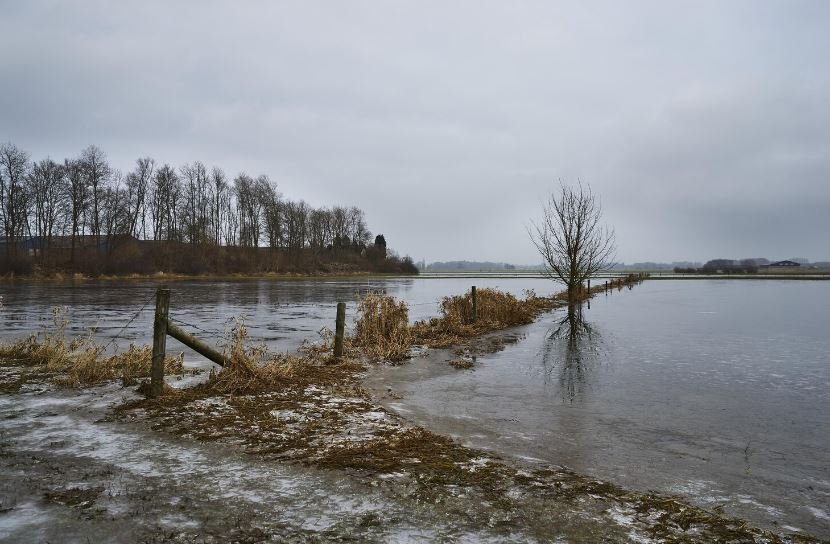
The current situation is different. The Lugg meadows haven’t truly dried up since October 2019. Where mice and rabbits once dug burrows, swans and gulls have taken over. Above the chocolate-colored water are the tops of fence posts. One of the most ecologically significant flood plain meadows in England, a 120-hectare nature reserve is essentially an inland lake. Additionally, spring is arriving without the ground, which is necessary for ground-nesting birds like skylarks and curlews.
This isn’t being broken by a single flood. It’s the repetition. The River Usk experienced significant floods in 2018, 2019, and 2020—three record-breaking occurrences within twenty months, according to Simon Evans, chief executive of the Wye and Usk Foundation. “Imagine each one as a bang on the ecology,” he replied. “If you keep hitting it, it just goes away.”
What’s going on below the waterline and in the saturated soil is overlooked in the coverage of evacuated homes and flooded high streets. Fast-moving water rips away river gravel, the unsightly base of aquatic life, and spits it downstream. The homes of macroinvertebrates are lost. The foundation of everything is those microscopic organisms—stone flies, bullheads, and marsh browns—which serve as food for fish, dippers, and kingfishers. The entire food chain above them silently collapses when you pull them out. The red bedrock is now completely visible in a few Llynfi tributaries. The gravel where trout and salmon used to spawn has completely washed away.
The state of the soil is arguably worse and much less obvious. More than 200,000 tonnes of topsoil, or 26 hectares, were removed from the valley by a single flood on the Lugg in September 2012. The flood also carried fertilizer and pesticide residue from harvested agricultural fields downriver. Water flowing through riverbed gravel is necessary for fish eggs to receive oxygen. Those channels are blocked by sediment. The eggs are suffocated. A single flood that washed away freshly laid salmon eggs during a poor spawning season in the Scottish Borders in the late 1970s is said to have influenced spring catch numbers on the River Tweed for the next twenty-five years.
In contrast, the state of England’s flood defenses is difficult to characterize without coming across as alarmist, but the statistics speak for themselves. Nearly 9% of the approximately 98,000 flood defenses that the Environment Agency had inspected were in subpar condition as of late October 2025. Of those, over 6,400 were deemed “high consequence”—that is, they safeguard numerous residences or commercial establishments. More than 40% of defences in Hampshire, Brentwood, and North Tyneside were not up to par. One-fifth of the defenses along the Thames corridor were performing poorly. Then, in December, Storm Bram arrived, and at the same time, flood warnings were issued for York, Devon, Cornwall, and Greater Manchester.
One detail from Loughborough sticks in your memory. Residents of the Grange Park estate witnessed a privately owned pond that was built especially to hold floodwater fill to capacity and start to spill toward front doors in January 2025. In almost freezing temperatures, about thirty people went outside and manually dug trenches. The water company was contacted. The borough council was summoned. The developer was contacted. Everyone said it wasn’t their problem, according to locals. Katie Anderson, an engineer, led the excavation. “If everyone hadn’t pulled together,” she replied, “I don’t want to think what could’ve happened.”
It’s still unclear how many communities in England, reliant on infrastructure they didn’t create, have no control over, and can’t be certain that anyone is watching, are just one bad storm away from experiencing a similar situation. Ministers claim that the government’s £10.5 billion commitment to flood defenses through 2036 is the biggest program ever. That might be accurate. However, only 2% of high-consequence defenses should be in poor condition, according to the Environment Agency’s own long-term goal. Four and a half times that is the current figure.
The ecological image carries a specific kind of silent sorrow. The majority of the original stock was lost decades ago due to agricultural intensification, leaving about 1,200 hectares of species-rich flood plain meadow throughout the United Kingdom. There is no buffer left. Long-term submersion may have already eradicated the rare red-shanked carder bee from the Lugg valley; it builds its nests in mouseholes in tussocky grass. Built into muddy riverbanks, kingfisher burrows vanish under several feet of water. Otters are killed when they cross roads in places with less cover after being forced from submerged riverbanks. Worms suffocate in the anoxic soil and rise to the surface, where they are eaten by foxes and crows, decreasing the amount of food available to the already struggling species.
According to James Hitchcock of the Herefordshire Wildlife Trust, it is the “homogenization of the countryside”—a situation in which generalist species, such as gulls and rooks, increasingly occupy areas that were previously occupied by specialists. “Everything is getting hit from every angle,” he stated. He is saying that the pressure is cumulative and the window for recovery is getting smaller, which is what anyone who watches this over time starts to feel. Floods do more than just cause damage. Before the final damage has healed, they arrive.
