


If you listen closely, you will notice that the birds sound different when you enter a park from a busy city street. It’s not quite louder, but it sounds sharper and more demanding, as if they’re putting in more effort than is necessary. It turns out that feeling is genuine. For years, scientists have been monitoring it, and what they have discovered is both fascinating and subtly unsettling.
The songs of urban songbirds are becoming more melodic. Not by chance, not at random. They are doing this in order to survive in a world that has become incredibly noisy due to human activity.
Most people are unaware of the depth of the research. When great tits were observed singing about 400 Hz higher than birds in peaceful forests outside of Paris in the early 2000s, biologists discovered the pattern in European cities. That’s not a small change.
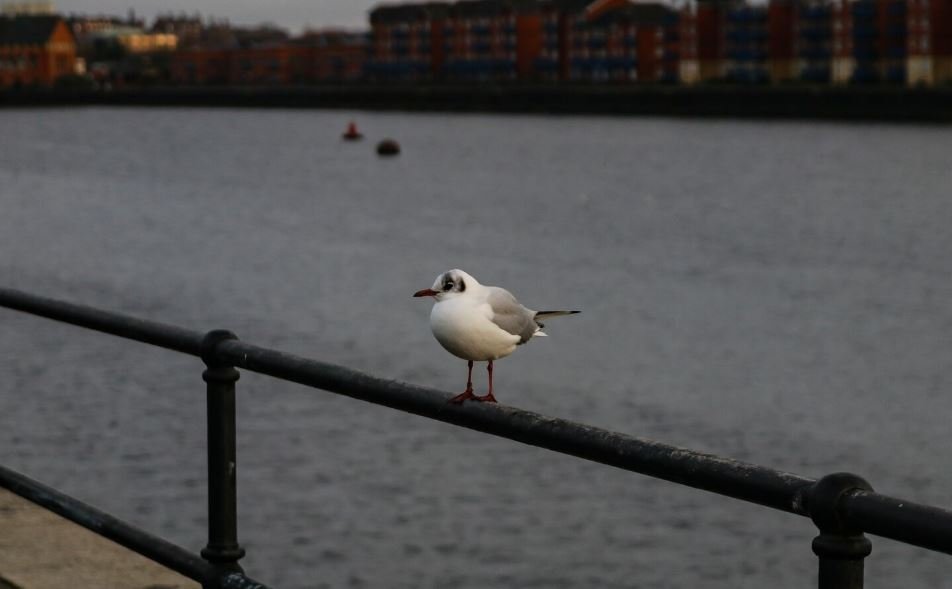
Changing pitch that drastically is about the same as a person going from a normal speaking voice to something that sounds like a constant shout for a bird that uses song to attract a mate or protect its territory. The higher notes break through the low-frequency rumble of traffic, so it functions in a limited way. However, there is a price for it.
Urban noise, mostly from automobiles and construction, clusters at lower frequencies, which is the issue. Birdsong that resides in the same acoustic area is simply muffled. Thus, birds that are able to raise their voices are able to be heard. Birds that are unable to do so may find it difficult to retain territory or attract mates. When Smithsonian researchers investigated this effect, they discovered something even more complex: buildings exacerbate the situation in their own unique way. Higher frequency sounds are scattered and reflected by hard surfaces, causing reverberations that distort the signal before it reaches the listener. When a bird must cope with both dense architecture and traffic noise at the same time, it is frequently unable to compensate for both.
Berlin nightingales sing about 14 dB louder than their rural counterparts, according to research from the Max Planck Institute for Ornithology. Their volume peaks during weekday rush hour and then decreases on weekends when traffic is less congested. That particular detail has an almost melancholic quality. In a sense, the birds have internalized the commuter schedule.
To its credit, Paris has achieved real progress. Through automated sound cameras that penalize excessively loud cars, anti-noise road coatings, and a regional monitoring organization that monitors decibel levels throughout the city, the city has spent years lowering traffic noise. According to studies, Paris is now about three decibels quieter than it was ten years ago. That is a significant reduction on a logarithmic scale.
Nevertheless, great tits that have been observed in Paris today continue to sing at higher pitches than birds that have been observed in rural areas outside of the city. The birds have not reverted to their natural frequencies, even though the noise level is decreasing. It’s unclear if they will in the near future or if some of these changes are solidifying across generations.
The pattern is not limited to Europe. On the Canadian Prairies, savannah sparrows sing at higher pitches close to noisy oil pump stations. In contrast to quieter rural areas, Australian silvereyes behave similarly in noisy urban areas. European robins adapt to wind turbines. This is a worldwide behavioral change occurring in dozens of species across several continents due to a single common cause: the constant background noise of human activity. It is not a local peculiarity.
It is more difficult to quantify what is lost in these adjustments, but it is likely important. Sheer volume and reach may take precedence over song complexity, which frequently indicates genetic fitness to possible mates. In a way, urban birds are exchanging quality for audibility. Researchers are still trying to figure out whether that trade has an impact on reproductive success over time.
One can’t help but wonder what Rachel Carson would think of all of this. In 1962, she issued a warning that human negligence could eventually cause the birds to become completely silent. The birds are still singing, but they are doing so in a different way—louder, higher, and more strained—in a world that constantly demands more of them in order to be heard. This is what we have instead, which may be stranger.
