


There is a photograph making its way around conservation circles right now that is hard to shake. Taken in the Chubut province of Argentina, it shows roughly a dozen dead pumas and foxes — strung upside down along a rural fence, limp, their bodies arranged in a row that somehow feels deliberate. The photographer, Darío Podestá, called it “The Silence of the Innocents.” It placed second in the Last Wild Places category at this year’s seventh Patagonia Photo Contest. Runner-up. Which means something even more unsettling edged it out.
That tension — between Patagonia’s jaw-dropping natural beauty and the increasingly difficult conditions under which its wildlife actually lives — is what made this year’s contest feel different. Not louder, exactly. More honest.
Organized every two years by Patagon Journal and covering southern Argentina and Chile, the competition drew 1,826 entrants from 12 countries this cycle, spanning landscape, wildlife, culture, and environmental categories. The range of images was broad. But the ones that lingered weren’t necessarily the most technically impressive. They were the ones that said something true.
The overall winner, Argentinian photographer Mauricio Rossanigo, took the Patagonia Photographer of the Year title with a wildlife image called “For a Lifetime” — two Andean condors nuzzling beneath the Fitz Roy massif near El Chaltén. It is genuinely moving. Condors are known to form lifelong monogamous bonds, and Rossanigo captured that bond with the kind of intimacy that usually takes years of patience to find. He described waiting quietly as more condors appeared above, landing on ledges, until the pair arrived and the moment simply happened. One click.
The image works partly because of what condors represent across the Andes — Bolivia, Peru, Argentina, and Chile have each claimed the bird as a national symbol, a connection stretching back to Incan communities who considered them sacred. It is hard to look at Rossanigo’s photograph without feeling the weight of that history. The French photographer Timothy Dhalleine captured a different kind of condor frame — two birds with their full wingspans extended, soaring above Laguna Sofía in the Magallanes region — and won the Readers’ Choice Award for it. His image is grand where Rossanigo’s is intimate. Together they form something like a portrait of a species: powerful, ancient, and, as Dhalleine himself noted, increasingly fragile in parts of northern South America where populations have disappeared entirely.
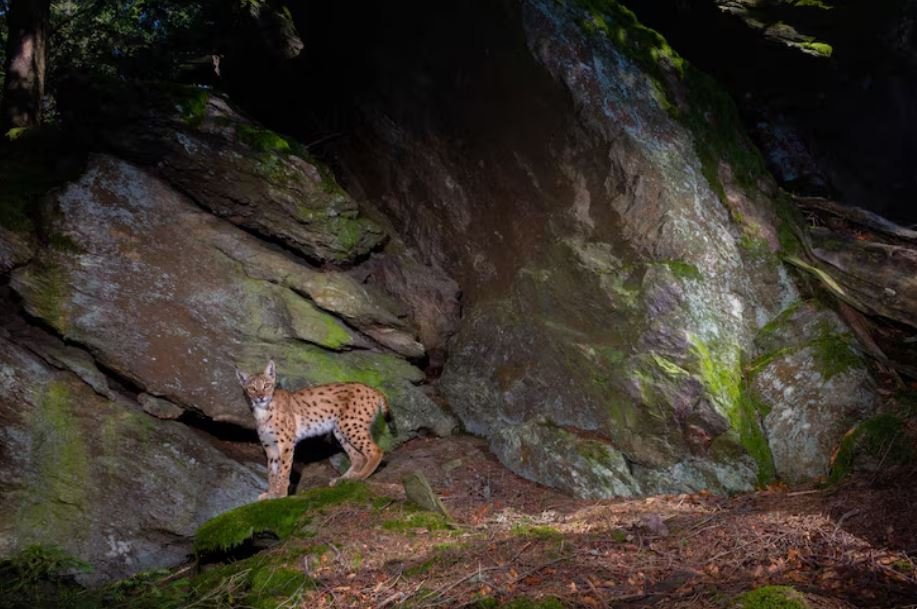
That fragility is where Podestá’s photograph enters, quietly and uncomfortably. The dead pumas and foxes it documents aren’t the result of poaching in the traditional sense. They reflect something older and harder to resolve: the conflict between sheep farmers protecting livestock and native predators that have nowhere else to go as human activity expands into wild habitat. It is not a new story in Patagonia. But seeing it rendered so plainly — bodies on a fence, a rural accounting of who lost — makes it feel urgent in a way that statistics rarely manage.
Conservation organizations have long flagged this friction as one of the defining pressures on Patagonia’s ecosystem. Figures like Douglas Tompkins and his wife Kristine — co-founder of The North Face and former CEO of the Patagonia clothing brand, respectively — spent hundreds of millions of dollars acquiring over 2.2 million acres of wilderness in Chile and Argentina to preserve it from exactly these kinds of encroachments. That land now stands protected. But protection is uneven, and the pressures documented in Podestá’s image exist well beyond any single reserve’s boundary.
The landscape winners rounded out a contest that felt, overall, more grounded than celebratory. Felipe Zanotti’s long-exposure waterfall shot beneath Mount Fitz Roy was technically stunning — the kind of image that wins landscape categories. Daniel Clavería’s Outdoor Adventure entry, showing hikers heading into Torres del Paine, captured the draw that brings people to this part of the world in the first place. Both are beautiful. Neither pretends the beauty is uncomplicated.
There is something worth noting about a photo contest choosing to spotlight conservation alongside scenery. It would be easy — and commercially safer — to fill the winning gallery with mountain peaks and azure lakes. The Patagonia Photo Contest keeps making a different choice. Whether that changes anything for the pumas and foxes of Chubut is another question entirely. But at minimum, it ensures the record exists.
