


It began with no idea of being therapeutic, as these things frequently do. Her little garden in the east of England consisted of a piece of lawn, an overgrown lavender border, and a bird feeder that had been there since she moved there and that she refilled out of habit rather than any special interest in birds. A goldfinch landed on the feeder one morning when she was enjoying coffee outside before the tasks of the day came to mind. She spent several minutes watching it. After that, she went inside to retrieve her phone.
The bird was already half-turned away when she took the technically subpar picture, which was taken into the light and rather blurry. However, she examined it for a longer period of time than she had examined most anything in months. She walked outside once more the following morning.
Over the past ten years, researchers focusing on nature-based mental health interventions have been looking more closely at what she had fallen across, even tho she did not yet have the word for it. Some professional organizations have started implementing structured nature exposure into therapy programs because to the strong evidence linking time spent in outside green spaces to lower cortisol levels and less anxiety. However, the mechanism that appears to matter most isn’t simply being outside; rather, it’s the level of focus that some outdoor activities demand. In particular, observing animals necessitates a level of leisurely presence that is methodically avoided in the majority of contemporary daily life.
That focus is sharpened in a certain way by photography. Looking via a lens, even a smartphone lens held at arm’s length or pressed to the eye, causes a focus narrowing that differs from normal observation. You begin to notice things like the precise angle of light on a wing, the way a bee passes thru the inside of a flower, and the texture of the bark where a nuthatch is searching for something that is undetectable to the untrained eye. These are not self-evident details. They call for quiet and gazing, which most people haven’t done in a while. Additionally, the act of waiting for the perfect moment—the light moving, the insect landing, the bird turning—forces the mind into a rhythm unrelated to a task list or news feed.
The point of entry doesn’t have to be difficult. In most temperate areas, a small dish of water placed on a garden wall attracts birds, bees, and butterflies in a matter of days. A lawn of decorative grass just lacks the activity that a few native flowering plants—plants that developed with local pollinators rather than being produced for looks alone—bring. A windowsill with a feeder is sufficient; a garden is not necessary. Additionally, the camera doesn’t have to be costly. The quality of the final photograph is not what makes the exercise valuable. It’s in the fifteen minutes of focus needed to understand it.
An increasing amount of research indicates that exposure to nature is beneficial for mental health since it contrasts with the cognitive demands of contemporary job and communication. The brain is trained to be in a state of constant partial attention—never totally present, never entirely rested—by screens, alerts, and multitasking. It is nearly the reverse of waiting for a sparrow to return to the feeder while sitting motionless in a garden. When there are no fresh inputs or tasks to accomplish, the mind starts to process, settle, and discover a rhythm that isn’t influenced by outside demands, which is more like to what it does during meditation or sleep.
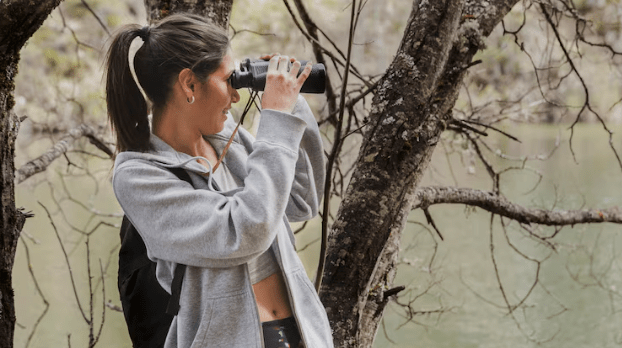
The picture of the woman with the goldfinch is not out of the ordinary. Grief, burnout, and the gradual emergency of feeling permanently cut off from anything that isn’t mediated by a screen are some of the ways that people come to engage in this type of practice. After a few weeks, students usually remark more about time—more especially, the perception of time traveling at a different pace—than about wildlife. Not more quickly, not more efficiently. Just in a different way. Hearing these stories gives me the impression that the backyard has been patiently waiting the entire time.
