


When people haven’t spent time in a forest, they don’t realize how calm it is at midnight. Insects, frogs crying from somewhere near water, and the rustle of something tiny moving thru leaf litter are all part of the continuous pattern of sound. Human sounds is missing. Additionally, that absence is not a luxury for scientists studying reclusive forest owls. It is the whole basis upon which the work is constructed.
When it comes to studying nocturnal owls, field craft is one of those disciplines that appears straightforward on the surface but is actually quite specific. The basic approach, which is to play a call, wait for a response, net the bird if it approaches, process it quickly, and then release it, condenses hours of silence and gradual adjustment into a sentence that doesn’t accurately describe what it’s like to work in a cold, wet montane forest at one in the morning with rain falling off the ridge and nothing happening for the third consecutive hour.
More than most people realize, clothing matters. Standard materials are soft, non-synthetic materials that don’t snag on branches or make noise when you move. When approaching a net site, hard-soled boots are swapped out for ones that make less noise. A specific type of physical awareness is developed by researchers who conduct these surveys on a regular basis. This includes an instinct for where their feet are landing and a tendency of moving slowly throughout the dark, which appears to be reluctance but is actually precision. Instead of using dry sticks, you learn to walk on the base of flora. Because reaching into a pack in the dark generates noise, you find out where your equipment is before you need it.
One of the few areas where the procedure is nearly absolute is light management. White light causes the majority of owl species within range to immediately flee, and it destroys the nite vision that field workers have spent thirty or forty minutes developing after abandoning any artificial illumination. The standard is to use red-spectrum headlamps at the lowest usable setting, which is sufficient to read field notes or disentangle a net but not to produce the kind of light spill that disrupts the site. A useful early warning that a bird is approaching a net site before it actually arrives is provided by thermal scopes, which have considerably altered the game by enabling researchers to scan the canopy for heat signatures without using any visible light at all.
The fieldwork becomes more like a dialog on audio playback; it is cautious, uncertain, and easily broken. If an owl is available and in a responsive state, a brief recording of the target species’ territorial call played at low intensity thru a directional speaker is sufficient to entice it closer. There is complete stillness throughout the wait once the call is placed. Not comparatively quiet. Everyone on the squad must completely stop moving and making noise. When an owl decides whether to approach, it does so while listening. Anything that deviates from the typical soundscape of the forest, such as a cough, a boot moving on stone, or a zipper, is sufficient to stop the approach. During this stage, seasoned researchers talk about learning to regulate their breathing. It’s not overstated.
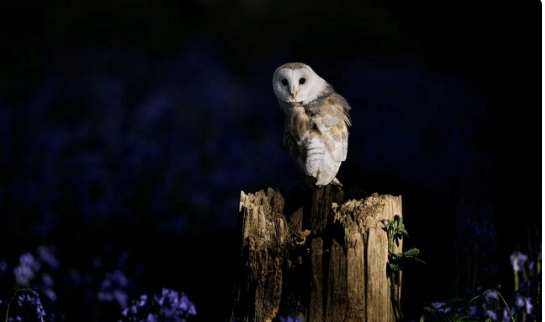
The extremely tiny mist nets used for owl capture are made of dark mesh that is intended to blend in with a tree line in low light. They are strung between poles at heights and angles determined by the target species‘ usual flight path thru a particular location. When a bird strikes the net, it folds into a mesh pocket that keeps it safe and unharmed, but the net needs to be constantly monitored from the moment it is raised. Field workers must use both skill and leather gloves that are thick enough to prevent a puncture when removing a forest owl from mist net in the dark. The window of opportunity between a bird striking the net and its safe extraction is brief, and the animal’s talons can exert force far greater than its size.
