


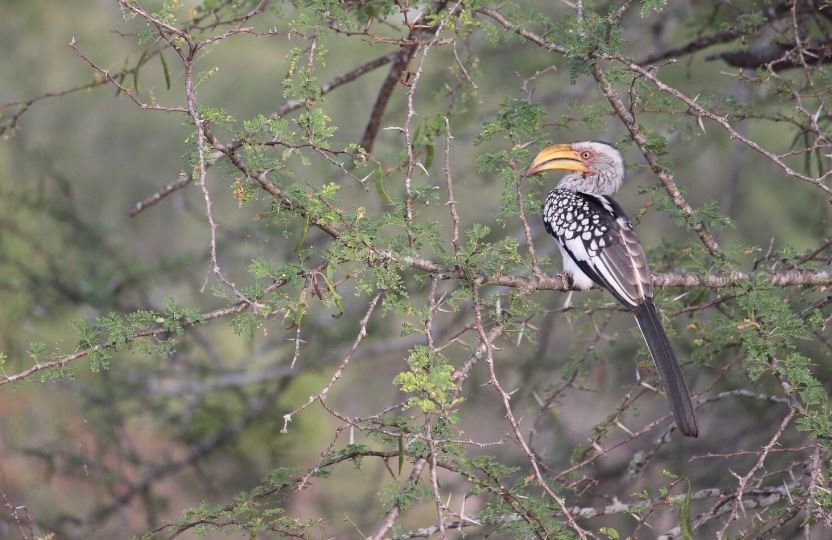
A male southern yellow-billed hornbill does an almost comical thing on a hot afternoon in the Kalahari: he opens his beak and simply holds it open, his wings drooping slightly at his sides as he stands motionless in a manner that birds hardly ever do. He’s not sleeping. He’s at work. working in order to survive.
For years, Dr. Susan Cunningham of the University of Cape Town has been associated with that image. Long before the debate over climate change became as heated as it is now, her team has been recording how Kalahari birds react to rising temperatures. What they’ve discovered is both intriguing and subtly concerning; rather than the dramatic mass-mortality narratives that garner international attention, it’s something more subdued and, in some respects, more concerning.
It turns out that the beak of the southern yellow-billed hornbill serves as a kind of thermal radiator. In order to release extra heat, hornbills actively dilate blood vessels in their beaks, a mechanism also observed in toucans, according to research by Cunningham’s collaborators. It is a sophisticated biological solution. The issue is that sophisticated solutions developed over millions of years of evolution weren’t anticipated.
Male hornbills start panting when the temperature of the air rises above about 36 degrees Celsius. They lose food as a result of panting. Foraging efficiency significantly decreases during periods of panting. This may seem insignificant, but during the breeding season, a female sealed inside a nest cavity and eventually a clutch of chicks depend only on the male for sustenance. He cannot afford to be sidetracked. He cannot afford to reduce his weight. And when the heat lasts, the data indicates that he does so consistently, day after day.
This growing body of evidence gave rise to the Cape Town Heat Protocol, which was spearheaded by Cunningham’s research team from UCT, the University of Pretoria, and affiliated institutions. Bird deaths during a single catastrophic heatwave are not the main cause for concern. It concerns what would happen if the number of consecutive hot days increased from a few per year to ten, fifteen, or twenty in a row. According to the team’s climate models, this scenario is likely to occur within decades. In those circumstances, birds lose body mass more quickly than they can regain it in a single nite. Breeding doesn’t work. Silently, populations decline.
A warning shot was given by the blue waxbill. Field rangers discovered dead and dying birds throughout the Phongolo Nature Reserve in KwaZulu-Natal in late 2020 following a severe heat event. Blue waxbills, tiny finches that spend their days searching for seeds in grass, made up nearly half of the carcasses. Nazley Liddle, a master’s student, subsequently verified thru laboratory tests that waxbills’ capacity to cool down is significantly diminished by high humidity. They can withstand air temperatures as high as 48 degrees Celsius in dry conditions. They were unable to sustain a safe body temperature above about 45.7 degrees in humid conditions similar to the day of the event. It proved to be the difference between mass death and survival, even tho it was only a few degrees.
Humidity is not as much of an immediate concern for desert hornbills in the Kalahari as it is in the wetter eastern regions. However, it is true that survivable days are gradually being compressed. The average maximum temperature in the Kalahari has already increased by almost two degrees Celsius since 1960, according to the original PNAS paper that Cunningham co-authored. According to projections, southern yellow-billed hornbills, as well as species like the southern pied babbler and southern fiscal, may be forced into situations where daily mass loss becomes chronic and irreversible by the 2080s due to a series of heat events.
Nothing appears disastrous from a distance, which makes it especially challenging to explain this to the general public. There are still hornbills. The Kalahari still appears vast, untamed, and untamed. However, the fitness data’s numbers reveal a more subdued story: birds arrive lighter for the breeding season, chicks spend more time in their nests waiting for less consistent food, and populations are steadily declining from the inside out.
The effectiveness of artificial cooling interventions, such as additional water stations, modified nest boxes made to stay cooler, or shaded foraging corridors, is still unknown. Such actions could buy time for some populations in strategic areas, according to a plausible scientific argument. It’s another matter entirely whether they expand beyond research sites. It seems that Cunningham’s team recognizes that difference. Their work may be more valuable in creating the kind of detailed, species-level evidence that ultimately makes the slow emergency of bird population decline impossible to ignore than in any one intervention.
The male hornbill will continue to do what evolution has given him, which is to stand in the sun with his beak open. The question is whether he will still be able to adjust to the world he has adapted to.
