


During the migration season, David Willard would walk the base of office buildings in Chicago every morning. I’m just looking for birds, nothing dramatic. Most of the dead were tiny migrants who had flown into glass the previous evening, drawn by artificial light that they were unable to fully comprehend. In 1978, he began doing this. He measured every bird by hand. mass, wing length, and lower leg bone. Everything was entered into ledgers. Decades of this, in silence, with no specific theory in mind.
One of the more disturbing conclusions in current climate science was eventually revealed by that data. Over 70,000 individual birds from 52 species collected over almost 40 years showed a distinct pattern: the birds were becoming smaller. The length of their lower leg bones decreased by about 2.4%. Their mass decreased. Despite this, their wings grew 1.3 percent longer, which is almost paradoxical.
What most impressed researchers was the consistency across species. These birds were not closely related. Their habitats, diets, and migration routes varied. Nevertheless, nearly all of them were evolving at roughly the same pace and in the same direction. The Chicago study’s lead author, Brian Weeks, described it as “shocking.” That’s not the language used in science.
Bergmann’s Rule, a concept that dates back to the 19th century, is the main explanation. Because mass retains heat, animals with warm blood tend to be larger in colder climates. Smaller bodies make more physical sense in warmer climates because a higher surface area to volume ratio facilitates faster heat loss. Comparable to two cups of coffee, the smaller one cools down first. Smaller birds might just be able to survive better as average temperatures rise. Those who are better at cooling down survive to procreate.
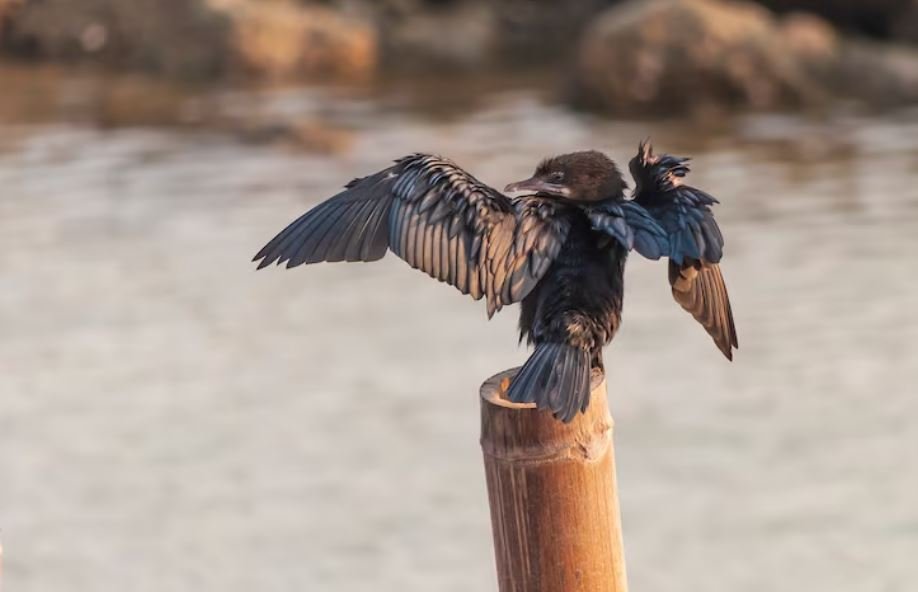
However, that narrative is complicated by the longer wings. The idea that birds are conserving resources in a hotter, possibly food-scarcer world appears to be at odds with the fact that building a longer wing requires energy. According to one theory, birds require longer wings to maintain effective flight as their bodies shrink, particularly during lengthy migratory journeys that require a significant amount of physical effort. Natural selection may be making two changes at once: lengthening the wing to continue flying and shrinking the body to control heat.
Far from Chicago, similar patterns have emerged. Since the 1980s, researchers monitoring over 10,000 birds from 77 species in the Amazon have discovered the same general pattern: longer wings and lighter bodies. Expanding beaks, which act as tiny radiators by dispersing internal heat through a network of blood vessels near the surface, were found to coexist with declining body sizes in Australian studies that used data from nearly 50 years of shorebird monitoring. It’s not just one area, one species, or one researcher who notices something strange. A convergence is taking place.
Nevertheless, it’s important to exercise caution when pushing this narrative. Not every study comes to the same conclusion. The fact that some French ducks seem to be gaining weight is probably due to the fact that milder winters yield more food. Over a comparable time period, California birds displayed modest weight gains. Ecosystems are not all affected by climate change in the same way, and ecology rarely moves in a single direction. In coastal France, what is true in the Brazilian rainforest might not be.
The evidence does, however, lean in one direction. Variations of the same phenomenon are being observed by several research teams across several continents using very different methodologies. Heat is putting pressure on birds, and over generations, those with particular physical characteristics are more likely to survive than others. It is still up for debate whether that represents true evolutionary adaptation or something more akin to ecological filtering, in which smaller individuals simply outlive larger ones without the species itself undergoing significant change.
Observing the growing body of research, it is evident that climate change is more than just a tale of habitat loss and extreme weather. The physical form of creatures that have been around for millions of years is something more personal. It might not seem like much when a warbler weighs a little less than it would have forty years ago. However, when you multiply that over thousands of species, decades, and continents, it begins to resemble something the natural world has seldom encountered on this scale.
None of this was intended to be recorded in Willard’s ledgers. For a very long time, all he was doing was paying attention. As it happens, that is precisely what the science required.
