


Observing a sparrow make its way through Padre Faura Street’s cacophonous traffic is somewhat ironic. In Manila, the Eurasian tree sparrow thrives in areas where nearly all other species have vanished, bobbing along sidewalks and building their nests in gaps in signage. It’s not an example of success. The majority of urban planners appear happy to disregard this warning.
In the past, Metro Manila truly was a garden city. Those who attended the former University of the Philippines campus in Ermita during the 1930s recalled the avenues lined with Poinciana and Acacia trees, as well as the June bird activity spike caused by the emergence of green caterpillars on the leaves. Nowadays, it is nearly impossible to imagine that Manila. There are no longer any trees. The majority of the birds followed.
Approximately 56 bird species are still found in Metro Manila, according to research published in the journal Landscape and Urban Planning. This number may seem impressive, but it becomes clear when you consider the distribution of those birds. Nearly half of the estimated bird abundance in the metro is made up of four ultra-tolerant species. The remaining 52 species, which cling to the few remaining green spaces in the city, range in frequency from uncommon to truly rare. With less than 5% green space, Manila proper provides very little for species that depend on riparian vegetation or tree canopy for survival.
The issue with Manila’s greening initiatives, which have been announced with the customary mix of enthusiasm and government optimism, is that they frequently count trees without considering the ecological impact of those trees. In a progress report, planting ornamental species along a road median looks good. For a lowland white-eye that depends on insects found in denser, layered vegetation, or a yellow-vented bulbul that requires native trees that bear fruit, it has very little effect. From a bird’s point of view, a monoculture of non-native shade trees resembles a concrete wall more than a forest.
It’s a spatial issue as well. The majority of Metro Manila’s remaining green space is concentrated in Quezon City, specifically in the vicinity of the La Mesa watershed and the UP Diliman campus. The exception is so severe that it distorts the regional average, with Quezon City having about 25% green space.
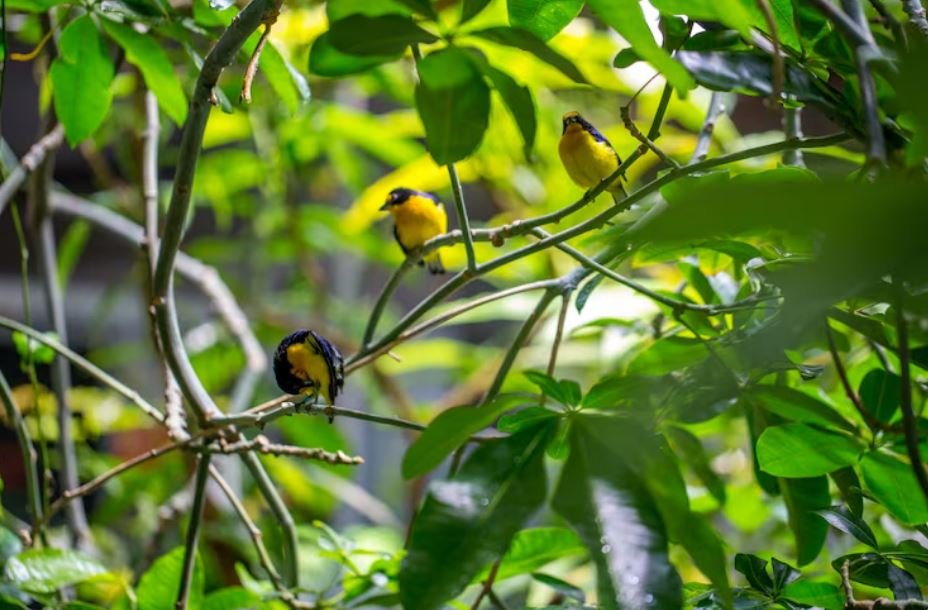
There is just no access to significant urban greenery for people living in Tondo, Sampaloc, or the crowded southern parts of the city. The geography is the same for birds. Only the greenest areas of the metro are home to Philippine endemic species, which have the highest ecological and conservation value. These species appear in small numbers, resembling refugees from a vanished landscape.
The role of waterways is something that is consistently absent from the plans. In the past, riparian vegetation—trees and shrubs that stabilized banks, filtered water, and produced layered habitat for birds and other wildlife—lined Manila’s rivers and esteros.
As early as the 1950s, those greenbelts were incorporated into urban plans. Very little of it was ever put into practice. For a brief period, the consequences of that failure were evident in the floods that followed Typhoon Ondoy in 2009. The engineering solutions—concrete channels, flood gates, and pumping stations—then took over once more. The majority of the time, vegetation near waterways is not considered an asset but rather a maintenance issue.
At least in some circles, awareness is rising. For years, riparian restoration, habitat connectivity, and native species have been promoted by foresters, ornithologists, and environmental advocates. In a minor but significant reversal, egrets have shown up to roost in the Makati CBD after some private developers realized that green sells. Economic incentives might encourage the city to become more environmentally friendly before laws do.
However, creating habitat and planting trees are two different things. If anyone is listening, Manila’s birds are communicating with the city. The sparrows are doing well. Everything else is having trouble. The planning is failing precisely in that gap between the rare and the tolerant, and as of right now, it doesn’t appear that the plans are considering it.
