


There is something quietly urgent about the way Maddie Bender approaches her work. She is not attached to a major institution or a well-funded conservation body. She is, in the fullest sense of the phrase, an independent voice — someone who has made it her business to document Hawaii’s native birds at a moment when that documentation feels more necessary than ever.
Her subjects are the honeycreepers of Oahu and the wider Hawaiian Islands. These birds have one of the more extraordinary origin stories in the natural world. Around six to seven million years ago, a single rosefinch-like species arrived in Hawaii, most likely drifting across from Asia. From that one bird, more than fifty distinct honeycreeper species eventually evolved, each adapting to different ecological niches across the archipelago. Their beaks alone tell the whole story — some curved dramatically for sipping nectar from tubular flowers, others stout and finch-like for cracking seeds, shapes found nowhere else on earth. It is, by most accounts, one of the finest examples of adaptive radiation the natural world has produced.
Bender came to this subject through her work as executive producer of The Conversation at Hawaii Public Radio, where she has spent years reporting on the islands’ ecology, conservation efforts, and the communities that depend on both. Her photography grew out of that reporting — a natural extension of someone who clearly pays attention not just to what scientists say in interviews, but to what the landscape itself looks like up close.
Capturing honeycreepers is genuinely difficult. These are not birds that come to feeders in suburban backyards. Many of the remaining populations live at high elevation, tucked into native forests where mosquito transmission of avian malaria hasn’t yet followed them. Getting there requires effort, patience, and a willingness to spend a lot of time in damp mountain forest waiting for something small and fast to stay still long enough. Bender’s photography reflects that effort without announcing it.
What her images convey, perhaps more than anything, is specificity. Each bird in her zine project was photographed as an individual, not a specimen. There is a meaningful difference between a field guide illustration and a photograph taken by someone who has waited for the right moment, the right light, and the right angle — and Bender’s work sits firmly in the latter category.
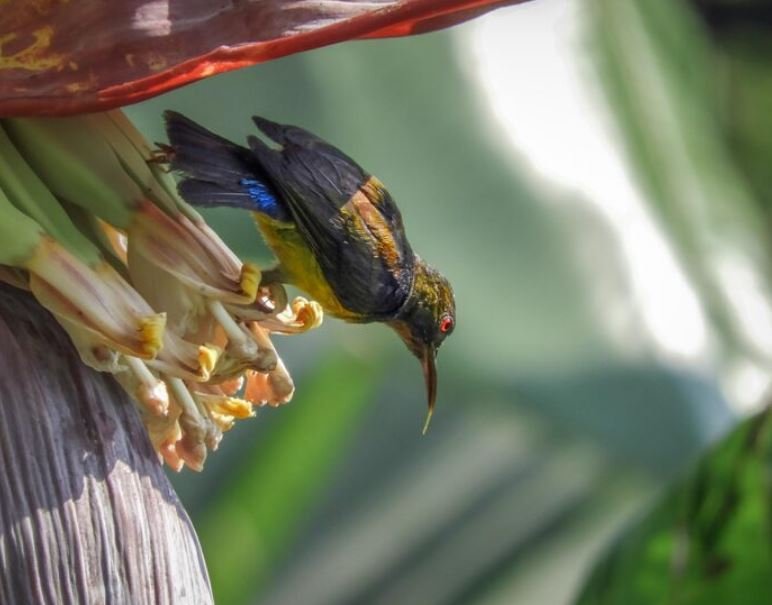
Her reporting has also put her close to the conservation infrastructure surrounding these birds. She has covered the rearing centers operated by the San Diego Zoo Wildlife Alliance on Hawaii Island and Maui, places where staff work to maintain viable captive populations of critically endangered species like the ‘akeke’e — a small, crossbill-like bird native to Kauai that is listed as critically endangered. The work is difficult and the setbacks are real. Earlier this year, one ‘akeke’e at the Keauhou Bird Conservation Center died following a series of severe Kona low storms, a loss staff attributed to the combination of the bird’s advanced age and the stress of the weather.
These are the details that tend to get lost in broader conservation narratives, and Bender has made it her practice to hold onto them. The honeycreepers of Hawaii are not an abstraction. They are individual animals living out individual lives in a landscape that has been dramatically altered around them, and the people caring for them are working under real conditions with real constraints.
It’s hard not to feel that what Bender is doing with her photography and her journalism together is something more than documentation for its own sake. Hawaii has been losing birds for centuries — to introduced predators, to habitat loss, to disease carried by mosquitoes that themselves arrived with human settlers. What remains feels genuinely precious. Whether that’s enough to shift public attention in a meaningful way remains to be seen, but Bender seems determined to make the case one carefully framed image at a time.
