


Owl watching requires a certain level of patience. Not the contemplative type that nature documentaries idealize. Something less comfortable: standing motionless on a narrow forest trail in almost complete darkness, hoping your headlamp battery lasts while you listen for a sound that might or might not come.
Most tourists come to Bohol because of the tarsiers or the Chocolate Hills. Both are worthy of the focus. After the tour vans depart and the souvenir shops close, however, a different Bohol emerges, one that belongs to moths, flying lemurs, and owls that have mastered the art of navigating a forest that humans have spent decades destroying.
Bohol’s lowland forests are not adjacent to one another. It’s been a while since they were. What’s left is a patchwork of secondary growth interspersed with small roads, farms, and coconut plantations that didn’t exist a generation ago. This is a challenging environment for a bird that requires both dense canopy cover and hunting range. One of the native nocturnal raptors of the Philippines, the Cebu Hawk-Owl, is subject to this pressure. It has never had a wide range. It is gradually losing what it had.
In the interior of the island, guides who lead night walks are aware of the patches that are still home to owls, and they carefully share this information. Among the more productive locations are the trails close to Carmen and into the remaining forest corridors above the Loboc River basin; however, “productive” in this context refers to the possibility of hearing a single call and, with good fortune, spotting a shape perched against a pale sky. That is frequently the entire interaction. It seems sufficient.
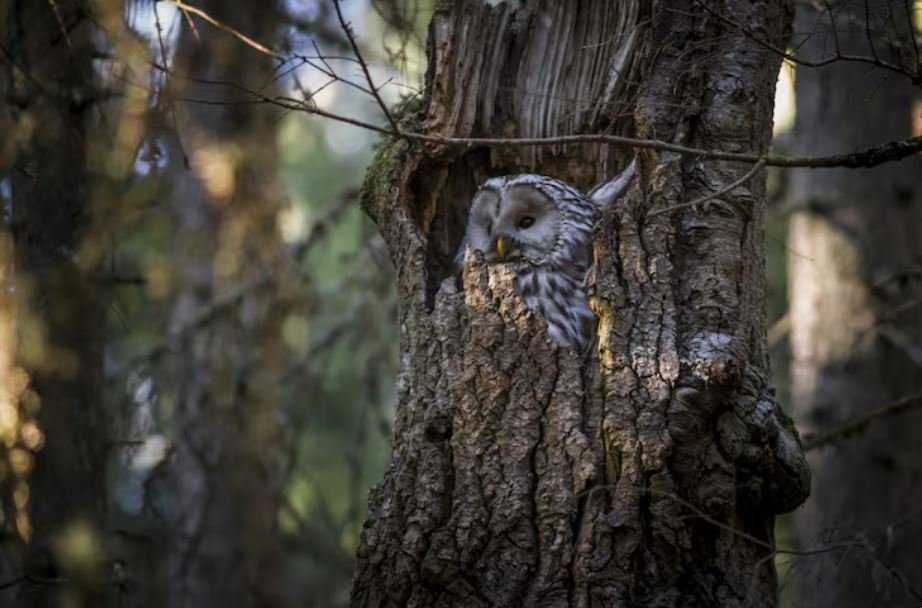
The Philippine Scops-Owl is a little easier to locate; once you get the hang of it, its monotonous, low whistle—almost mechanical in its evenness—becomes distinctive. However, hearing is not the same as seeing. You can stand underneath it for twenty minutes without ever getting a clear view, and it calls from somewhere inside a fig tree. Your lamp is known to the owl. It adapts. On these walks, you get the impression that you are being watched more intently than you are being watched.
Spending time in these remnants after dark makes you realize how much ecological work is still being done by the remaining forest. The small frogs calling from the leaf litter, the fruit bats cutting arcs overhead, and the canopy insects are all part of a working system that is stressed and compressed but manages to hold together. At the top of that nocturnal chain are the owls. They typically indicate that something basic has already gone wrong beneath them when they vanish from a patch.
In Bohol, local birdwatchers and forest rangers have observed steady pressure on nesting sites, which has resulted in gradual attrition rather than catastrophic destruction. A tree tumbles. Noise is increased by a new access road. A hunting dog strolls in. These events don’t make headlines. They build up silently, much like habitat loss nearly always does in areas where it isn’t actively monitored.
Standing there with a red-filtered torch and the sound of a far-off river, it’s difficult not to consider how important these night patrols are in many ways. The forest patch either provides the owls with what they require or does not. Walking it tends to alter people’s perceptions of what lies beneath the island’s tourist façade. Most tourists are unaware of Bohol’s wealth. It is also more brittle. The owls, if you have the patience to locate them, convey the simultaneous truth of both statements without using any words.
