


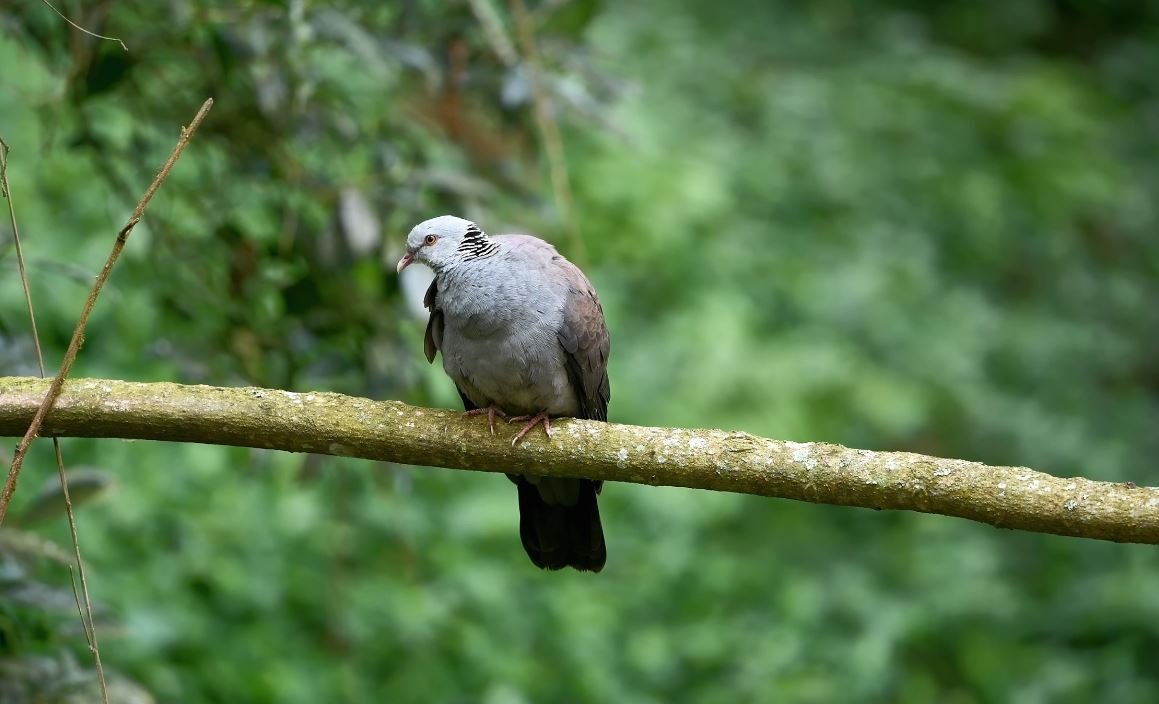
The majority of Indians have never seen and are unable to identify a large, dark pigeon that lives in the high forests of the Western Ghats. It lives in the type of dense, mist-draped montane forest that has been dwindling for decades, feeds on canopy fruits, and has a characteristic checkerboard pattern on the back of its neck. According to a study that was published earlier this year in the Proceedings of the Indian National Science Academy, the Nilgiri Wood Pigeon’s future appears to be much worse than its current state of conservation would indicate.
The study projected habitat suitability for the species under various climate scenarios using MaxEnt, a machine-learning tool commonly used in ecological modeling. The results carry the kind of slow-burning alarm that scientists typically find more concerning than an acute crisis, but they are not immediately catastrophic. In the short term, between 2021 and 2040, there may be a slight increase in suitable habitat as lower montane zones become momentarily more hospitable due to rising temperatures. However, the model predicts significant drops in high-quality habitat after the middle of the century, with the bird’s viable range shrinking to a few remote areas by 2081 to 2100.
The end-of-the-century scenario is not the only thing that makes this reading unsettling. It’s the difference between the bird’s current classification and what the numbers indicate. The Nilgiri Wood Pigeon, which is thought to number between 10,000 and 50,000 mature individuals, is still listed as “Least Concern” on the IUCN Red List. That sounds comforting.
However, the study’s researchers take care to point out that this population estimate is not based on a thorough field count. In essence, it’s an educated guess based on eBird citizen-science records and habitat modeling from 2017. In reality, no one has gone out and methodically counted these birds throughout their range.
In terms of drawing attention, the species itself doesn’t support its own cause. It is unique to the Western Ghats and cannot be found anywhere else on Earth. With smaller populations spreading into the Biligirirangan hills and portions of Maharashtra, it is found throughout the Nilgiri and Anamalai hills of Tamil Nadu and Kerala. Because it is almost completely absent from tea estates and Acacia plantations and is highly dependent on undisturbed closed-canopy evergreen forest, it is unable to simply adapt to a modified landscape in the same way that more generalist birds can. The pigeon has nowhere else to go when its forest vanishes.
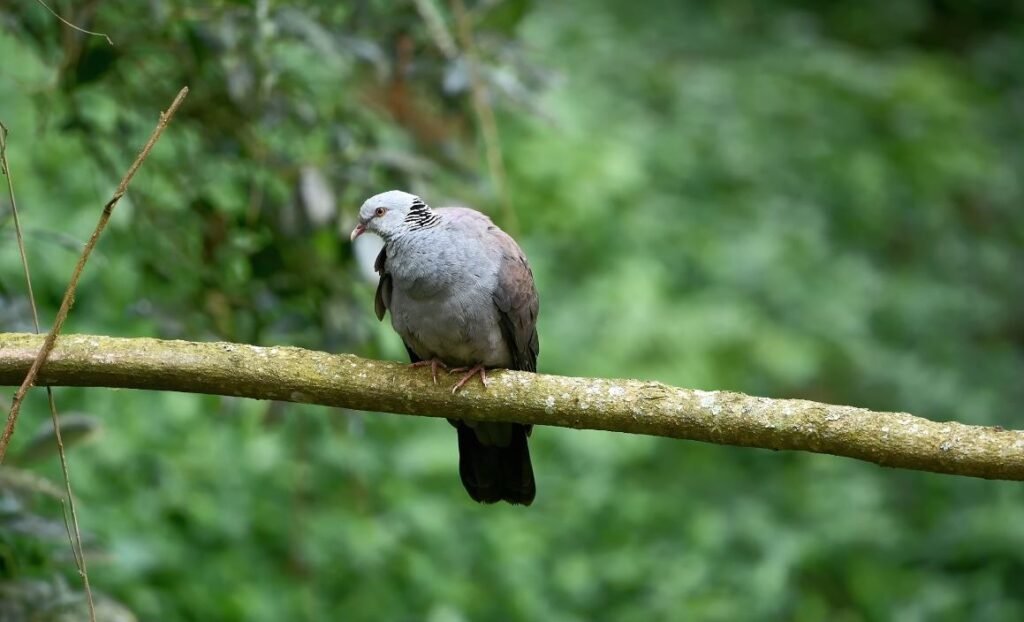
In the past, the species suffered from hunting for food and recreation. Reports from Goa, for example, indicate that poaching is still a localized issue, so the pressure hasn’t completely stopped. Today, however, habitat itself is the greater stressor: agricultural fragmentation, the development of wind energy infrastructure, ongoing mining proposals in Maharashtra, Goa, and Karnataka, and now the anticipated temperature changes that may push the species above its viable elevational ceiling. Researchers believe that threats that seem manageable on their own are combining in ways that may be more difficult to counter.
The Nilgiri Wood Pigeon’s current range is largely covered by India’s protected area network, and the rate of deforestation there has significantly decreased from previous highs. The news isn’t all bad in that regard. However, climate projections extend beyond park boundaries, and if warming continues to compress that thermal band from below, a bird that breeds nearly exclusively in montane shola forests above 2,000 meters will have very little runway. Whether the species can quickly change its range or modify its behavior to keep up with these changes is still unknown. Based on what is currently available in the literature, the honest response is that nobody knows.
Simple demographic surveys, long-term monitoring, and conservation planning that takes future climate trajectories into account rather than just current conditions are what the researchers are advocating for. It’s possible that the Nilgiri Wood Pigeon is not in danger of going extinct right now. However, it is a species with a small ecological niche, an unresearched population, and a habitat under constant pressure, all of which call for more attention than a “Least Concern” designation typically produces.
