


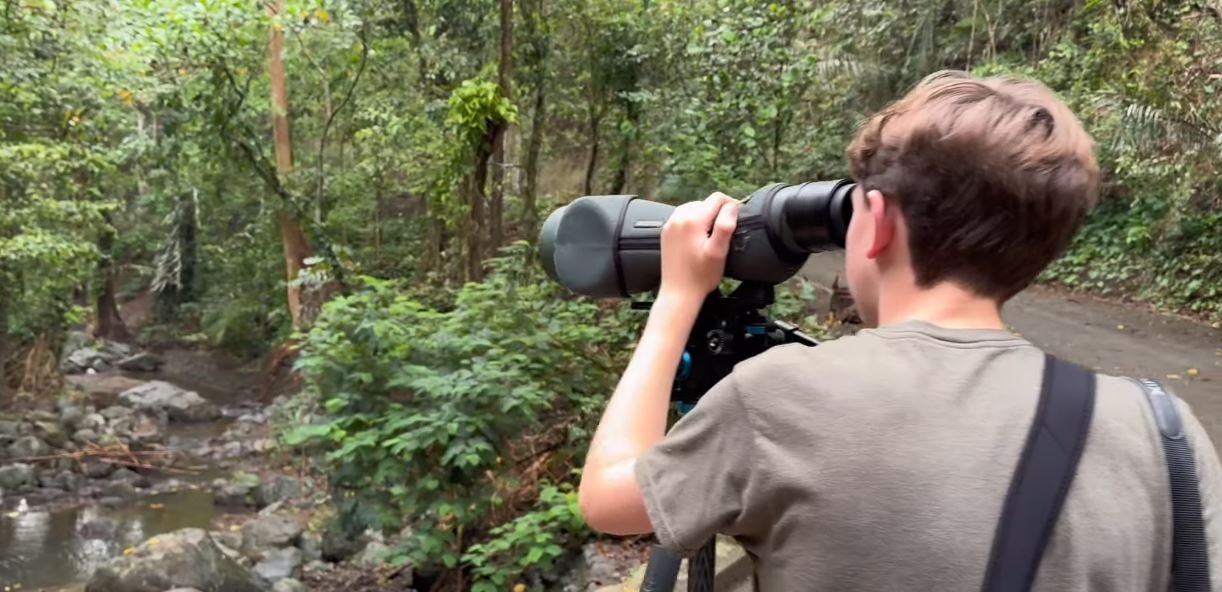
It becomes clear why people travel halfway around the world to stand in this forest at a certain point on the trail to the Philippine Eagle’s watchpoint on Mount Kitanglad. This point is likely around 5,000 feet, with the air becoming slightly thinner and flocks of mixed species moving through the trees next to you. Ticking a species is not the only thing involved. It is more difficult to identify. Between the trailhead and the first Sulphur-billed Nuthatch, visitors often feel the cumulative weight of the approximately 266 bird species that are unique to the Philippines.
The country covers an area of about 300,000 square kilometers and is made up of more than 7,600 islands in the western Pacific. The remarkable endemism can be explained by the geography alone—islands divided by water that have evolved in relative isolation over millions of years. The three primary locations for serious birdwatching tours are Mindanao, Palawan, and Luzon, each of which operates essentially as a distinct birding world. The fauna of Palawan is more similar to that of Borneo than it is to the rest of the Philippines. The Philippine Eagle’s last dependable strongholds are in Mindanao. From the cunning Ashy Thrush at La Mesa Ecopark on the outskirts of Metro Manila to the Green Racket-tail in the old-growth forest patches close to Subic Bay, Luzon has its own unique fauna.
Similar geographic reasoning is usually followed by organized tours, many of which last 17 to 18 nights and include domestic flights between islands. After arriving in Manila, you take a plane south to Mindanao to see the eagles and pittas, travel through PICOP Forest to find the Celestial Monarch and the Wattled Broadbill, then circle back north through Luzon to see the peacock-pheasant and frogmouths in Palawan. There’s a lot of ground to cover. It’s also truly worthwhile.
A former logging concession in eastern Mindanao, PICOP Forest is situated at the intriguing and unsettling nexus of ecology and history. Decades ago, logging ceased, but illegal pressure hasn’t. Visitors who are birdwatchers say it’s one of the most species-rich areas they’ve ever seen, which makes the continuous deforestation more difficult to accept. This is the Azure-breasted Pitta. This also applies to the (Mindanao) Wattled Broadbill, a species that Southeast Asian birdwatchers whisper about. To be honest, it’s unclear if these birds will have sustainable populations into the following generation.
Perhaps the most distinctive emotional undercurrent of Philippine birdwatching at the moment is this uncertainty. Currently, 97 species in the nation are classified as globally threatened by BirdLife International. The brilliant and endemic Red-vented Cockatoo is classified as Critically Endangered. The Chinese Crested Tern, which is sometimes seen in the winter along coastal Mindanao, also does. Even on specialized tours, sightings of the Philippine Eagle, a massive, unlikely-looking bird that bears the burden of being the national bird, are never guaranteed.
Here, local guides are crucial in a way that goes beyond practicality. In Manila, guides like Irene Dy and Nicky Icarangal Jr. of Birding Adventure Philippines have developed in-depth knowledge of species behavior, habitats, and access to locations that would be nearly impossible to find without them. There is a practical aspect, such as forest trails, permits, and local knowledge of bird migration patterns, but there is also a deeper level of significance. In many instances, Philippine birding guides are also among the nation’s most ardent supporters of conservation. It is now impossible to separate the two.
The majority of international tours plan departures in January or February, with the dry season lasting roughly from December to April. Birding requires early starts and patient afternoons, the mountains can be chilly at night, and some lodging is genuinely basic (Mount Kitanglad’s tented camp is described as such without apology). Those who have actually done it don’t seem to be deterred by any of this. The majority characterize the experience as irreversible in some way.
The trip tends to get softer in Palawan. The light is different, the pace slows, and the forest seems more approachable. For someone who hasn’t been waiting for it, a Palawan Peacock-Pheasant emerging at a bird blind close to Puerto Princesa is the kind of moment that is hard to describe. Palawan may be a bit too indulgent for casual birdwatching. Or perhaps that’s the whole point.
