


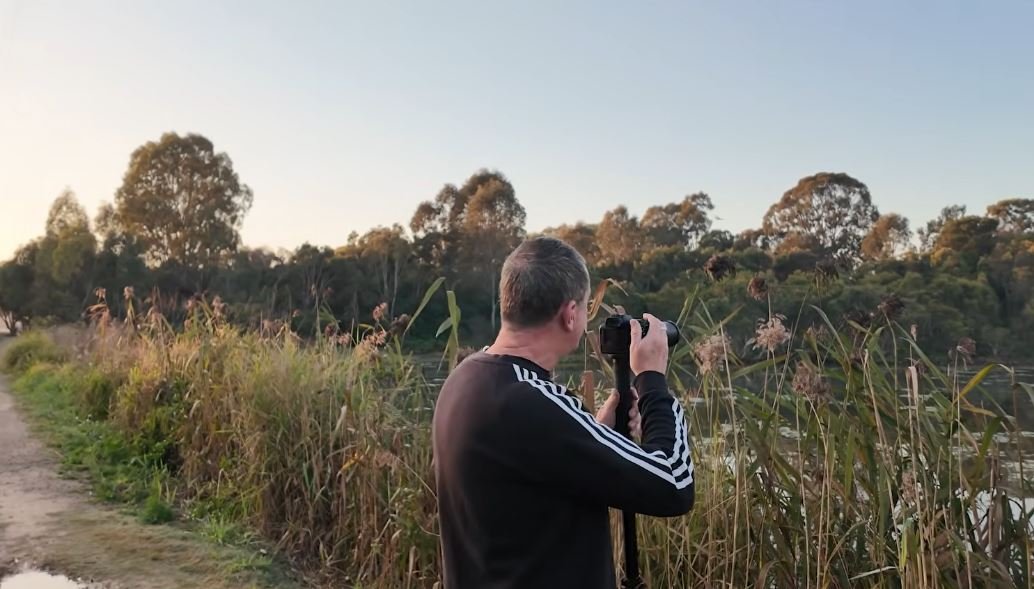
Missing a shot because the camera was unable to keep up causes a certain kind of frustration. The autofocus hunts, hesitates, and then the moment is gone as a bird leaps from a branch, its wings opening in an instant. Nearly all wildlife photographers experience it at some point. However, over the past few years, it has become less common for people using Canon EOS bodies.
It’s no coincidence that bird photographers have come to rely on the Canon EOS lineup. Canon has spent years fine-tuning autofocus performance for subjects that move quickly and are unpredictable. In particular, the EOS R5’s introduction of Animal AI Detection won over even doubtful reviewers. Not only was it able to identify birds perched on feeders, but it was also able to track heads and eyes through partially obscured frames, wing beats, and the kind of disorganized, overlapping motion that used to trick nearly every camera’s tracking system.
Only a portion of the story can be revealed by testing that kind of capability under controlled circumstances. Photographing pigeons and grieving doves fighting over food at a balcony feeder was one of the more fascinating real-world tests; it wasn’t a glamorous setup, but it was genuinely challenging.
Birds move quickly laterally, darting erratically, and crossing their wings in front of one another. It was well handled by the EOS R5. The focus was maintained on individual birds even when another bird crossed the frame by setting the AF-On button to single point with low tracking sensitivity and then switching Servo AF to Case 2, which instructs the camera to hold the subject and ignore obstacles. Finding the right setting combination requires some trial and error, but once it works, the outcomes seem almost unjust.
For bird photographers, the earlier EOS R—Canon’s first mirrorless model—was a more challenging option. Although it lacked the later refinement, its autofocus system was genuinely capable in many situations, such as fast subject acquisition and the ability to lock focus in extremely low light. The lack of a joystick was a practical annoyance in the field, but shooting with modified EF lenses worked and the 5,655 selectable AF points provided helpful compositional freedom.
Once you developed the muscle memory for it, the workaround—using touch-and-drag AF through the EVF with a thumb on the rear screen—actually performed fairly well. It was a workaround, though. It’s possible that Canon was always aware that the original EOS R was not a definitive tool but rather a transitional product, a first significant step into the RF system.
The EOS R6 Mark II occupies a distinct position, possibly the sweet spot for avid birdwatchers who aren’t aiming for the lineup’s top spot. With deep-learning autofocus and Eye Detection AF for animals and birds, it can shoot at up to 40 frames per second, meeting most of the requirements of a professional wildlife photographer without the high cost of the R5. On paper, the 24-megapixel sensor may seem like a drawback, but in reality, the image quality is good and the file sizes are reasonable for days with a lot of shooting.
Experienced bird photographers using the Canon EOS system almost always advise back-button focusing. You can lock focus, reframe the composition, and take multiple shots without the camera constantly refocusing on the background thanks to the fundamental idea of separating focusing from the shutter button and assigning it to the AF-On button instead. This method offers a significant practical benefit in low light at dusk, when birds are most active and autofocus may have trouble with small, far-off subjects. Rewiring the habit may take a day. The majority of photographers claim they can’t imagine returning after that.
In bird photography, lens selection is just as important as body selection, and Canon’s RF glass has significantly improved. The RF 100-500mm f/4.5-7.1 L IS USM has developed into a dependable partner for the R5 and R6 Mark II, providing sufficient reach for the majority of field scenarios while still being manageable for prolonged sessions.
Some photographers have reported surprisingly sharp results at f/8 with the older EF 100-400mm through the EF-EOS R adapter, demonstrating how capable the sensor and processing engine have become. Adding a 1.4x extender extends that reach meaningfully. Instead of a system where the body and glass are always at odds, it seems that Canon’s dedication to the RF mount has given bird photographers a system that can truly grow with them.
The more significant change is that firmware now contains a significant portion of this capability. Although the EOS R5 was already impressive when it was first released, later firmware updates significantly increased the camera’s capabilities in terms of tracking behavior, animal detection, and processing speed. Even though it’s easy to take for granted, photographers have learned to value this kind of continuous improvement. In the case of Canon’s EOS system, this has generally been a good thing because the camera you purchase today isn’t exactly the same as it was a year ago.
